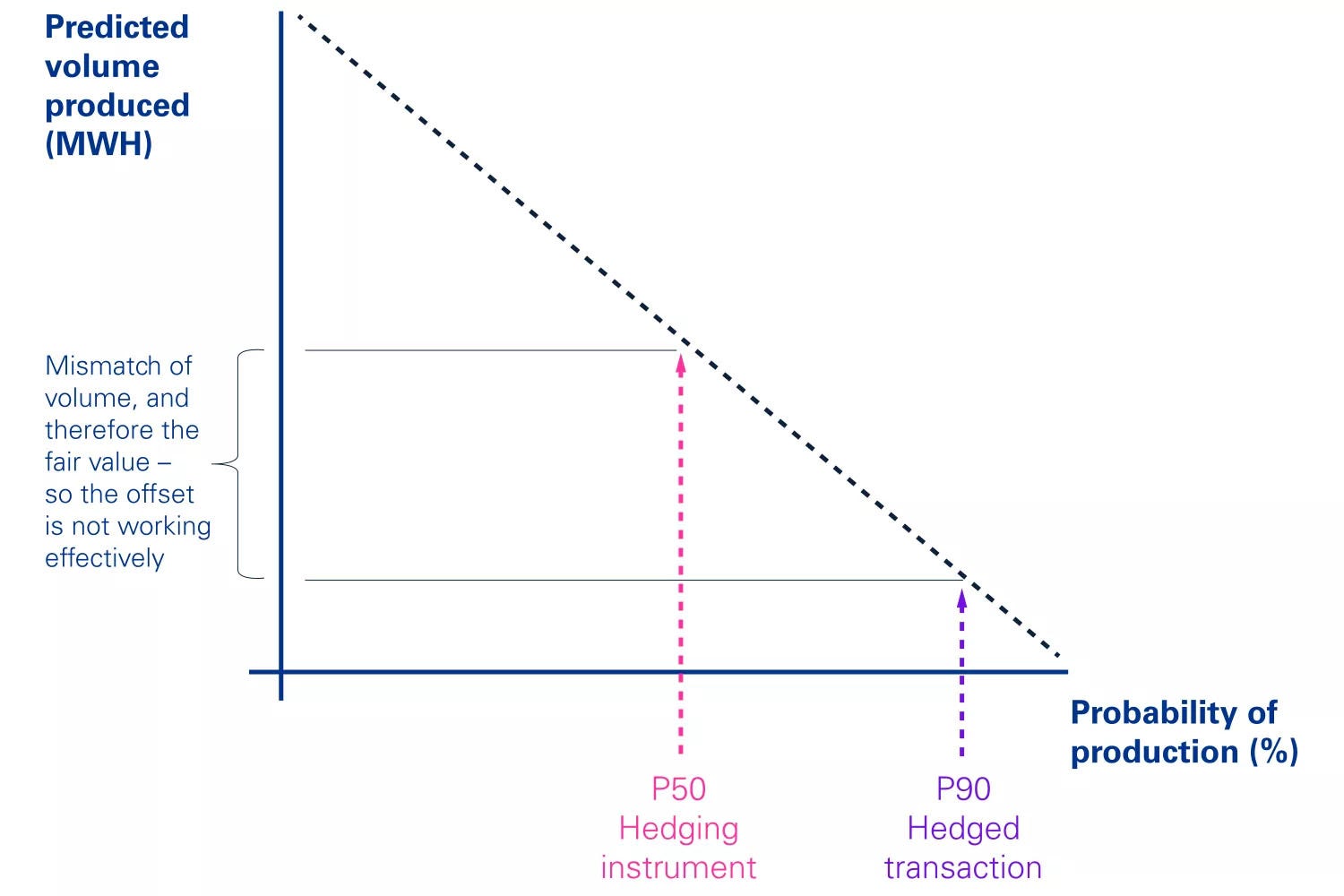
Subject to certain conditions, the amendments permit companies to designate a variable nominal volume of forecasted sales or purchases of renewable electricity as the hedged transaction, rather than a fixed volume based on P90 estimates. The variable hedged volume is based on the variable volume expected to be delivered by the generation facility referenced in the hedging instrument. This would facilitate an economic offset between the hedging instrument and the hedged transaction, enabling companies to apply hedge accounting.
The amendments apply prospectively to new hedging relationships designated on or after the date of initial application. They also allow companies to discontinue an existing hedging relationship, if the same hedging instrument (i.e. the nature-dependent electricity contract) is designated in a new hedging relationship applying the amendments.
What are the new disclosure requirements?
A company may apply the own-use exemption to certain PPAs under the amendments and therefore would not recognise these PPAs in its statement of financial position. Where this is the case, a company is required to disclose further information such as:
- contractual features exposing the company to variability in electricity volume and risk of oversupply;
- estimated future cash flows from unrecognised contractual commitments to buy electricity in appropriate time bands;
- qualitative information about how the company assessed whether a contract might become onerous; and
- qualitative and quantitative information about the costs and proceeds associated with purchases and sales of electricity, based on the information used for the ‘net-purchaser’ assessment.
In addition, for PPAs designated in a cash flow hedging relationship, companies need to disaggregate the information disclosed about terms and conditions by risk category.
Effective from 1 January 2026
The amendments apply for reporting periods beginning on or after 1 January 2026.
Early application is permitted. To find out more about the amendments, speak to your KPMG contact.
1 The amendments apply only to contracts referencing nature-dependent electricity in which a company ‘is exposed to variability in the underlying amount of electricity because the source of electricity generation depends on uncontrollable natural conditions (e.g. the weather)’.
2 For the purposes of this article, when the term PPA is used it refers only to PPAs in scope of the amendments (refer to footnote 1).
3 A virtual PPA (vPPA) is a contract for difference where the purchaser and the seller net settle periodically in cash for each unit of power generated (on the basis of the difference between the fixed price agreed at contract inception and the current spot market price on each periodic settlement date). If the fixed price exceeds the spot price, then the purchaser pays the difference to the seller and vice versa. Under vPPAs, there are no physical transfers of power and hence the own-use exemption does not apply.
4 A P50 estimate indicates the volume of energy production expected to be exceeded with 50 percent probability.
5 A P90 estimate indicates the volume of energy production expected to be exceeded with 90 percent probability. By definition, the P90 volume estimate will be lower than the P50 estimate.