

      Double materiality assessment

      With evolving EU regulations, and specifically the Corporate Sustainability Reporting Directive (CSRD), the double materiality assessment has become a priority assessment for most companies operating in Europe and beyond. 

      Organizations are confronted with a wide range of ever-changing sustainability issues (e.g., decarbonization, diversity in the workforce, business ethics). A double materiality assessment is the process for prioritizing sustainability topics. Material topics are those that have an impact on the company (financial materiality) and/or through which the company has an impact on society and/or the environment (impact materiality).

      This assessment is an essential foundation for designing an effective sustainability strategy and is the first step towards CSRD compliance. However, the double materiality assessment is increasingly used as a strategic business and risk assessment tool, with implications going beyond traditional corporate responsibility and reporting. Leading companies employ it to embed sustainability within existing business practices and the overall business strategy.
      Which companies fall under CSRD?

      All NFRD companies and non-EU parent companies with a combined group turnover in Europe of more than EUR 150 million will be subject to CSRD. In addition, other large companies meeting two out of the three criteria below will be required to comply with the regulation.

      • More than EUR 40 million net revenue
      • Total assets are more than EUR 20 million
      • Employee base of more than 250 employees

      What is CSRD-aligned double materiality?

      Companies are required to conduct the double materiality assessment following strict guidelines and pre-defined criteria. This methodological ‘standardization’ aims to enhance comparability across organizations and sectors. It is also important to point out that it will be subject to third-party assurance. 

      Strictly-speaking, the CSRD-aligned double materiality assessment looks to deepen the understanding of how an organization impacts - and is impacted by - a range of sustainability topics. For each topic assessed, impacts on the environment and society, as well as business risks and opportunities should be identified and assessed. This necessitates, among others:

      • Defining clear operational boundaries and the value chain for inclusion in the assessment.
      • Developing an appropriate stakeholder engagement strategy to support the materiality assessment.
      • Fully aligning the list of sustainability topics that are assessed with the topics and sub-topics provided by CSRD and ESRSs.
      • Identifying and consistently assessing impacts, risks and opportunities for each topic, including transparency on the underpinning rationale.
      • Determining materiality based on a set of pre-defined criteria; that is, for impact materiality: scale, scope, remediability, likelihood; for financial materiality: magnitude of financial impact, likelihood.
      • Fully documenting the outcome and process in the form of a double materiality report, including supplementary documentation aligned with third-party assurance requirements.

      How we can help

      KPMG professionals can provide the following services to help you prepare and execute on your organization’s double materiality assessment:

      Peer analysis can be used to establish a first understanding of the relevant sustainability topics and the sector’s overarching market consensus on topics. Similarly, assessment of the wider trends and how they impact your organization and the sector can provide an outlook on the dynamic nature and interplay of sustainability topics.

      Align brands, subsidiaries/affiliates, joint ventures, and any other entity that would be in-scope of CSRD and double materiality assessment. Based on the identified operational boundaries, map the organization’s value chain. This scoping serves as a basis to start the double materiality assessment and is crucial for a coherent and structured process.

      Conduct stakeholder consultation and engage in desk research to identify relevant positive and negative impacts, and financial risks and opportunities in connection with each topic (e.g., Diversity, Equity, and Inclusion). These IRO’s will then be assessed against the threshold criteria which serves as the basis for materiality and ensuing reporting obligations.

      Provide assistance and guidance in mapping and prioritizing stakeholders (across your organization’s value chain), defining best stakeholder consultation methods, as well as capturing and processing the results of the stakeholder consultation and integrating it into the double materiality assessment. The double materiality assessment may also feed into the update of your organization’s stakeholder management policy.

      Based on the outcomes of the double materiality assessment, we can assist with the ESRS’ Disclosure Requirements (DRs) that the organization will need to report upon. Map the CSRD mandatory KPIs with the material topics and IROs, and identify where additional company-specific metrics should be included for external and/or internal reporting and controls.

      Development of your organization’s CSRD-activation strategy. We can support you in the definition of actions; the identification of resource needs; the identification and assignment of roles & responsibilities (governance); the optimal scheduling of timelines; etc. in support of CSRD-compliance. This may also involve the set-up of a cross-functional PMO-office to manage the various strands of implementation, as well as identifying optimal ESG data & technology solutions.

      Based on the outcome of the double materiality assessment, set appropriate targets (short-, mid- and long-term) and develop action plans for material topics. From this, build a coherent, multi-year sustainability / ESG strategy that supports the realization of the business strategy.


      Decarbonization & Greenhouse Gas (GHGs)

      Climate change is the next high impact, high probability risk that requires urgent action. In this regard, decarbonization is a cornerstone for every organization. Meeting global targets will require macro and micro economic transformation, led by fundamental business model changes for public and corporate organizations. Understanding and planning for the likely profound implications of decarbonization on your business is crucial as your response will meet increasing pressure from governments, consumers, employees, investors and lenders. Prior to COVID-19, pressure was already building. Now, the imperative to act is only getting stronger.

      Many companies are currently starting to outline or are reviewing their decarbonization strategy to reduce their greenhouse gas (GHG) emissions or achieve their net-zero emission targets. These strategies vary significantly across industries but some key success factors apply to every organization:

      • Ensure the decarbonization strategy aligns with the business strategy
      • Define the reporting strategy for both internal and external stakeholders
        • Ensure reliable reports are in place to prove your results, as words and pledges alone are no longer enough
        • Embed your achievements in external narratives as climate impact has become an increasingly important component of a brand
      • Pursue partnerships and engage supply chain partners in a common decarbonization target
      • Demonstrate tangible progress through targeted emissions-reduction initiatives that support broader business goals
      • Align executive compensation with environmental performance

      While the decarbonization journey starts with delineating a strategy, there is a fundamental shift that needs to happen within organizations with respect to people and organizational culture. The decarbonization mindset must live within every part of an organization so that climate risks and opportunities become instinctive parts of business thinking. 

      How we can help

      KPMG is your single point of contact for your decarbonization needs and can provide the following services:

      • Assistance in outlining climate ambitions;
      • Advice on adopting Science-based Targets (SBT);
      • Assistance in setting objectives for Scope 1 (direct emissions from owned or controlled sources), Scope 2 (indirect emissions from purchased energy) and Scope 3 emission (indirect emissions, other than the ones under Scope 2, that occur in the value chain of a company) reductions;
      • Assistance in developing a decarbonization strategy, including a decarbonization option analysis and development of a carbon neutrality roadmap;
      • Support in transforming your organization by:
        • exploring the feasibility of renewable energy sourcing alternatives such as Power Purchase Agreements (PPA’s);
        • advising on energy efficiency roadmaps.
      • Assistance in Task Force on Climate-related Financial Disclosures (TCFD) and Carbon Disclosure Project (CDP) reporting.


      Circular Economy

      The circular economy is gaining more power on the corporate agenda. Challenges like resource availability, volatile commodity prices and changing consumer preferences are forcing us to rethink wasteful and inefficient models of production and consumption. In our view, shifting from a linear to a circular economy means preserving existing value, protecting the environment and making optimal use of resources, materials and products. This brings economic, as well as social and environmental, value.

      More companies are now designing products or services from the start for longer-term use, reuse and recycling. Markets are increasingly disrupted as leasing and sharing business models challenge traditional “linear” models of product manufacture, ownership and disposal.

      Moreover, authorities are recognizing the potential of the circular economy to drive business competitiveness, sustainable economic growth and job creation. China, Japan and the EU are among those with circular policy strategies and programs.

      For businesses adopting circular models, benefits include greater efficiency and profitability, less waste and cost, better innovation and stronger relationships with customers. Research suggests that the economic opportunity for business is huge. In Europe alone, adopting circular principles could generate a net economic benefit of €1.8 trillion (US$2 trillion).[1]

      However, unlocking these benefits demands a dramatic shift from business-as-usual to blue-sky circular thinking. Strong specialist capabilities in developing and implementing circular policies and strategies is critical.

      How we can help

      Our experts combine skills in strategy, innovation, business modeling and finance to help you understand the challenges you face. They have the knowledge and experience to help you move from linear to circular.

      Our team can help your business, no matter what stage you are at on your circular journey:

      • Analyze the market and conduct benchmarking: Our analysis provides insights into how other businesses in your sector and beyond are approaching circularity and implementing circular strategies;
      • Understand regulatory trends: Our professionals analyze the regulatory landscape and identify the risks and opportunities for your company;
      • Engage stakeholders: We can help you engage your stakeholders, both internal (e.g. senior management, business units) and external (e.g. suppliers, customers, investors) to identify their needs and expectations regarding circularity and your business.

      • Identify circular risks and opportunities: Our specialists conduct a material flow analysis to identify and map circular risks and opportunities in your business. Based on this analysis, they identify the circular solutions – ranging from process and product to business model innovation – that are most suitable for your company;
      • Model the impact of the circular opportunities: Our analysts use advanced modeling tools to assess the costs, benefits, risks and effects of the identified circular solutions;
      • Measure the impact on your balance sheet: Our professionals use financial modeling tools and simulations to help determine the financial implications of circular solutions on your business.

      • Select the most appropriate circular solutions to implement: Our advisers work with you to identify which circular opportunities are strategically right for your business. They help you determine what is needed to implement these solutions, including skills and competencies;
      • Design the circular strategy and implementation plan: Our professionals help you to design a strategic approach to make your business more circular. They work with you to quantify your ambition level and set goals, targets and performance monitoring metrics. They help you create an implementation roadmap for your circular strategy;
      • Build capability: Our specialists help your business build its circular capabilities through internal training and education programs;
      • Collaborate with external organizations: You can accelerate circularity in your business by collaborating with trusted universities, research bodies, NGOs, vendors and others. We can help you forge the right partnerships to drive your circular strategy forward.

      • Execute circular strategy across business functions: Our advisers help you put your circular strategy into practice. This includes supporting change management activities;
      • Monitor, track and report on performance: Our analysts use advanced digital tools to help you measure and report on the impact of your business's circular strategy;
      • Our professionals can also measure and value the positive impact your circular initiatives have on people and the environment using the KPMG True Value impact measurement and valuation methodology;


      Sustainability communications and buy-in creation

      Sustainable transformation starts at the top of organizations, with business leaders and managers internalizing the sustainability story. They need to get the right message out and do what they say: actions speak louder than words.

      At the same time, managers must seize every opportunity to explain why they are initiating certain actions based on the company's mission and vision - and they must clarify the consequences of those actions for stakeholders.

      Moreover, employees must be given the opportunity to make their own suggestions, to act sustainably and to launch sustainability initiatives.

      Consequently, the expectations of various stakeholders have changed and companies therefore need to be aware of some essential aspects of sustainability communications.

      Talking about your sustainability efforts is one thing. To walk the talk, you need to consistently demonstrate that you are innovating sustainably and implementing good practices.

      Anything you claim can now be verified by anyone through various online channels. Stakeholders trust organizations when what they communicate is reflected in tangible results.

      The roll-out of an optimal sustainability roadmap is often strenuous and complex. Openly addressing issues and challenges among different stakeholders not only strengthens trust, it also creates an opportunity to take their input and suggestions on board and improve your plans.

      Sustainability communications is not a one-way street. Interaction with your different internal and external stakeholders is vital. Critical questions, different points of view and discussions are part of the game, which means a certain loss of control on the company’s side. At the same time, it also presents an opportunity to learn from these interactions and make your scope of action richer.

      Successful sustainability communications requires careful long-term planning and investment. Trust and credibility will only grow with regular commitment and follow-through on all levels of the organization.

      Our sustainability communications experts are specialized in connecting the dots between sustainability strategy, corporate communications and different, relevant stakeholders. Our communication experts work side-by-side with ESG experts in KPMG Sustainability Services to offer a unique and truly integrated service at every stage of your sustainability transformation.


      How we can help

      KPMG sustainability communications experts can provide the following services:

      1. Finger on the pulse: assess current communication practices to define gaps & opportunities;
      2. Sustainability vision & narrative: help organizations find purpose and direction;
      3. Brand positioning: integrate sustainability in the DNA of your brand;
      4. Communications strategy: build an effective and hands-on approach on a solid sustainability strategy and audience insights;
      5. Internal engagement: create buy-in that motivates your people so everyone is up for it;
      6. Campaigns: launch engaging campaigns that inspire and move audiences;
      7. Creative execution: develop tools and reports with content and stories that matter and have an impact.


      True value - Impac measurement and reporting

      Enabling clients to devise improved methods, tools and frameworks to better track and measure performance.

      In business, it is often said that you can't manage what you don't measure. This is just as true when it comes to how your business affects society. Companies are under increasing pressure to show they make a positive contribution to society as well as generating profits for shareholders. Focusing on the financials alone is no longer enough.

      In many sectors and markets today, an organization's positive impact on society can make the difference between winning and losing. Therefore, measuring and managing those impacts is simply good business. In recent years, methodologies to measure an organization's impacts – both positive and negative – have become much more sophisticated.

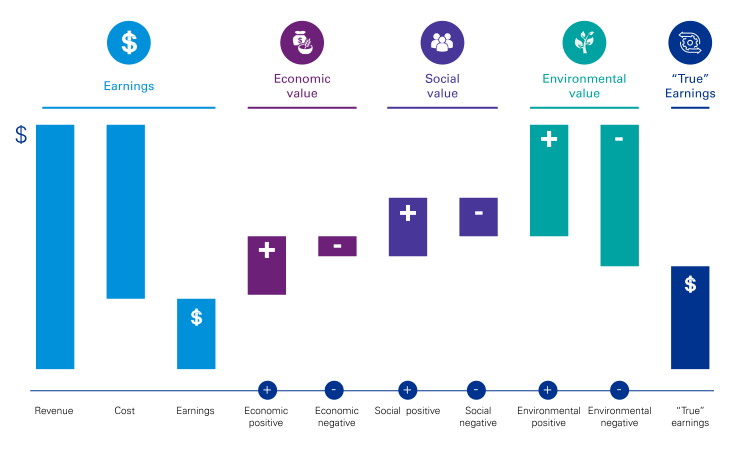
      A growing trend is to express all economic, social and environmental impacts in a common financial metric; doing this can inspire productive conversations in the boardroom and management meetings. It can also help change thinking and stimulate action within organizations. A common metric allows you to compare the impact of your organization across topics (social, environmental, governance) and identify what’s most important. Furthermore, it allows you to take societal impact into account when evaluating investment decisions: not only looking at financial return, but simultaneously considering how the investment affects our communities and ecosystems.

      The KPMG True Value methodology has been at the forefront of this movement since its launch in 2014. Since then, dozens of organizations around the world have used KPMG True Value to measure their impacts on society and apply that learning to their business. The methodology improves the decision-making process, looking further than merely the financial return-on-investment. It enhances reporting of the company’s contribution to society including the strengthening of relationships with stakeholders, and it helps measure the impact of the company’s products, services and projects on people and the environment.

      How we can help

      Our analysts carry out a detailed assessment of your organization's most significant economic, social and environmental impacts, both positive and negative.

      The assessment is totally scalable: it can be applied to a single product or service, to a company's global operations or to the entire value chain including suppliers and the downstream use of the company's products.

      Once your company's material impacts are identified, we calculate the financial value for each materiality. We select the most appropriate valuation factors from a comprehensive KPMG database, which is sourced from academic research around the world and continuously expanded and updated.

      Generic KPMG True Value Bridge

      Generic KPMG True Value Bridge


      KPI monitoring through sustainability dashboards

      Follow-up on progress towards your sustainability objectives, by installing SMART targets and monitoring KPI’s via insightful and actionable sustainability dashboards.

      Defining your sustainability strategy is the first step toward a more sustainable future for any organization. The strategy outlines your sustainability commitments and priorities. However, a clear view on your destination marks only the beginning of your sustainability journey. Any truly successful sustainability transition requires monitoring of progress to transform ambitions into reality.

      Technology can accelerate your sustainability efforts and enable you to focus on the most important domains. Typically, most of the data required to monitor progress on sustainability is already available in an organization. Harmonizing this data and visualizing the information in a clear and compelling way to the responsible business managers boosts the likelihood of a successful realization of your sustainability transition. What’s more, leveraging technology doesn’t only help with keeping track and measuring progress, but can also support you at gaining data-driven actionable insights, to understand what you can do to improve.  

      How we can help

      KPMG can support you in defining targets and KPI’s in line with your sustainability strategy, considering topic specific reporting standards, the SDG’s and KPI’s reported by peers. Next, we harmonize the data already available in your organization to quantify progress. Together with you, we then create fit-to-purpose sustainability dashboards answering to your needs via an iterative design-and-build process. The dashboards allow you to easily monitor progress on sustainability, while also providing data-driven actionable insights on how best to proceed. As we’re genuinely convinced of the added value of sustainability dashboarding, we’ve implemented the solution for KPMG Belgium as well. Our own sustainability dashboards support us in realizing the objectives laid out in Our Impact Plan by presenting an updated view of the status and by providing value-adding insights. 

      Get in touch

      We'd love to hear from you. Get in touch with one of our professionals, specialist groups or KPMG offices.

      Contact us
      Carreers