While a majority of Canadian business leaders say their organizations are using generative artificial intelligence, few have integrated it fully across their operations and only a small fraction are seeing a return on their investments, new KPMG Canada research reveals.
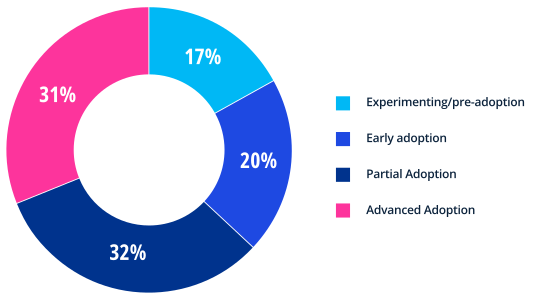
In a survey of 753 business leaders across Canada, most (93 per cent) said their organizations are using AI in some form – up from 61 per cent last year. However, only three in 10 (31 per cent) have fully integrated generative AI solutions across their core operations and workflows. Another 32 per cent have partially adopted generative AI by integrating it across some workflows and operations, while 20 per cent are still experimenting or piloting projects.
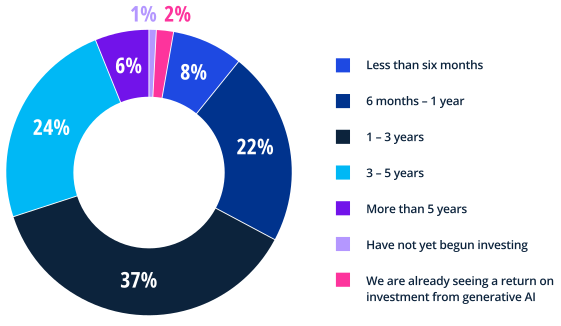
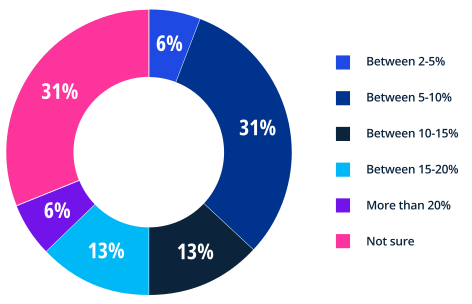
Despite growing adoption, only two per cent of respondents said their organizations are seeing a return on their generative AI investments, most (63 per cent) of which were large companies with at least $1 billion in annual revenue. More than half (57 per cent) described their ROI as between five and 20 per cent, while nearly one third (31 per cent) were unable to quantify it.
Three in 10 respondents expect their AI investments to start generating a return within the year, while six in 10 (61 per cent) said between one to five years.
“Only a small sliver of Canadian businesses are generating growth from their AI investments today, and that’s understandable – new technologies take time to be adopted and demonstrate identifiable return on investment,” says Stephanie Terrill, Canadian Managing Partner of Digital and Transformation at KPMG Canada.
“However, Canada is facing near-term threats to its economic competitiveness and grappling with declining productivity and prosperity, so waiting years for AI investments to create value isn’t realistic in this environment – in fact, it’s downright risky. Canadian organizations need to accelerate AI implementation into core operations to start achieving near- to medium-term productivity gains if we hope to become more economically competitive as a country,” she says.
Ms. Terrill says many organizations are still in the experimentation phase and have not yet deployed AI at scale or into production. Some organizations lack consistent methods to track and report AI-driven outcomes, while others are using outdated or irrelevant methodology that doesn’t account for the full value AI brings. This is where businesses need to get innovative in their approach to capturing and measuring their ROI on AI, she notes.
“To realize the full value of AI, organizations need clear ROI frameworks that measure not just financial impact, but strategic and capacity gains. Paired with strong governance and accountability, that’s how businesses will turn AI ambition into measurable results."
Ms. Terrill recommends a holistic approach that combines hard financial metrics such as cost savings, revenue growth and operational efficiency with softer strategic metrics such as improved decision-making, improved employee experience, customer loyalty, and successful and sustained adoption to measure AI’s ROI.