

As organizations shift from pilots to scaling AI and autonomous agents, trust is no longer a check-the-box requirement — it’s what enables speed, scale and sustainable value.
KPMG helps organizations unlock sustainable value by embedding trust throughout the AI agent life cycle. This enables you to move faster and scale with confidence, knowing your AI tools and systems are designed to operate safely within your organization.
Our AI Trust capabilities combine proven methods with practical experience to help organizations adopt ethical, secure and compliant AI—including autonomous and semi-autonomous agents. By embedding trust into AI from the outset, organizations can accelerate innovation, scale with confidence and deliver measurable business outcomes.
At the heart of this approach lies our Trusted AI framework, combining strategy, governance, technology and operations, supported by leading methodologies, alliances and practical experience. It is designed to enable responsible AI to move faster, scale with confidence and deliver measurable, sustainable value.

Kareem Sadek
Partner, Advisory, Tech Risk, Trusted AI and Digital Assets National Leader
KPMG Canada
Our Trusted AI framework
Our ten core principles guide our approach to trusted AI across the AI/machine learning lifecycle.
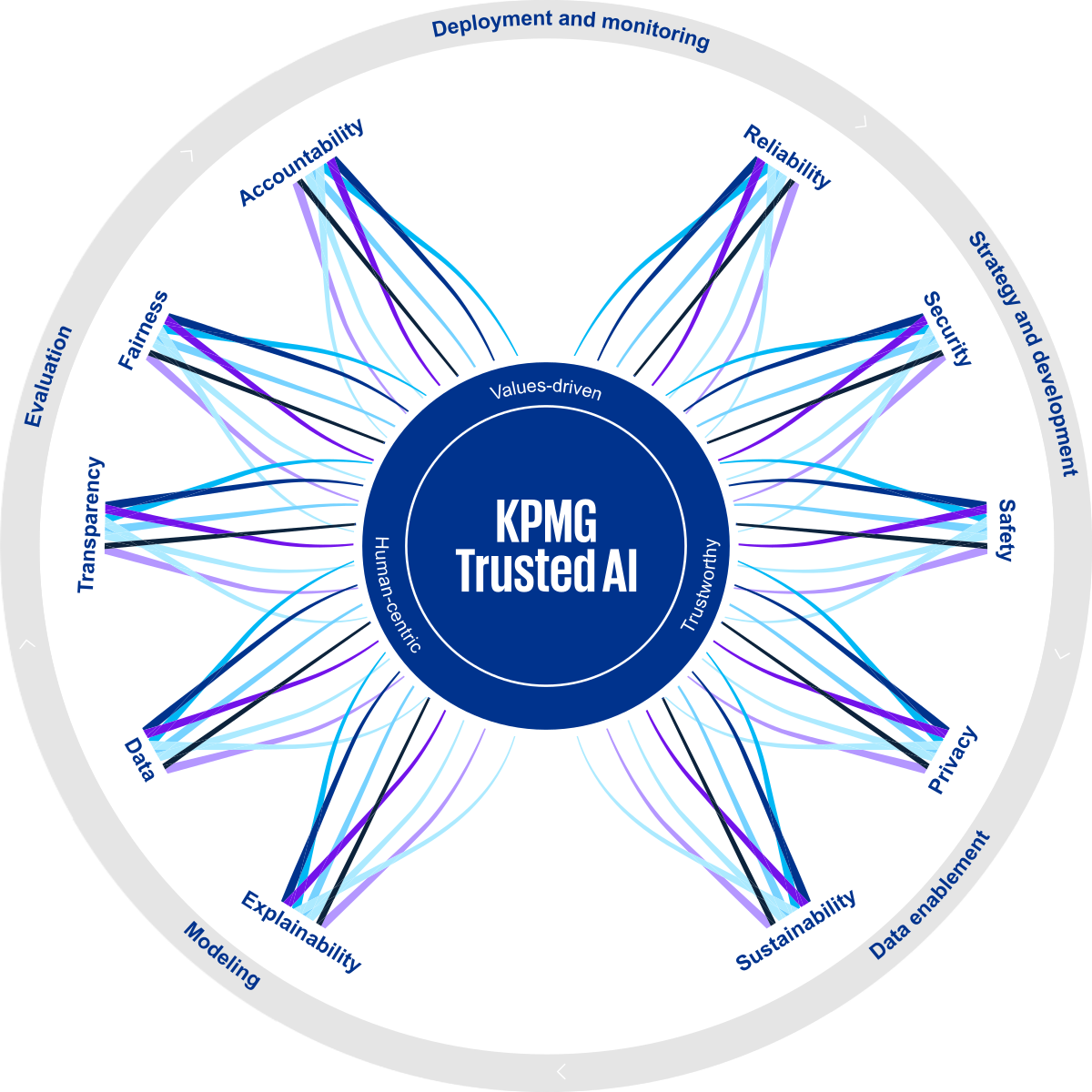
AI systems should perform consistently and at the desired state of precision within their intended scope.
AI systems should be managed across the AI lifecycle in a manner that safeguards against bad actors, misinformation or adverse events.
AI systems should be managed across the AI lifecycle in a manner that safeguards against harm to people, business, property and societal well-being.
AI systems should be managed across the AI lifecycle to comply with applicable privacy and data protection legal requirements.
The use of AI systems across the AI lifecycle should be warranted by their purpose, and they should be designed to optimize energy efficiency and minimize carbon emissions.
AI systems should provide an understandable explanation for their output, actions, or decisions across the AI lifecycle, with that explanation being appropriate to the use case, context and audience.
Data used in AI systems across the AI lifecycle should be acquired and handled in compliance with contractual obligations, applicable laws, and regulations, and assessed for accuracy, integrity, completeness, relevance and quality.
Across the AI lifecycle, AI systems should include reasonable disclosures so stakeholders are informed when they are interacting with AI, content was AI-generated, or a decision was influenced by AI.
AI systems should be managed across the AI lifecycle to mitigate bias and promote inclusive engagement for all people.
AI systems should be governed across the AI lifecycle with appropriate levels of human oversight, upholding standards of professional responsibility and quality.
How we can help
Our AI Trust professionals help organizations move beyond pilots and deploy AI—including autonomous and semi-autonomous agents—at speed and scale, with trust built in from day one. We guide organizations across the AI life cycle, embedding ethical, secure and compliant practices that accelerate innovation, support confident scaling, and deliver measurable business outcomes.


