      At KPMG, we want to help shape the transition to a sustainable economy and society. That is why we consistently embed sustainability in our business activities. To this end, we have developed "Our Impact Plan" - the global sustainability strategy of KPMG International, which describes how we live corporate responsibility. In the four areas of action Governance, People, Planet and Prosperity, we have set ourselves concrete commitments for our contribution to sustainable development in society.

      What sustainability means to us

      For us as a company, sustainability has two closely interlinked dimensions:

      • We are pursuing the goal of driving our own transformation into a more sustainable company.
      • As a leading auditing and consulting firm, our range of services makes an important contribution to creating trust in society and making the economy more sustainable.

      As a purpose-driven transformation partner, we support our clients with our technological and sustainable perspective in the market to transform their business and work towards a climate-neutral and social economic future.

      Transparent sustainability reporting

      The reporting of sustainability performance, the environmental management system and KPMG's social commitment are bundled in our sustainability management, which is headed by the Head of Infrastructure/Head of Our Impact Plan and the Sustainability Officer. This is where measures are managed and implemented. As a staff unit within the CEO department, the sustainability team reports directly to the entire Executive Board.

      Further information can be found in our current sustainability report.


      Awarded the EcoVadis Platinum seal

      EcoVadis recognises our commitment to responsible action and sustainable development in auditing and consulting with the Platinum Seal. As the highest distinction awarded by EcoVadis, this puts us in the top 1 per cent of all participating companies. EcoVadis analyses four key areas (environment, labour and human rights, ethics and sustainable procurement) and evaluates policies, measures and results in each area.

      For us, the Platinum rating is recognition of our transparent, ethical and environmentally conscious way of working and at the same time a mandate and incentive to consistently continue on our path of sustainable transformation.

      KPMG x Team Malizia: A Race We Must Win

      One partnership. One course. Out of conviction.
      Team Malizia


      Our social commitment

      We live corporate responsibility in concrete programmes and initiatives.

      We are committed to sustainable and ethical behaviour and assume social responsibility. Our aim is to harmonise economic success with social and ecological demands and to promote social commitment so that we can jointly address the issues of our time.

      As part of our social commitment, we are committed to corporate responsibility and have launched programmes and initiatives that focus on the topics of "equal opportunities and high-quality education" and "lifelong learning". The personal commitment of our employees is a central element of our sustainability concept and is particularly valued and encouraged through time off work. Together with our employees, we want to make a positive contribution to our community - in line with our value: For Better. We do what really matters.

      Giving something of what we do every day

      Our engagement programmes address current issues such as inclusion and integration and focus on education. After all, education is a human right and a cornerstone of sustainable development. Promoting lifelong learning for all people is a global priority for KPMG.

      Our activities contribute to the United Nations' Sustainable Development Goals (SDGs), with a particular focus on SDG 4: "Quality Education". Our engagement formats are characterised by personal motivation, direct contact with the participants and concrete support.


      Further links

      KPMG in Germany is a member of the nationwide corporate citizenship network "Unternehmen: Aktiv im Gemeinwesen".


      More about our social activities in detail:


      Together against youth unemployment and for the integration of refugees into the labour market.

      The Germany-wide, non-profit initiative JOBLINGE aims to counteract youth unemployment and is aimed at two target groups: socially disadvantaged young people and - as part of JOBLINGE Kompass - young refugees. In a six-month qualification programme, participants are specifically prepared for working life. The aim is to enable the young people to enter the labour market and society in the long term and pave the way to a financially independent life.

      Since JOBLINGE was founded in 2008, we have audited the annual financial statements of the non-profit stock corporations at the JOBLINGE locations and the umbrella organisation as a pro bono service.

      We have been supporting JOBLINGE in the form of mentoring since 2017. Our employees can volunteer as mentors or trainers, e.g. in the context of job application or language training. They open up prospects for young people, who in turn benefit from the knowledge and experience of their mentor/trainer. At the same time, the mentors/trainers open up their own perspective and meet young people who often have a completely different learning and life background.

      Study meets entrepreneurship

      Enactus is one of the largest international student organisations and pursues the goal of making the world a better and more sustainable place through social and ecological projects. Enactus teams contribute entrepreneurial and technical knowledge from various disciplines to socially relevant projects in order to provide "help for self-help" on an economically viable basis. Business advisors can contribute their expertise and experience - for example, to support the student teams in terms of time and project management or networking.

      Enactus' work is always based on the "Olympic idea" of competing with projects in a "sporting" manner. The main forums for this are the annual national competition and the World Cup.

      KPMG tutors support the project work

      The KPMG network with its member companies is one of the largest Enactus supporters worldwide. For each Enactus team in Germany, KPMG provides volunteer business advisors who support the students involved in the initiatives with expertise for the implementation and development of their projects and in preparation for the national competitions.

      The Enactus network

      The logo with the three peaks symbolises the three stakeholder groups that make up Enactus as a network: the more than 42,000 students worldwide in more than 1,000 campus programmes of various sizes and sectors who are united in a common goal: To make the world a better place on a small scale using an entrepreneurial spirit and business management methods.

      Enactus is derived from "to enact" ("to decide or realise something") and is also the abbreviation for "entrepreneurial" ("entrepreneurial spirit").

      Social engagement in the digital age

      Advancing digitalisation and the ongoing trend towards digital learning prompted us to expand our engagement strategy in the 2020 financial year - with a partnership with the Munich-based social start-up Volunteer Vision.

      Volunteer Vision is an online mentoring platform that enables KPMG employees to pass on their skills to disadvantaged young people around the world as online mentors. The three-pronged approach of software paired with eLearning content and services creates powerful interactions that connect people online and across geographic and cultural boundaries to learn together. Mentors and mentees meet online via video chat and have the choice between structured learning journeys or a free exchange.

      The idea of using mentoring as a method for lifelong learning not only promotes a change of perspective, but also significantly improves the social skills of both mentor and mentee.

      Teaching economic and financial topics to students in grades 8-10

      The "Fit for Business" engagement programme introduces pupils to the topics of business and finance in a practical and action-oriented way under the motto "learning by doing". The young people experience the various facets of the world of business and work and acquire skills such as teamwork, personal responsibility and independence. Experts from the world of business give the pupils an insight into the practical side of things and familiarise them with the professions of the future.

      KPMG has supported this programme since 2020 and offers KPMG employees the opportunity to volunteer as business trainers.

      Social commitment at KPMG always means personal commitment on the part of the individual employee.

      Naturally, this also applies to donations as a component of our social commitment.

      In Germany, we use three forms of donations: financial support, the contribution of our expertise for social good (pro bono) and donations of time as part of our engagement programmes.

      Financial support

      We focus our donations on the following areas of support: Education including science and research, society and social affairs, art, culture and sport, environment and nature conservation as well as commitment to the social market economy. Our focus in the education funding area is particularly on professional cooperation.

      The KPMG Residual Cent initiative is an activity that forms part of our social commitment. Here, our employees can voluntarily waive the cent amount of their net salary and donate it to a good cause. KPMG collects these amounts over the course of a year, doubles the sum collected by the employees and donates it to three charitable organisations. In the form of a survey, our employees can decide on the distribution of the donation amount.

      Contributing our expertise for the good of society (pro bono)

      In line with our sustainability approach, we also provide part of our social commitment in the form of pro bono services. This is because our employees have specific skills that enable us to make valuable contributions to the further development of the social and education sector and at the same time make our expertise visible on the market. With our know-how, we support organisations in solving specific issues and increasing their professionalism. At the same time, our employees can broaden their insights into civil society and come into contact with a completely different clientele. KPMG has been auditing the annual financial statements of all JOBLINGE non-profit stock corporations and the umbrella organisation as part of pro bono services for several years now.

      Donating time - actively taking responsibility

      Every employee has the opportunity to get actively involved in a specific area according to their personal inclinations. KPMG was one of the first companies in Germany to introduce a scheme that enables employees to take up to four hours a month off work for social commitment. This can take place both as part of the engagement programmes offered by KPMG and in the form of self-initiated, charitable engagement.

      Lifelong learning is our philosophy

      In line with our focus on lifelong learning, our employees are actively involved at universities. They take on voluntary teaching assignments, supervise dissertations and theses.

      At the same time, KPMG is adapting to changing study conditions. For example, students have the opportunity to study at the Frankfurt School of Finance & Management with the support of KPMG. Every winter semester, high school graduates can begin a bachelor's degree programme there, partially financed by KPMG, with a focus on auditing and consulting for banks, insurance companies and asset management. 


      Environmental protection at KPMG

      Our activities for the environment

      To make our contribution to preserving a world worth living in for future generations, we are continuously working to reduce our environmental impact in our own business activities and in our supply chain. With our ESG services, we also help our customers to make their business models, products and services more sustainable. In this way, we work together to combat climate change and support our customers in reducing their emissions.

      Our goal for the environment

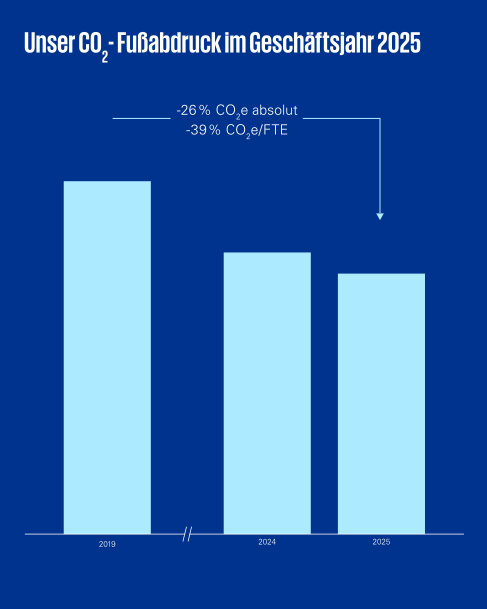
      Together with the other member firms of the global KPMG organisation, we have joined the Science-Based Targets initiative (SBTi) and have committed to reducing our greenhouse gas emissions by 50 percent by 2030. The SBTi is committed to making science-based targets for reducing greenhouse gas emissions a standard part of corporate practice.

      KPMG in Germany has also committed to halving its greenhouse gas emissions by 2030. To this end, we have set ourselves a national environmental programme, Environment 2030. It includes specific measures in the areas of mobility, sustainable supplier management, energy and resource consumption and commuting. In this way, we want to play our part in achieving the 1.5-degree target and fulfil our responsibility for environmental and climate protection.

      Another measure from the 2023 financial year is the internal CO2 price, which we want to use to change employees' travel behaviour in the long term.

      Our internal CO2 price

      In the 2023 financial year, we began mapping our CO2 emissions in our management reporting and charging a CO2 price. This initially takes into account emissions from business travel and the energy consumption of our office buildings. KPMG in Germany is starting with a price of 50 euros per tonne. In this way, we are raising awareness of climate-damaging activities in the context of our service provision and offering our employees the necessary transparency for their daily decisions in the context of their order management. The resulting financial resources are to be used for environmental and climate protection projects.

      We are certified

      Our ISO 14001-certified environmental management system provides the framework for the implementation and realisation of all our activities and measures to reduce our environmental impact in the Planet area of activity. It enables us to continuously scrutinise and improve our business processes with regard to their environmental impact.

      The management system applies to all KPMG locations and their affiliated companies in Germany (excluding temporary locations). The management system covers all environmental impacts and energy consumption caused by the provision of audit, tax and advisory services that KPMG can directly influence or control.

      Our measures and decisions in the area of ecology are based on the principles of our environmental policy.


      compost

      Find out how KPMG lives sustainability and promotes positive change in society.

      More about our activities for the environment

      KPMG is committed to a sustainable future:

      Climate change and environmental pollution are the existential challenges of our time. As a service provider, KPMG also uses natural resources and therefore has an impact on the environment and climate - whether through energy and resource consumption, travelling to clients and the workplace or our supply chain. We see it as our duty to establish a programme for the continuous improvement of our environmental performance in all business areas and at all locations.

      Preamble "Our environmental policy guidelines"

      KPMG AG Wirtschaftsprüfungsgesellschaft

      Our environmental policy is:

      KPMG is committed to a sustainable future that provides good living conditions for present and future generations. That is why social, ecological and ethical criteria are an important part of our business decisions.

      To this end, we adhere to the following principles:

      1. Our environmental performance should always improve. We consciously manage all the environmental impacts of our business activities and provide the necessary information and resources for this purpose. Naturally, this means that we are fully aware of all binding obligations that apply to us and always comply with them.
      2. KPMG wants to make a contribution to decarbonising the economy and limiting the rise in global temperatures. We pursue a consistent avoidance and reduction of our greenhouse gas emissions and also focus on the procurement of sustainable and climate-friendly products and services. We review our environmental performance and publish the results regularly.
      3. KPMG strives to apply the best and most innovative practices in environmental and climate issues and wants to play a leading role in the development of innovative solutions in our industry.
      4. We encourage our employees to act in an environmentally and climate-friendly manner and we also work with our suppliers to reduce greenhouse gas emissions in our supply chain. We offer our customers professional and sustainable consulting and auditing services so that they can also optimise their environmental impact.
      5. The Executive Board of KPMG in Germany regularly reviews how well we implement this policy and fulfil the targets we have set ourselves.

      All KPMG employees in Germany are required to comply with and implement the environmental policy.

      We sensitise our employees to conscious energy and resource consumption.

      Increase energy efficiency

      In order to make the KPMG offices sustainable and energy-efficient, we commission external service providers to carry out energy assessments and analyses in advance of a new lease. As a result, the planned facilities can usually be significantly optimised.

      By switching to green electricity in the KPMG offices, we have already taken a major step towards greater sustainability in building operations.

      Conserving resources

      Numerous digitalisation projects in our services in recent years have shown that paper files are almost superfluous. As a result, we use the advantages of digitalisation as a matter of course and save a lot of paper. In the future, we want to drive forward further process optimisation and digitisation, particularly in our internal processes, and exploit potential savings.

      In those areas where we cannot completely do without paper, we have been using paper from certified sustainable sources (FSC) for many years. We have also made double-sided black and white printing standard on all our printers.

      More than 80 per cent of our total CO2 emissions are attributable to business trips.

      Mobility is essential for our business. Our customer-orientation in our business generally requires a local presence. Our customers are always at the centre of everything we do. Our environmental footprint shows that this has an impact on the environment: more than 80 per cent of our total CO2 emissions are attributable to business trips (before the Covid-19 pandemic). We want to sensitise our employees with a variety of projects and communication measures and at the same time create greater incentives for sustainable mobility with specific offers.

      Travelling by train without emissions

      We see a major lever in replacing domestic flights with rail travel in particular. Our employees have been travelling CO2-neutral on ICE and IC trains since 2009. We provide information about alternative connections within our booking system and also raise awareness of the fact that travelling times by train are often much more efficient than by plane.

      Charging infrastructure for electric cars

      By continuously expanding the charging infrastructure in our KPMG offices, we are supporting the commitment of our employees who are enthusiastic about e-mobility. At some KPMG locations, we already provide our employees with free green electricity to charge their vehicles during working hours. In this way, we enable them to drive climate-neutral cars - for business and private use.

      Cycling for the environment and well-being

      Since 2019, we have been offering our employees another attractive mobility option: bicycle leasing. Both normal bikes and e-bikes can be leased through our cooperation partner. This not only gives our employees the opportunity to get around for business and pleasure in an environmentally friendly way, but also to do something for their health at the same time.

      By joining the Science Based Target initiative (SBTi), we have committed to reducing our greenhouse gas emissions by 50 per cent by 2030. We are also making a contribution to global climate protection and have entered into a partnership with WWF Germany for this purpose.

      Our cooperation with the WWF

      As part of our sponsorship, we are financing two nature conservation projects: in the Unganisha nature reserve in East Africa and in the Cerrado in Brazil. Both projects not only have climate protection as their primary goal, but also the protection of the global common goods of water and biodiversity. Furthermore, the success of both projects is essentially based on the involvement of the local and indigenous population.

      The projects are financed with funds from KPMG's internal CO2 pricing, which we use as part of our sustainability programme Our Impact Plan to document our own emissions and create additional incentives for sustainable action.

      Through our partnership with the WWF, we want to further underpin our climate protection efforts. By investing in nature conservation projects, we are taking on additional responsibility. We want to make a sustainable contribution and therefore pay particular attention to being able to measure and track the impact of our commitment.

      The world must act quickly and collectively to achieve the 1.5 degree target of the Paris Climate Agreement. We at KPMG also have a responsibility, which is reflected in our own climate targets. In addition, we are also committed to protecting the climate and natural resources such as water and biodiversity outside of our own company in cooperation with the WWF.

      Mattias Schmelzer

      Chairman of the Managing Board, CEO

      KPMG AG Wirtschaftsprüfungsgesellschaft


      Our projects with WWF

      The Brazilian Cerrado

      This area, which, like the Amazon rainforest, plays a key role in protecting the climate and preserving biodiversity, is currently under severe threat from soya cultivation. Many indigenous peoples and communities live in this region and are dependent on a healthy ecosystem. WWF is using our funds to implement a nature conservation project in the Cerrado with the aim of restoring large areas of the original landscape. In the degraded areas, the focus is on restoring ecosystems, including improving water quality and supply, protecting biodiversity and sequestering CO2 through reforestation and land conservation.

      The Unganisha nature region

      This region is home to eight national protected areas, including the Serengeti and Kilimanjaro National Parks. Fences, roads and irrigated maize cultivation are increasingly blocking the migration routes of native animals. WWF's aim is to connect the Mara-Serengeti, Amboseli-Kilimanjaro and Tsavo-Mkomazi landscapes, which are already largely protected, so that a large-scale network of protected areas can be created. In Unganisha, we are investing in an existing and ongoing WWF project that brings together conservationists, governments and people in the region.


      Video: Examples from the work of WWF