
Extended WWF partnership
to support two
conservation projects
to support two
conservation projects
by 12 per cent compared compared
to the base year 2019
for the EINZ Tower and at
all our locations
of our CO2 emissions compared
to the base year 2019
Limiting climate change and its consequences requires decisive and binding action. We take responsibility for shaping a better future for generations to come and are constantly working to minimise our environmental impact - both in our own business operations and along our supply chain.
We want to contribute to a sustainable future by reducing the negative environmental impact of our own operations and our supply chain. To this end, KPMG International has joined the Science Based Targets initiative (SBTi) on behalf of the member firms of the global KPMG organisation. The SBTi aims to firmly anchor science-based targets for reducing greenhouse gas emissions in corporate practice in line with the 1.5 degree target of the Paris Climate Agreement. As part of a short-term target, we have committed to reducing our emissions by 50 per cent by 2030. This target is based on a 1.5-degree reduction pathway and commits us to an absolute reduction in emissions in the areas of Scope 1, 2 and 3. We have set the 2019 financial year as the base year for this target.
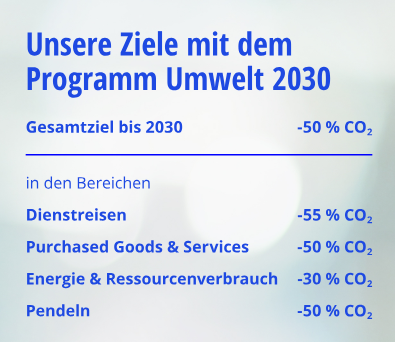
With our national environmental programme Environment 2030, we also want to meet our commitment in Germany to halve greenhouse gas emissions by 2030. The programme focuses on specific measures in the areas of mobility (business travel), sustainable supplier management, energy and resource consumption and commuting.
Further information can be found here.

We also want to utilise the influence we have on our customers with our services: With our ESG services, we support our clients in making their business models, products and services sustainable. Our services also include the development of integrative ESG strategies that not only aim to manage climate risks and strengthen resilience, but also to comply with regulatory requirements and utilise technological innovations to sustainably increase value. In this way, we want to work together to help preserve a world worth living in for ourselves and future generations.
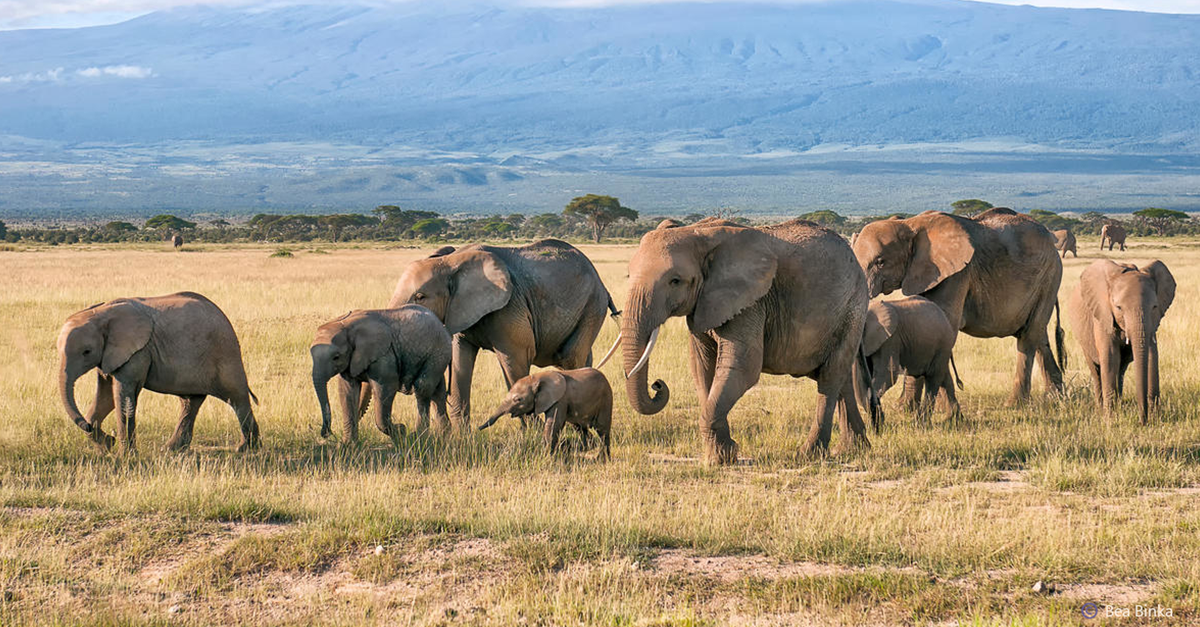
The partnership we have had with WWF Germany since October 2023 has been extended by two years with the aim of protecting the climate, water and biodiversity as part of two projects in Unganisha, East Africa, and in the Cerrado, Brazil. The projects will continue to be financed by funds from our internal CO2 price
Highlights Cerrado:
In the first year of the project, the implementing project partner WWF Brazil was able to successfully realise the planned measures:
Highlights Uganisha:
In the first year of the project, the responsible project partner WWF East Africa was able to successfully implement the planned measures:
As a service provider, our business activities have an impact on both people and the environment. A key lever for reducing our environmental impact is the greenhouse gas emissions generated in KPMG's upstream value chain1 . These include, in particular, the procurement and provision of goods and services. In addition, greenhouse gases caused by our own business activities - including business travel - also contribute to climate change. With our Environment 2030 programme and the associated measures, we aim to effectively reduce this negative impact. The programme focuses on four areas of action: Business travel, sustainable supplier management, energy and resource consumption and commuting. In addition to actively reducing our emissions, our aim is to provide transparent information about our impact on climate change, in particular by raising awareness among our employees through training courses, presentations and measures.
Further information can be found here.
1 Emissions from the downstream value chain are not material for us as a service company and are therefore not reported.
Business trips are an essential part of our business model, as personal contact with our customers is a key success factor in our projects. At the same time, they account for a large proportion of our carbon footprint. In the 2024 financial year, emissions from business trips increased further compared to the previous year, but remained well below the pre-pandemic level or the level of the base year. This is not only due to changes in working methods, with virtual meetings replacing many business trips, but also the result of increased use of environmentally friendly modes of transport. Business trips currently account for 30 per cent of our total emissions. We strive to continuously reduce the environmental impact of our travel activities with comprehensive measures and incentives for environmentally friendly business trips.
In the 2023 financial year, we introduced an internal CO2 price in management reporting. This measure makes activities with high greenhouse gas emissions more expensive in order to raise the awareness of our project managers for climate-damaging activities and ensure transparency in their daily decisions in order management. The internal CO2 price of EUR 50 per tonne is currently levied on emissions from business trips and the energy consumption of our buildings, which account for 40 per cent of our total emissions. The resulting amounts are invested in climate and environmental protection projects.
In the 2024 financial year, we revised our travel expenses policy to take greater account of environmental aspects. A new coordination process for domestic flights is intended to sensitise our employees to more sustainable travel options before booking.
An increasing number of leased vehicle users are opting for alternative drive systems. Half of our vehicle fleet now consists of electric and plug-in hybrid vehicles, with average CO2 emissions of 88 g/km. We support this development by providing additional electric charging points at our locations and through our Environment Plus programme, which incentivises the selection of more expensive leased vehicles with alternative drive systems. Since 2019, we have also offered a bicycle leasing programme for our employees, which now also allows them to use second bikes.
All employees have the opportunity to view their personal CO2 footprint resulting from business trips by plane, train or car via a CO2 dashboard. This information is intended to raise awareness among our employees and educate them about their individual impact in order to sensitise them to choose environmentally friendly means of transport for future business trips.


Over 50 per cent of our emissions are caused by the purchase of goods and services, which is why environmental aspects play an important role in our purchasing decisions.
We continue to face the challenge of obtaining real data from suppliers to calculate these emissions. We therefore use an input-output analysis from an independent institute for Scope 3.1 emissions (Purchased Goods and Services). Last year, we started to improve the data quality in this category by using supplier-specific data from the CDP Supply Chain Programme. We currently record 24 per cent of CO2 emissions with specific supplier data.
Further information on the topic of sustainable supply chains can be found in the Supplier Management chapter.
Energy consumption is currently responsible for 10 per cent of KPMG's greenhouse gas emissions. In order to minimise our ecological footprint, we are focusing on the following initiatives, among others, to optimise our energy use:
When renting new office space, we attach great importance to ensuring that the buildings have platinum certification from the German Sustainable Building Council (DGNB). We have been using only green electricity at all our locations since 2010. We are also currently working with the landlords of our office space to source the electricity for the common areas of the properties from renewable energy sources. Furthermore, relevant employees are being sensitised to the topic of energy saving and efficiency. Back in autumn 2022, we drew up an energy-saving programme to not only implement the measures required by law at the time, but also to identify and implement previously unused energy-saving potential in the long term. This included optimising the setpoint temperature for heating, cooling and ventilation and extending the weekend and night setback in buildings where this is technically possible.
We also continuously take measures to make our everyday office life more environmentally friendly in order to conserve resources in the long term. These include
Our "World-of-Work-2025" office concept is being gradually implemented in all branches. It includes, among other things:
We also aim to continuously improve space efficiency through flexible workstations and booking systems. The branches in Berlin, Munich, Dresden, Hamburg, Hanover, Jena, Karlsruhe, Nuremberg, Bielefeld, Mannheim and Ulm have already been equipped accordingly.
To save resources, we promote an internal circular economy: we offer our employees used IT hardware and furniture for sale at favourable conditions. Since 2023, there has been an internal company notice board for exchanging items. We have introduced a reusable deposit system for to-go packaging in our canteens and use a deposit system for reusable coffee cups at many locations.
Having already introduced organic and fair trade coffee at all locations, we are currently also switching our tea range to organic and fair trade products. In addition to cow's milk, we now also offer oat milk as a more environmentally friendly alternative at all our locations.
We have developed a guideline with tips and recommendations for resource-saving event concepts, which is available to our employees when planning and organising our KPMG events.
Process optimisation (in particular digitalisation projects) has enabled us to reduce our paper consumption by 75 percent since 2019. Since 2020, KPMG has only used recycled paper with the "Blue Angel" eco-label at all locations. We only use FSC-certified conventional virgin fibre paper for our print publications and in a few exceptional cases in our day-to-day work.

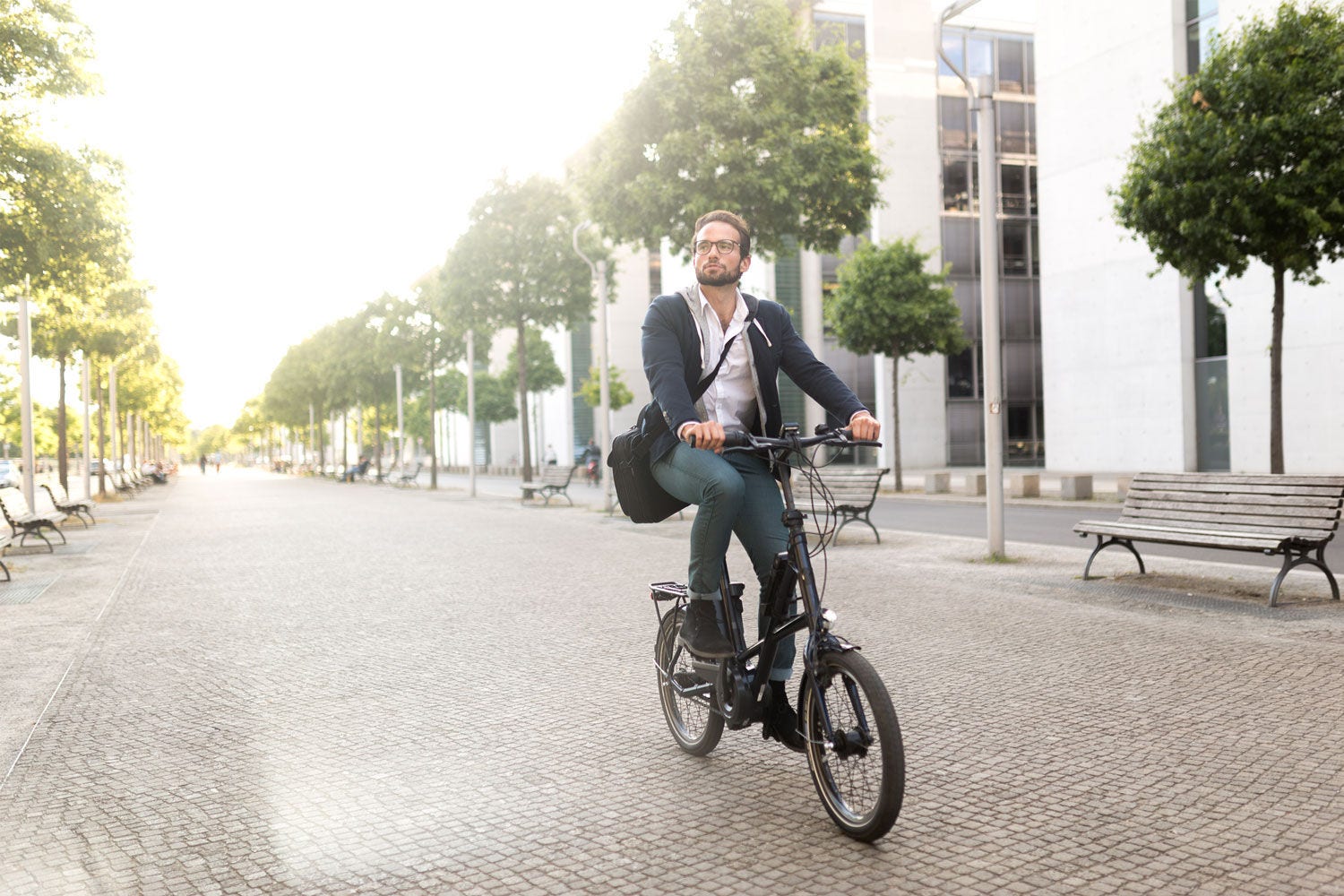
Our employees' journeys to work currently account for 8 per cent of our emissions. We want to use targeted incentives to sensitise and motivate our employees to use the most environmentally friendly means of transport for their commute:
Since October 2024, our "Deutschland-Ticket Job", supported by KPMG, has promoted the use of local public transport in regional and inner-city areas. This offer applies to all specialist employees. For many years now, all employees in our Central Services have had the opportunity to opt for a job ticket financed by KPMG.
With innovative mobility solutions, we want to encourage people to replace CO2-intensive modes of transport with more sustainable alternatives. One example of this is the mobility concept at our Berlin site since summer 2022, where we have been subsidising the use of public transport or sustainable options such as lease bikes with proceeds from the rental of our parking spaces.
KPMG actively supports the use of electric vehicles with charging infrastructure at our locations. In the 2024 financial year, around 162 charging points were available to our employees at 18 locations.
"Einz" Tower in Berlin: A modern working environment with new standards in holistic sustainability
In April 2024, we opened our new head office in the "Einz" Tower in Berlin. Together with two existing offices, this building forms the new KPMG campus and offers around 37,000 square metres of space for around 2,500 employees. The 84 metre high tower offers optimal conditions for modern working, including flexible workspaces, energy-efficient technical equipment, first-class catering facilities and a fitness studio.
Sustainability aspects already played a central role in the planning and construction phase. The building's carbon footprint was optimised through a life cycle analysis and is around 15 percent below the recommendations of the German Sustainable Building Council (DGNB). The building has also been classified as a "Nearly Zero Energy Building" by the EU Commission and has been awarded DGNB Gold certification.
The tower's location in the immediate vicinity of Berlin's main railway station promotes sustainable mobility thanks to its excellent public transport connections. The building offers a spacious bicycle room with 200 parking spaces, including 30 e-charging stations. Commuters also benefit from showers, changing rooms and a small bicycle workshop.
Inside the building, we have also opted for an open-plan office concept (WoW25) that integrates environmentally friendly materials. The furniture in all standard workstations is certified with the Blue Angel. The carpets and fabrics are also made from recycled materials. For the first time, desks made from recycled clothing are being used in an innovative pilot project. We are also focussing on sustainability in the outdoor area: environmentally friendly osmosis technology enables façade cleaning without chemicals.
Our CO2 footprint
We determine our carbon footprint in line with our sustainability goals and the SBTi guidelines, taking into account all material Scope 3 emissions. This includes relevant upstream emissions from our value chain, including greenhouse gas emissions from our supply chain and the commuting behaviour of our employees. KPMG transmits the corresponding emissions data annually to KPMG International, which integrates it into the global reporting of the KPMG organisation to the SBTi.
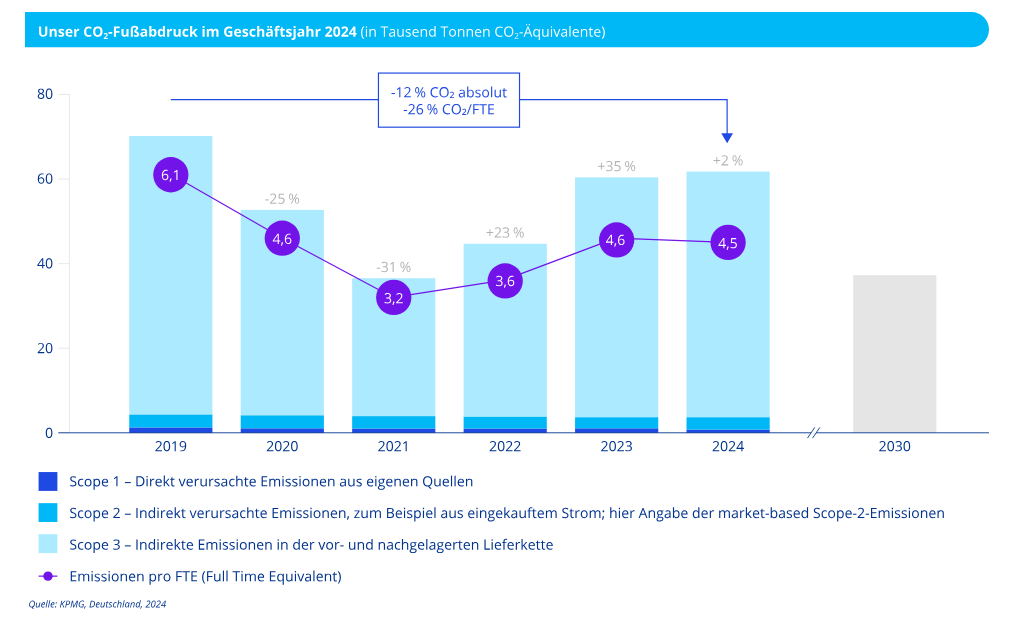
In the 2024 financial year, we were able to reduce our greenhouse gas emissions by 12 per cent compared to the base year 2019. This means that our greenhouse gas emissions are still well below the pre-corona level. Compared to the previous year, there was a slight increase in greenhouse gas emissions of 2 per cent, mainly due to the following developments
Scope 1 emissions have fallen by 25 per cent compared to the previous year, which is partly due to a reduction in energy consumption for heating (natural gas), but also to a reduction in the use of company cars. Scope 2 emissions increased by 9 per cent compared to 2023, in particular due to the relocation at the main site in Berlin and the associated parallel use of (old and new) buildings over several months. In addition, there is still an increase in business travel, particularly long-haul flights, but this is almost offset by lower greenhouse gas emissions from "Purchased goods and services" (Scope 3.1) and therefore only leads to a slight increase in Scope 3 emissions. The strong growth in sales and the continuously rising number of employees make it difficult to reduce emissions in absolute terms. It should be emphasised that total emissions in relation to employee capacity have decreased slightly compared to the previous year and have fallen by 26% compared to the base year.
In addition, KPMG, Germany and KPMG International jointly report annually to the CDP on our global environmental performance and the management of climate-related risks. To this end, the CDP takes the information provided as part of the annual reporting and rates companies based on their disclosure progress according to a D (Disclosure) to A (Leadership) system. This not only enables us to make more precise emissions assessments, but also to make informed decisions and take targeted measures to reduce emissions in the supply chain. KPMG's environmental performance is currently rated with the second-highest B score (Management).
Further information can be found here.

Partner, Central Services, Head of Our Impact Plan Germany
KPMG AG Wirtschaftsprüfungsgesellschaft

