
      The administration is the backbone of church organisations.  Through centralised services - such as human resources, IT, construction and real estate, finance, etc. - the provision of a wide range of services in society. However, a lot of administrative work also means that there is less time for the core business.

      In order to maintain the impact of church work, changes are necessary. In addition to the restructuring of pastoral areas, the realignment of the administrative organisation is central. Pastoral care stands for diversity and proximity, administration for order and efficiency. A holistic approach must take both sides into account so that church activities can once again take centre stage.
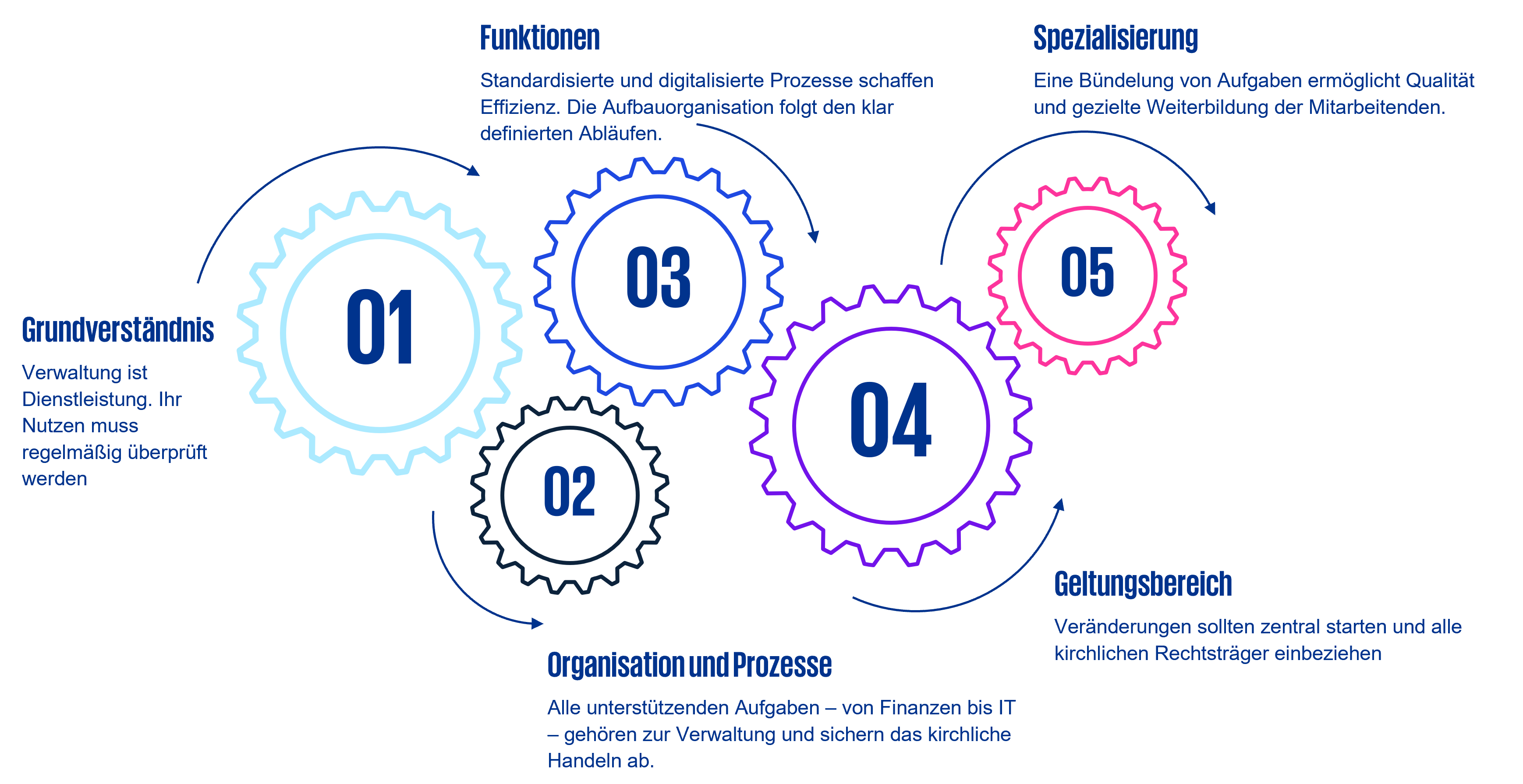
      In order to meet the requirements of the church and society, church administrative organisations need clear objectives. They provide orientation and enable a professional, sustainable and adaptable structure. The five principles of good church administration are

      1. Basic understanding: Administration must know its mission and understand it as a supporting function.
      2. Organisation and processes: Efficiency is achieved through standardised processes and a suitable organisational structure.
      3. Transparency: The role of the administration must be clearly defined and communicated.
      4. Scope: Administrative action requires a clearly defined area of responsibility.
      5. Specialisation: Professional specialisation improves quality and promotes targeted skills development.

      Functioning administrative procedures are based on clear processes. They enable pastoral action by supporting core church activities. They enable pastoral action by supporting core church activities.

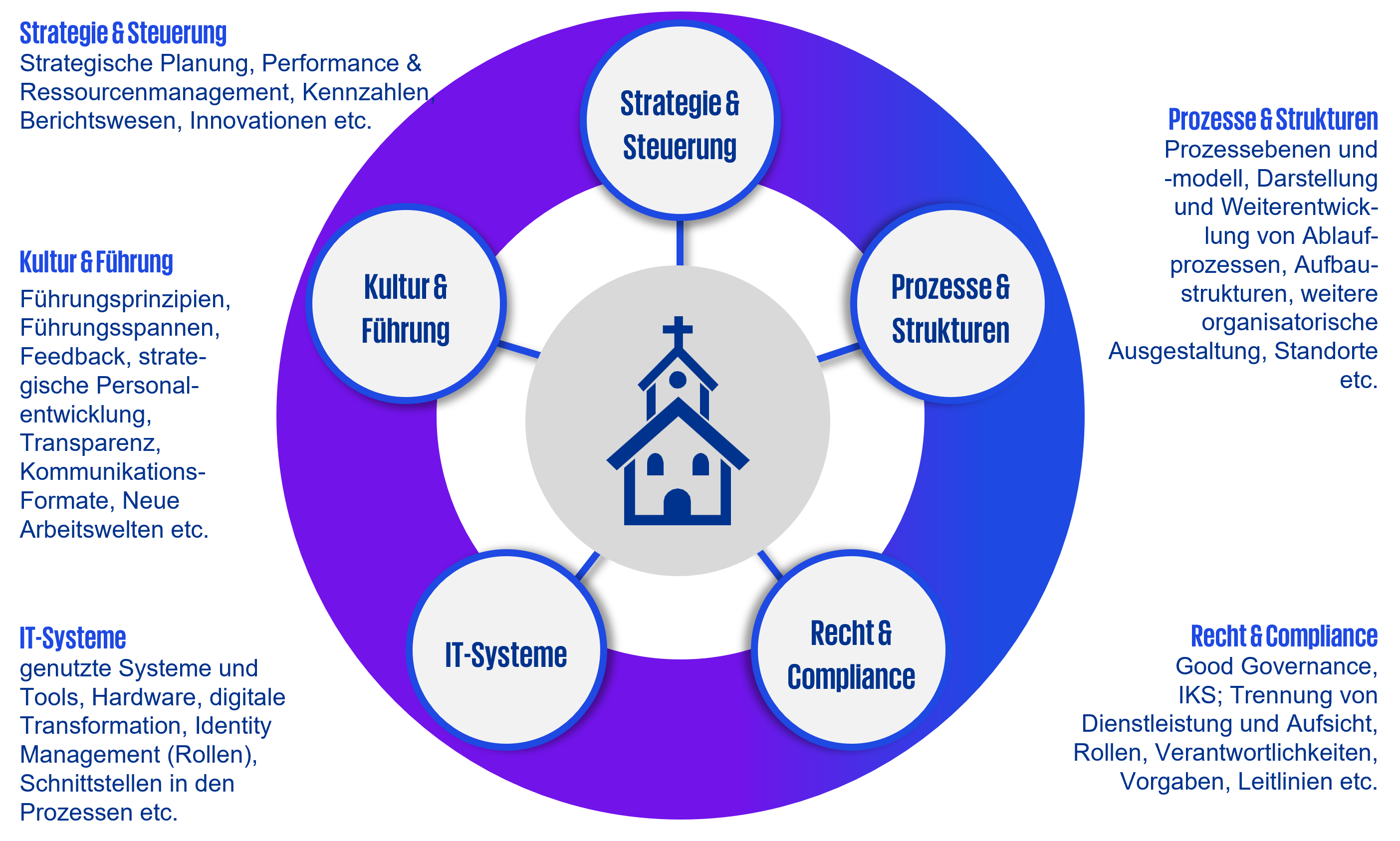
      We think of church administration along five dimensions, from vision to IT. The focus is on process organisation, as processes ensure transparency, legal compliance and digital connectivity. A process logically links several steps together, from the trigger to activities such as checking and approval through to the result. Supporting IT systems and clear responsibilities are key elements in this process.

      These five points should be taken into account when optimising processes:

      • At the beginning, it should be clarified whether existing processes should be adapted or new processes developed.
      • Uniform, automated and standardised processes save resources in the long term and increase the impact.
      • Complete documentation of all processes ensures clarity and standardised application in day-to-day work.
      • The process map organises all main processes logically and provides orientation. It is also the basis for the organisational structure and the IT architecture.
      • For new IT solutions, all technical and process-related requirements must be taken into account.

      The reorganisation of church administrative processes entails far-reaching changes. In order for these to be implemented successfully, professional change management is required that involves employees and reduces resistance.

      Sensitisation: Employees need to understand why changes are necessary. Open communication creates awareness of existing problems and strengthens confidence in the planned measures. The management level plays a central role here.

      Mobilisation: Those who are convinced are easier to activate. Target groups can be specifically addressed with a communication matrix. Employees who get involved can take on responsibility and act as multipliers.

      Implementation: Changes must become part of everyday life. Training, quick wins and clear responsibilities help to establish new routines. Continuous support and leadership are needed to ensure that the organisation does not fall back into old patterns.

      ESG describes ecological, social and organisational responsibility. For church organisations, this is closely linked to their mission to protect creation. Sustainability is not a trend, but a lived practice. The current challenges lie in structured ESG reporting and further improving the carbon footprint. Specific measures are required in areas such as energy, mobility and procurement. In addition, social issues and responsible investments are increasingly becoming the focus of church leaders.

      Do good and report on it:

      Sustainability is deeply rooted in the church's mission. The biblical responsibility for creation includes not only the protection of nature, but also social justice and responsible leadership. ESG takes up these values and translates them into concrete fields of action.

      Church organisations are faced with the task of presenting their activities transparently. ESG-orientated reporting makes social impact visible, promotes credibility and enables learning from negative effects. It shows how church activities contribute to the achievement of global sustainability goals.

      Sustainability reporting is therefore not only an instrument of accountability, but also an opportunity to make the added value of the church's work comprehensible.

      attach_email

      Well informed about current topics relating to church administration

      Your contacts