

We support our customers in the following areas, among others:
Portfolio optimisation
- Analysing and updating the real estate strategy, taking into account the corporate strategy and current trends and challenges
- Creating transparency and structuring the property portfolio into sub-portfolios / clusters with comparable properties
- Derivation of (sub)portfolio strategies and specific property strategie
- Identification of optimisation potential for the property portfolio along the strategic guidelines with the aim of
- Cost savings
- Increases in income and value
- Targeted strategic investment planning
- Utilisation of building rights
- Space optimisation in consideration of New Work
- Creating added value in property management (IFM)
- Evaluation, implementation and ongoing monitoring / controlling of the optimisation potential identified
Strategy and transformation consulting
- Strategy / Transformation
- Business / property strategy
- Business model
- Market entry
- Performance optimisation
- Portfolio / performance analysis
- Benchmarking
- programme management
- Organisational / Operational Excellence
- Reorganisation / PMI
- Target Operating Model
- Process management
- Industry regulation
- Value Chain Transformation
- Value Chain
- Service provider selection / management
- Procurement strategy


Corporate Real Estate Management at a glance
- Property and portfolio strategy
- Real estate organisation and processes
- Workplace Strategy
- Facility Management
Secure your property and portfolio strategy
More and more companies are recognising the potential of their corporate real estate. Corporate real estate (CRE) is regularly one of the highest cost blocks in companies. Optimised corporate real estate management (CREM) can reduce costs, create liquidity for the core business and increase productivity. Nevertheless, these potentials are very often misjudged by management.
The cornerstone for developing a property and portfolio strategy lies in analysing the location and space requirements of the core business. This provides the basic direction, as a property strategy can only follow the corporate strategy.
Against the background of the corporate strategy, portfolio analyses of the property portfolio must be carried out with regard to their compatibility with the strategic requirements of the company. The focus of these analyses can include the identification of operationally and non-operationally necessary properties, the identification of the main cost drivers and the discovery of unused potential in the property portfolio. In addition, a personnel analysis is used to derive the organisation's space and functional requirements. The property and portfolio strategy should be derived accordingly on the basis of these analyses.
It is important here not to view the derived strategy as a rigid construct, but to use it as an instrument that can be further developed on a rolling basis. Cyclical portfolio adjustments are particularly necessary due to changing conditions, such as the recent Covid-19 crisis. The extent to which the portfolio is marketable and how it can be transformed must be examined. There will be no "business as usual" in land consumption. Space requirements must be adjusted in line with the changing world of work, digitalisation and the sharing economy. Space that becomes available can, for example, be made available to other areas of the company. Real estate that is not required for operational purposes could be sold, thereby reducing unprofitable capital commitment. The most economical alternatives can be determined as part of scenario analyses and business case calculations based on these.
Based on the corporate or business unit strategy, the property and portfolio strategy has a direct impact on the individual property level. At this level, the strategic and tactical guidelines must be implemented operationally. There is often enormous potential at property level, which can be uncovered using property cost and investment requirement analyses (e.g. OpEx/CapEx). The aim is to find out which measures can be used to utilise this potential, increase (rental) income and/or reduce property-related costs. Questions that companies need to ask themselves in this regard include Is maintenance carried out proactively and with foresight? Have cost savings already been achieved? Have potential revenue and earnings increases been identified? Is space being utilised efficiently and in a usage-oriented manner?
The introduction of control instruments is recommended to check the effectiveness of the developed strategy. Key performance indicators (KPIs), for example, provide a quick overview of your own property portfolio. By benchmarking the KPIs, outliers can be identified and countermeasures can be taken at an early stage. As property data is often still recorded manually at many companies and comprehensive IT implementations are usually very costly, agile business intelligence solutions are a cost-effective alternative for managing the portfolio with up-to-date figures and data. This enables a shift from the entrepreneur as a data collector and processor to a property controller.
To round off the property and portfolio strategy, we recommend not forgetting the issue of sustainability. As a buzzword on everyone's lips, the topic has long been neglected. However, with the property sector accounting for 40% of energy consumption and over a third of CO2 emissions, sustainability is more relevant than ever. As part of the German government's endeavours to achieve a climate-neutral building stock by 2050, companies are already facing challenges today. Higher taxation on fossil fuels provides additional incentives to achieve energy savings. Furthermore, the topic of "wellbeing" is also becoming increasingly important in the area of sustainable property. Further information on this can be found in the Workplace Strategy section.
Ensure optimised structural and process organisation
More and more companies are recognising the potential of their corporate real estate. Corporate real estate (CRE) is regularly one of the highest cost blocks in companies. Optimised corporate real estate management (CREM) can reduce costs, create liquidity for the core business and increase productivity. Nevertheless, these potentials are very often misjudged by management.
The cornerstone for developing a property and portfolio strategy lies in analysing the location and space requirements of the core business. This provides the basic direction, as a property strategy can only follow the corporate strategy.
Against the background of the corporate strategy, portfolio analyses of the property portfolio must be carried out with regard to their compatibility with the strategic requirements of the company. The focus of these analyses can include the identification of operationally and non-operationally necessary properties, the identification of the main cost drivers and the discovery of unused potential in the property portfolio. In addition, a personnel analysis is used to derive the organisation's space and functional requirements. The property and portfolio strategy should be derived accordingly on the basis of these analyses.
It is important here not to view the derived strategy as a rigid construct, but to use it as an instrument that can be further developed on a rolling basis. Cyclical portfolio adjustments are particularly necessary due to changing conditions, such as the recent Covid-19 crisis. The extent to which the portfolio is marketable and how it can be transformed must be examined. There will be no "business as usual" in land consumption. Space requirements must be adjusted in line with the changing world of work, digitalisation and the sharing economy. Space that becomes available can, for example, be made available to other areas of the company. Real estate that is not required for operational purposes could be sold, thereby reducing unprofitable capital commitment. The most economical alternatives can be determined as part of scenario analyses and business case calculations based on these.
Based on the corporate or business unit strategy, the property and portfolio strategy has a direct impact on the individual property level. At this level, the strategic and tactical guidelines must be implemented operationally. There is often enormous potential at property level, which can be uncovered using property cost and investment requirement analyses (e.g. OpEx/CapEx). The aim is to find out which measures can be used to utilise this potential, increase (rental) income and/or reduce property-related costs. Questions that companies need to ask themselves in this regard include Is maintenance carried out proactively and with foresight? Have cost savings already been achieved? Have potential revenue and earnings increases been identified? Is space being utilised efficiently and in a usage-oriented manner?
The introduction of control instruments is recommended to check the effectiveness of the developed strategy. Key performance indicators (KPIs), for example, provide a quick overview of your own property portfolio. By benchmarking the KPIs, outliers can be identified and countermeasures can be taken at an early stage. As property data is often still recorded manually at many companies and comprehensive IT implementations are usually very costly, agile business intelligence solutions are a cost-effective alternative for managing the portfolio with up-to-date figures and data. This enables a shift from the entrepreneur as a data collector and processor to a property controller.
To round off the property and portfolio strategy, we recommend not forgetting the issue of sustainability. As a buzzword on everyone's lips, the topic has long been neglected. However, with the property sector accounting for 40% of energy consumption and over a third of CO2 emissions, sustainability is more relevant than ever. As part of the German government's endeavours to achieve a climate-neutral building stock by 2050, companies are already facing challenges today. Higher taxation on fossil fuels provides additional incentives to achieve energy savings. Furthermore, the topic of "wellbeing" is also becoming increasingly important in the area of sustainable property. Further information on this can be found in the Workplace Strategy section.
Land utilisation strategies for the implementation of "new working environments"
The development of the workplace strategy is a key component of the property portfolio strategy, which analyses the property portfolio in terms of its profitability, utilisation and flexibility. Property costs are significant for the profitability of a company. Depending on the industry and business model, they can account for 5 to 20 % of a company's total costs and are often the second-largest cost block after personnel costs.
Needs-based concepts are derived from the existing portfolio analysis (workplace analytics), taking into account users and areas, based on the changed utilisation requirements (workplace design). These changes are mainly the result of changes in corporate structures due to structural change (digitalisation, globalisation, demographic change).
The topic of health and well-being in the workplace is becoming increasingly important. In addition to health aspects, factors such as employee productivity and satisfaction also play a major role in the design of new workplace concepts. Our experts can support you in carrying out health and wellbeing assessments and accompany your project team on the way to achieving WELL Building Standard certification.
The dimensions of change must be considered in cooperation with all stakeholders in the company, in particular the HR department (change design). They concern the employees (working models and work structures), the workplace (work organisation and space design) and the technology (working methods and visualisation).
The following critical success factors must be actively managed in order to successfully implement the workplace strategy:
- Budget and resources
- Involvement and communication with stakeholders
- Change management
- Leading by example and setting an example of change by managers
- Guidelines and procedures
- Flexible workplace design and
- Ability to adapt
Workplace management ensures permanent optimisation of workplace management and a continuous improvement process through ongoing monitoring of space utilisation, utilisation of space and building costs.
The property as a management tool for change
The transformation of a company towards "new working environments" requires an interdisciplinary and integrative approach by the corporate real estate division with HR, facility management and IT. Real estate becomes a management tool for change. They shape the corporate identity, influence success in the war for talent, labour productivity and shift competitive positions. A successfully implemented workplace strategy makes a significant value-added contribution to the company's success.
Service solutions for your company
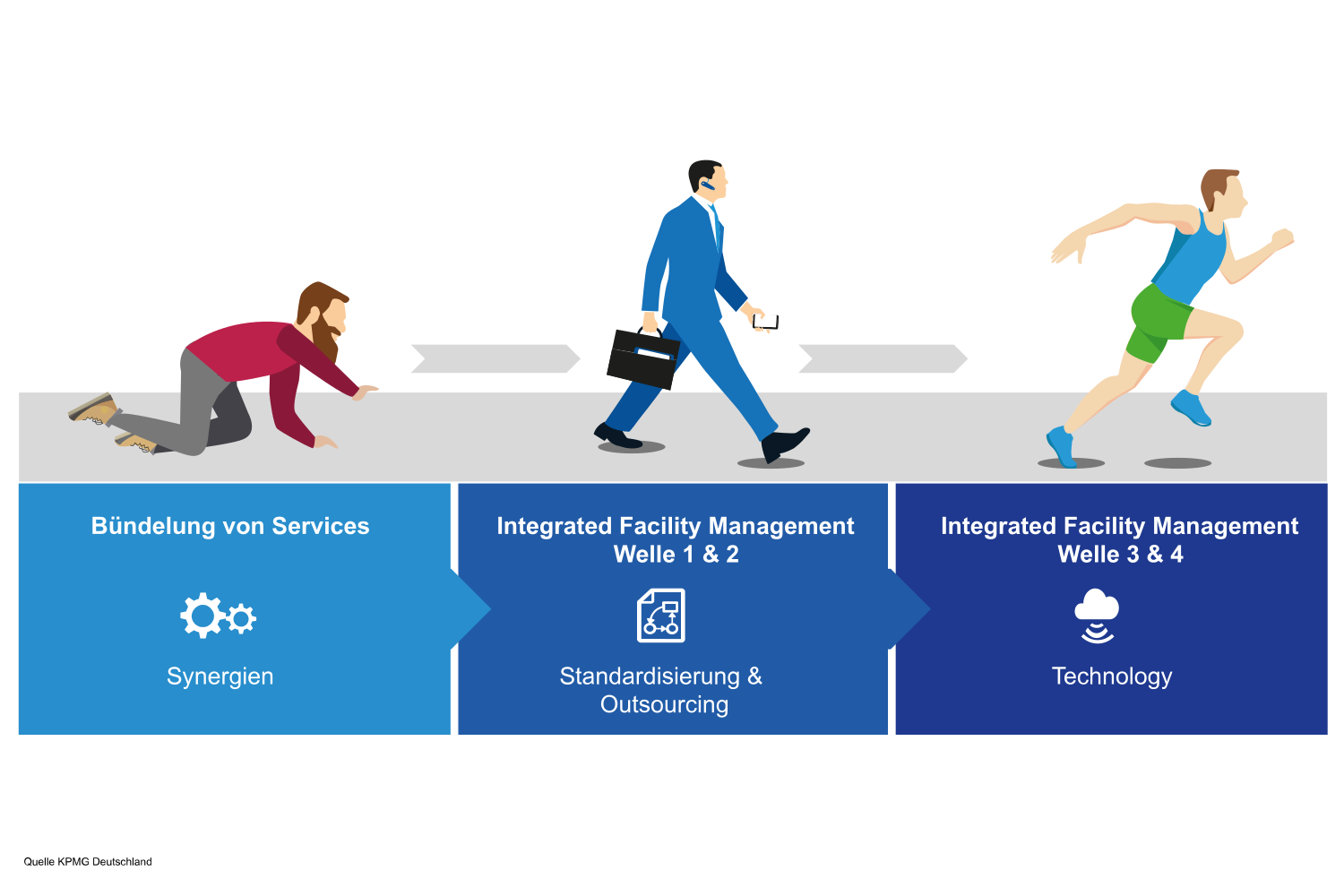
The tasks and requirements of facility management have changed significantly in recent years. In the past, the focus was on cost-optimised management and maintenance of buildings. Today, however, sustainability and user experience in the workplace have become much more important. Issues such as the lack of transparency of building-related costs, the frequent lack of certainty on the subject of operator obligations and increasing cost pressure with a high level of innovation in services represent the greatest challenges for FM organisations.
Integrated Facility Management (IFM)
IFM manages all facility management services on an interdisciplinary basis and achieves significant cost optimisation with innovative solutions. IFM follows the strategic decision to focus on its core business and hand over the management of all facility management services such as cleaning, technical maintenance, security, catering, reception and many more to a single partner.
The challenge, as with any other paradigm shift, is to set up the process correctly from the outset. In addition to collecting data on quantities and costs, a suitable service description and the right commercial model are the guarantors of success for the successful introduction of an IFM model.
We would be happy to discuss how we can organise this transformation process together. In recent years, KPMG has been able to accompany many clients on this path and help them achieve savings of up to 20% on historical costs.
Integrated Facility Management (IFM)
User experience and innovation in facility management
The traditional management approaches for office space and the changing requirements of an agile working concept in the "New Ways of Working" are diverging. In order to survive in the "war for talent", innovative solutions from the real estate sector are needed to help strengthen employer branding.
Integrated Workplace Service for New Ways of Working
Health check of your connection with your service provider
Also consider whether your KPI system differs from the actual service provision with your service provider. Are you sure that your service provider provides all the services owed and invoices them in accordance with the contractual provisions?
If you are aware of these issues and would like a third party's professional view, we should sit down with you and evaluate the actual performance of your service provider.

Health check of the performance of your FM service provider
Your contacts

Dr. Sven Weberbauer
Director, Advisory, Corporate Real Estate Management
KPMG AG Wirtschaftsprüfungsgesellschaft

Melanie Schüll
Senior Manager, Advisory - Corporate Real Estate Management
KPMG AG Wirtschaftsprüfungsgesellschaft
- Item 1
- Item 3