Sustainability understood as a three-dimensional ESG model (environment, social, governance) is one of the greatest challenges of our time. Our study provides a picture of the status quo of ESG integration in the three TMT sectors and identifies key areas of action that TMT companies are confronted with.

      The products and services of the technology industry are an integral part of our everyday lives and require high-performance telecommunications networks. Media are relevant for the functioning of our social system by serving the information needs of the knowledge society. TMT companies therefore have great social significance. They should rethink their business practices in terms of sustainability, not only because of regulations, but also because of their social responsibility and pioneering role.

      It is predicted that the world's data centres could be responsible for 4.5 percent of global energy consumption by 2025.1 This would mean a doubling within eight years. The United Nations also expects that almost 75 million tonnes of electronic waste will be produced by 2030, which would represent an increase of around 25 percent compared to current levels.2 These examples show that the TM sectors also contribute to environmental and climate damage.

      What is the sustainability situation at German TMT companies? What measures have already been taken? Where are the biggest areas for action? We investigated these questions by interviewing 150 ESG managers in TMT companies based in Germany.

      auto_stories

      How sustainable is the technology industry really? In our study, we show which measures tech companies have already taken and where there is still a need for action.


      Executive Summary

      • Many TMT companies believe they are already well positioned.

        The majority of respondents see little need for action to improve sustainability along the three ESG dimensions. However, this self-image is somewhat deceptive. Our study shows that many TMT companies still have a need for action in many ESG areas.

      • The environmental aspect takes centre stage.

        The greatest need for action was identified in the environmental dimension. At the same time, many respondents stated that they had already made significant improvements in energy efficiency and resource consumption in the last two years.

      • There is a lack of key figures for measuring sustainability measures.

        Although the majority of respondents have defined sustainability targets for the three ESG dimensions, only a third also have corresponding key figures. Many TMT companies are therefore unable to measure the achievement of their targets.

      • There is a backlog in sustainability reporting.

        The majority of TMT companies do not provide the public with sufficient information about their ESG activities. Comprehensive reporting along the three ESG dimensions has only been practised by a minority to date.

      • ESG regulations are perceived differently.

        European ESG regulations such as the EU Taxonomy and CSRD are only categorised as relevant by a minority of TMT companies. The Climate Protection Act and the Supply Chain Duty of Care Act receive significantly more attention.


      Industry reports

      In order to paint a clearer picture for the sectors, we have published three separate reports in which the survey results are analysed in detail for each sub-sector and enriched with recommendations for action. The reports can be read individually, but also side by side to recognise similarities and differences between the three TMT sectors.


      Focus topics: Key take-aways

      These three chapters will give you an insight into the TMT sector as a whole.

      Sustainability has arrived in the TMT sectors. Many TMT companies have taken measures in recent years and have been able to improve in important ESG aspects. However, there is often still a need for action in the area of climate and environmental protection.

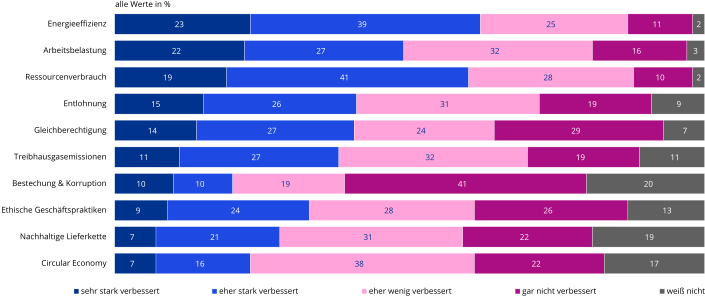
      • Energy efficiency and resource consumption are the areas in which the greatest progress has been made (see chart). Overall, the majority of TMT companies surveyed consider themselves to be well positioned in all three ESG dimensions.

      89 %

      of the companies surveyed see little or no need for action in the area of social affairs.

      48 %

      have not or only slightly improved the workload of the workforce.

      Conclusion

      • However, this self-image is somewhat deceptive. Our study shows that many TMT companies still need to take action in many ESG areas - for example in recycling electronic waste, monitoring suppliers, reducing workloads or promoting equal pay. The reporting of sustainability measures is also rudimentary at best.
      • ESG investments are also often still at a relatively low level. The share of sustainability investments in total investments is less than 10 per cent for just over a third of respondents. A further third were unable to make a concrete statement on this point. This lack of knowledge is an indication that sustainability is often not firmly anchored in the organisational structure.
         

      Chart: Progress in the area of sustainability

      To what extent has your company demonstrably improved in the following areas in the last two years? (n=150)

      The more firmly sustainability is anchored in corporate management, the more effective the sustainability measures will be. However, such anchoring is not yet widespread in the TMT sectors. There are often no defined targets and key figures to which ESG activities can be aligned.

      • The selection of business partners can have a significant impact on a company's sustainability rating. In order to reduce risks, analyses of suppliers and sales partners should be carried out. Around half of TMT companies do not carry out risk analyses and are therefore unable to check compliance with ESG standards along the value chain.

      52 %

      of the TMT companies surveyed do not carry out risk analyses along the value chain.

      34 %

      do not have a person or department responsible for sustainability.

      Conclusion

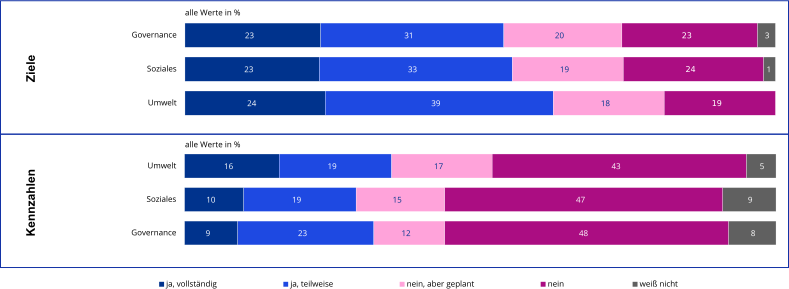
      • Although the majority of respondents have defined sustainability targets for the three ESG dimensions, only one third also have corresponding key figures (see chart). Many TMT companies are therefore unable to measure the achievement of their targets. Consequently, in these cases it is difficult to determine whether the sustainability measures have been successful.
      • Good data management is a prerequisite for successful sustainability management. Our survey results show a heterogeneous picture here. The maturity level of ESG data management varies greatly depending on the aspect and dimension.


      Measurement of sustainability activities

      To what extent has your company defined sustainability targets and key performance indicators (KPIs)? (n=150)

      Regulation is an important driver of the sustainable transformation of the economy and society. This also includes reporting obligations that require large (and in future also medium-sized) companies to inform the public about their ESG activities.

      • Some TMT companies already report on their sustainability activities. However, comprehensive reporting along the three ESG dimensions has only been practised by a minority to date. The least information is published in the area of governance. However, more than half also state that they publish little or no data on the environmental aspect.

      59 %

      inform the public about their sustainability activities in the area of environmental and climate protection only rudimentarily or not at all.

      70 %

      have only implemented the CSRD in part or not at all. The CSRD will apply from 1 January 2024.

      Conclusion

      • Many TMT companies have started to make their organisation and business activities more sustainable. However, there is usually a lack of consistent implementation along the three ESG dimensions. Comprehensive and systematic sustainability management is still the exception in the TMT sectors.
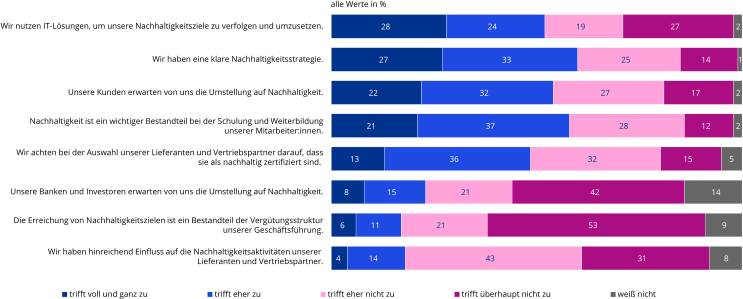
      • This divided picture between sensitisation on the one hand and a lack of consistency on the other is also reflected in some of the concluding statements. For example, although 60 per cent of respondents have developed a clear sustainability strategy, only 17 per cent have taken the achievement of sustainability targets into account in the remuneration structure of management (see chart).


      Statements on the topic of sustainability

      To what extent do the following statements apply from your company's perspective? (n=150, deviation from 100 per cent due to rounding differences)

      More KPMG Insights

      Your contacts