There are established benchmarks for treasury costs, such as “cost as a percentage of revenue”, “FTEs per entity” and “cost per payment”. They are useful and provide an initial point of reference. However, a single benchmark is not enough to answer the question “How much should my treasury function cost?” because the same company can be classified very differently depending on the methodology used.
A real, anonymized case from our project work illustrates this clearly. For the same company, two established sources, a cost comparison from a well-known benchmarking provider and a peer-group benchmark from a recognized strategy consulting firm, produced cost ranges that differed by more than 100%. Both results were understandable and supportable within their respective methodologies. For management, this means that the same company could operate a treasury function for around EUR 1 million or for EUR 2 million to EUR 2.5 million and cite a recognized benchmark in either case. Both figures are legitimate statements of what “the benchmark” says within the respective scope. However, neither source indicates what services sit behind the figure or what contribution the treasury function delivers in return.
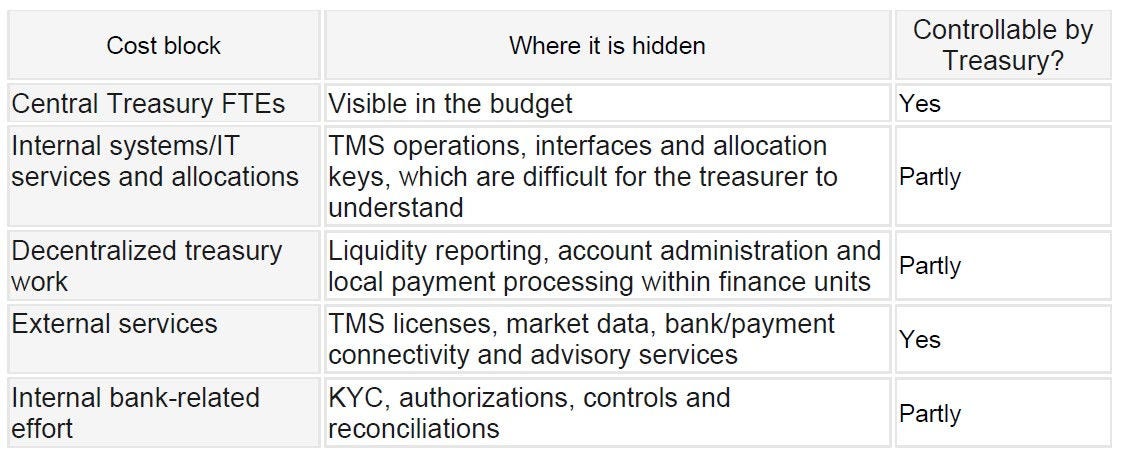
An isolated benchmark does not provide a robust budget figure. It becomes meaningful only when the company also considers its own circumstances. A cost comparison should therefore be supplemented by three steps: capture total costs accurately, normalize them within the appropriate peer range and calculate the value contribution transparently.
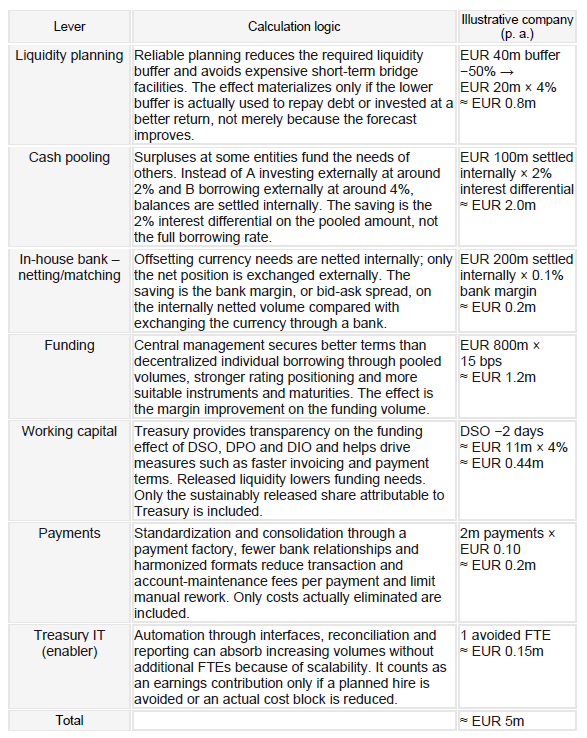
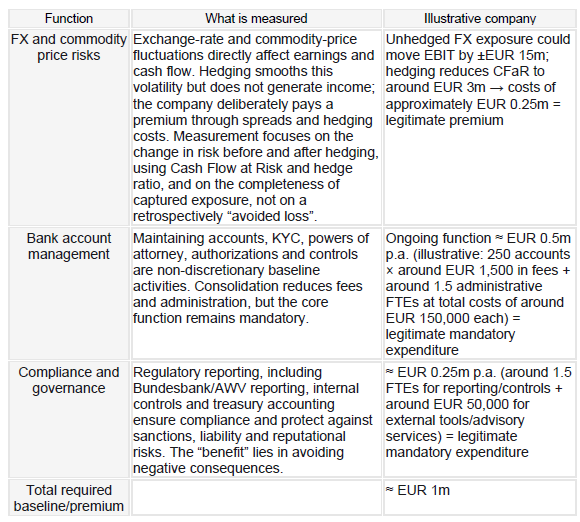
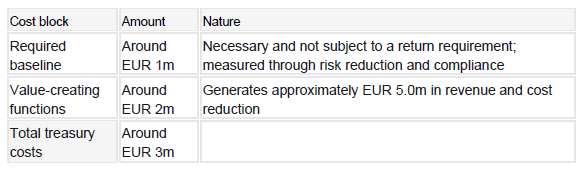
The value contributed by a treasury function can significantly exceed its costs. The amount depends not only on revenue, but also on funding, liquidity, exposure, transaction volumes and the function’s starting level of maturity. Depending on the business model and starting position, a well-designed treasury function can make a substantial contribution to earnings, cash flow stability and capital efficiency. Given this leverage, the difference between a budget of EUR 1 million and EUR 2.5 million is no longer purely a cost issue. It is an investment decision. The illustrative calculations below show how this contribution can be composed.