

International corporate groups often centralise administrative services in order to save costs and benefit from standardised processes. One challenge is the correct allocation of costs for tax purposes, as these services often benefit several companies within the group. Particularly in inbound cases, the fees for centralised services are regularly questioned by the German tax authorities. This article provides recommendations for action and a practical example of bundled service charging at the parent company.
1. billing of centralised services regularly poses challenges for group companies
Virtually every internationally active corporate group centralises administrative services in areas such as finance, tax and legal, human resources and IT. These are functions that are not part of the company's core business, but are essential at the same time. Bundling these activities can lead to significant savings due to their uniformity. Organisational aspects also play a role, as the corporate group can benefit from uniform processes - for example in the form of a shared IT landscape. However, difficulties arise when it comes to who has to bear the costs for such services. The challenge lies in allocating the costs appropriately for tax purposes, as the services are usually provided for several companies across the group, making it difficult or even impossible for the individual group company to delineate the activities. The preparation of transfer pricing documentation (and in particular a master file or benchmarking studies) are good examples of such services.
2. transfer pricing regulations for group allocations
The German tax authorities are bound by special regulations for the charging of central services in the Group and thus largely follow the international standard of the Organisation for Economic Co-operation and Development (OECD). As a rule, routine services are to be remunerated using the cost-plus method (i.e. cost reimbursement plus a profit element). The so-called "routine services with low added value" are of a supportive nature and are not part of the company's core business. They are provided without the use or creation of significant intangible assets and no significant risks are controlled or incurred.
For such services, the tax authorities accept the application of a profit component amounting to 5 per cent of the full costs without proof of comparative data if this is done uniformly within the group. The costs may then be allocated to the individual service recipients by way of an apportionment. It is recognised that the direct allocation of service costs per group company (e.g. using timesheets) is hardly feasible in group practice. It is therefore possible to allocate overheads to the companies using appropriate allocation criteria. For IT services, the PC workstations or the number of software licences are frequent allocation keys; for personnel services, on the other hand, the number of employees is often chosen as an appropriate allocation key.

In principle, when charging for services within the Group, it should be proven that the services were actually provided. It must also be demonstrated whether the services are for the benefit of the recipient. This also implies that the services do not include any shareholder activities, i.e. activities of the parent company that serve to control and manage its investments. In the case of routine services with low value added, however, simplifications apply, which the OECD has specified and which the German tax authorities use as a guide. For example, the tax authorities should therefore refrain from examining the proof of benefit (also known as the benefit test).
3. tax audit of inbound companies
It is often the parent company that bundles central services for the group. In inbound cases, where the parent company is based abroad, tax audits regularly call into question the fees that mean a tax-reducing deduction of operating expenses for the company receiving the service.
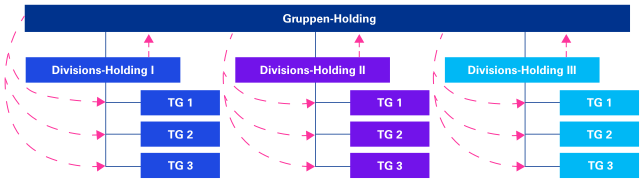
In this case, for example, price increases in the group allocation were observed during the audit period. The auditor asked about the reasons for the additional costs and demanded proof that additional services had been provided. This presented the company with particular challenges for the following reasons:
- The German company was acquired, so the parent company and therefore the service provider changed over time. Due to the takeover and the long period of time between the assessment period and the audit procedures, it was very difficult to obtain documents and information from the former Group management.
- Documents and information from the new Group management were denied due to the discrete Group policy. From the perspective of the Group management, calculation details for the Group allocation contain confidential data (e.g. salaries of the parent company's management) that should not be disclosed to local management.
- From the perspective of the German tax audit, some of the services also included shareholder expenses. The distinction between administrative activities and shareholder expenses is not always clear and can be interpreted differently; this can affect areas such as business development or controlling.
- The tax audit declared a hidden profit distribution, which leads to dividends and therefore to capital gains tax. A transfer price adjustment in accordance with Section 1 of the Foreign Tax Act, which only results in an off-balance sheet adjustment, is generally only subordinate to the hidden profit distribution.
4. measures
The question remains as to how one can protect oneself against corrections due to the charging of management fees. Evidence of the services provided and calculations of the fees must be provided to the tax audit and in practice - even when applying the simplified approach for routine services with low added value - it is hardly possible to defend oneself against excessively detailed and extensive requests for evidence, as these are discretionary and case-by-case decisions. There are also increased obligations to co-operate in the case of foreign matters. The argument that the data is confidential is not valid due to tax secrecy.
It is therefore advisable to collect documents promptly, i.e. at the latest upon receipt of the services, or to request them from the group management. This includes written contracts, invoices with detailed service descriptions and calculation bases. Ideally, the group management should draw up centralised transfer pricing documentation, which should be requested at an early stage. In case of doubt, confidential data can be collected directly by the tax advisor from the foreign group management and forwarded directly to the tax audit.
If the documentation provided by the group management is insufficient, local records of the services received can also be prepared. In order to demonstrate that the remuneration is appropriately high, the group company can use third-party offers from service providers or the personnel costs of appropriately qualified employees as a guide.
5. conclusion
In tax audits, group allocations are often audited and specific evidence is required. This can be time-consuming and, in inbound cases, regularly requires centrally prepared documentation with the support of the service provider. This should be addressed at an early stage, as the options for local documentation are limited.
Your contact

Michael Freudenberg
Partner, Tax, Head of Tax Technology & Operations
KPMG AG Wirtschaftsprüfungsgesellschaft