The Digital Operational Resilience Act (DORA) is a new EU regulation that came into force in January 2023. It is part of the European Commission's digital finance package with the aim of increasing the digital resilience of the European financial market. The aim is to ensure that financial market participants can continue to operate securely and reliably even in the event of major incidents affecting information and communication technology (ICT).

      Companies affected by the regulation have a transitional period until January 2025 to fully implement the regulation.

      The new requirements for ICT security, operational resilience and reporting obligations in the event of cyber attacks, for example, are explained below.

      auto_stories

      Ein Leitfaden zum Verständnis von DORA und ihrer Auswirkungen auf den Finanzsektor

      Requirements & current developments


      DORA attaches great importance to the overall responsibility of the management body for digital operational stability. Management must ensure that the company is adequately protected against ICT disruptions and cyber attacks.

      DORA provides a holistic ICT risk management framework as fundamental to creating resilient financial organisations. This enables ICT risks to be identified, assessed, managed and monitored.

      One example of the implementation of the DORA requirements is the establishment of resilient ICT systems in accordance with a uniform standard throughout the European Economic Area.

      Financial organisations need to ensure that their IT systems and processes are able to detect and respond to potential threats quickly and effectively.

      In order to increase responsiveness, DORA specifies requirements for processes and systems for the immediate detection and defence of potential threats, among other things.

      One example of the implementation of this requirement is automatic network isolation in the event of cyber attacks. This minimises the risk of data loss or system failures and makes it easier to restore normal operations.

      Another DORA requirement is to standardise reporting obligations for serious ICT incidents across the European financial industry. This should help to improve the response to such incidents and ensure effective cooperation between national and European authorities.

      One example of the implementation of this requirement is the introduction of standardised procedures for monitoring, classifying and reporting ICT incidents to the competent authorities.

      Regularly checking the operational stability and security of critical IT systems is crucial for the smooth operation of financial organisations. A risk-based testing approach is required to ensure that potential ICT disruptions are recognised and rectified.

      One example of the implementation of this requirement is the performance of penetration tests on live production systems at least every three years. This involves looking for specific weaknesses in the system in order to identify potential attack vectors and take appropriate countermeasures.

      DORA is designed to enable financial organisations to effectively monitor the risks posed by third-party ICT providers. This is particularly important as more and more financial companies are relying on the services of third-party providers for their IT systems and processes.

      One example of the implementation of this requirement is the introduction of penalties and new cancellation options for third-party ICT providers that do not comply with the requirements of the DORA Regulation. These measures will enable financial organisations to ensure robust monitoring of the risk posed by third-party ICT providers

      Audit practice began with the end of the DORA implementation period in January 2025. Since then, the implementation of DORA and therefore the resilience of financial companies, including information and communication technology (ICT) service providers, has been audited by the internal audit department, the auditor of the annual financial statements and, in particular, by the national (BaFin) and European (European Supervisory Authorities) supervisory authorities. The starting point for these audits is a functioning ICT risk management system. Based on the definition of critical and important functions, all areas of the DORA are reviewed both in terms of requirements and their effective implementation.

      We provide financial companies with comprehensive support during these audits: starting with the preparation of our clients, we accompany the entire audit and then help them to work through the findings in a structured manner. We ensure a professional audit process and transparent communication with the authorities. Through a gap analysis, we avoid surprises in terms of content and can quickly identify, assess and communicate anomalies.

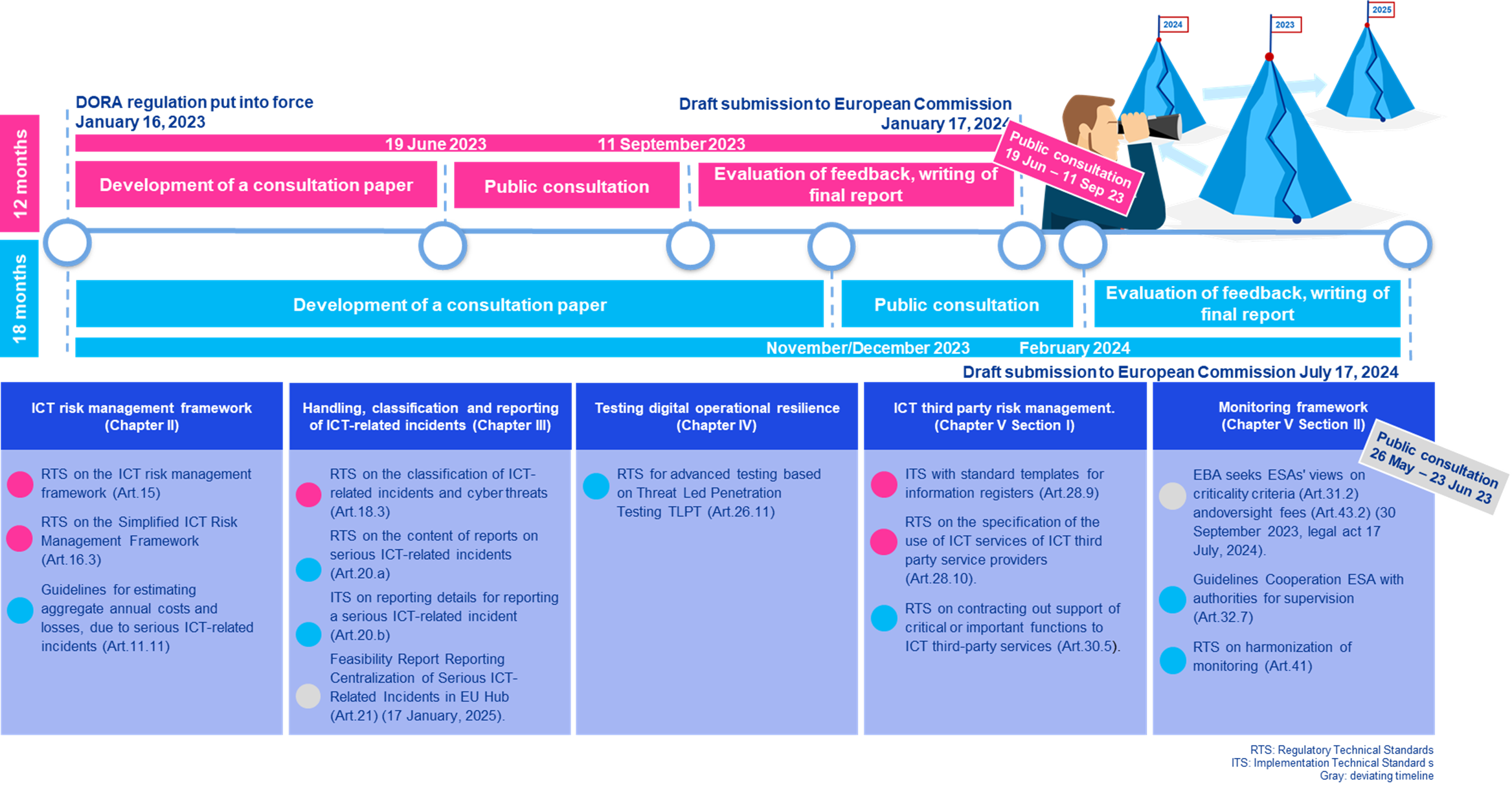
      DORA also includes the concretisation of the requirements on the part of the ESAs (European Supervisory Authorities) through technical regulatory and implementation/implementation standards (RTS/ITS).

      The following graphic shows the overview and timeline of the concretisations provided in the first round (pink) and still to come in the next round (blue), broken down by DORA chapter. The current public consultation phase of the first round has been running since 19 June 2023 until 11 September 2023. The European Commission should then receive the revised drafts by 17 January 2024. The RTS/ITS of the second round of public consultation are expected at the end of November/beginning of December 2023:

      dora-regulations

      Challenges for customers

      The introduction of the DORA regulation may pose a number of challenges for financial companies, as they may not be sufficiently prepared to implement the new requirements. 

      In order to meet the requirements and continue to operate appropriately and successfully, ICT systems must be brought up to date, processes optimised and employees trained. 

      Legal aspects

      With regard to contract management, DORA defines, among other things, requirements for contracts with ICT third parties that must be incorporated into the contract management of financial organisations. During implementation, it is therefore necessary to categorise (existing) contracts, define target requirements, carry out gap analyses and close potential gaps.

      DORA also changes the requirements for the responsibility and liability risks of companies and managers with regard to ICT third-party risks. For example, the scope and conditions of insurance cover need to be reviewed and adjusted if necessary.

      How KPMG supports you

      • KPMG has a comprehensive repertoire of expertise in all relevant disciplines in the area of DORA regulation, including management consulting, ISM (Information Security Management), IRM (Information Risk Management), BCM (Business Continuity Management), outsourcing and cloud solutions. We specialise in advising and supporting our clients in all aspects of these disciplines.
      • We have a deep understanding of processes, risks and controls as well as governance structures. Our expertise and know-how enable us to support our clients in implementing effective control mechanisms and risk management strategies.
      • Our extensive project experience with companies in the industry has provided us with valuable insights and knowledge that help us to better understand our clients' challenges and requirements. With our proven process model, we apply these insights in a targeted manner and develop customised solutions that are optimally tailored to the individual needs of our clients.
      • We benefit from direct access to global expertise and experience through our corporate network. We work closely with our international teams and have access to a wide range of experience and expertise specifically tailored to the financial sector.
      • In addition to our technical and methodological expertise, we also offer know-how for the implementation of tools. We support our clients in the implementation of standard GRC tools to efficiently manage and control risks and controls. We also offer tools for the effective management of third-party providers and their contracts in the area of information technology (ICT).

      Jetzt herunterladen

      Neue Meldeanforderungen im Third-Party-Risk-Management - Key-Learnings und Take-Aways zum Informationsregister

      Jetzt herunterladen

      Digital Operational Resilience Act

      Jetzt herunterladen

      Digital Operational Resilience Act - Warum Sie jetzt handeln sollten


      KPMG Webcast – DORA: So gelingt die Umsetzung

      Unterlagen des Webcasts Live vom 27. April 2023, 9:00 - 11:30 Uhr

      Frau mit cafe schaut auf Telefon

      More KPMG insights for you

      Your contacts