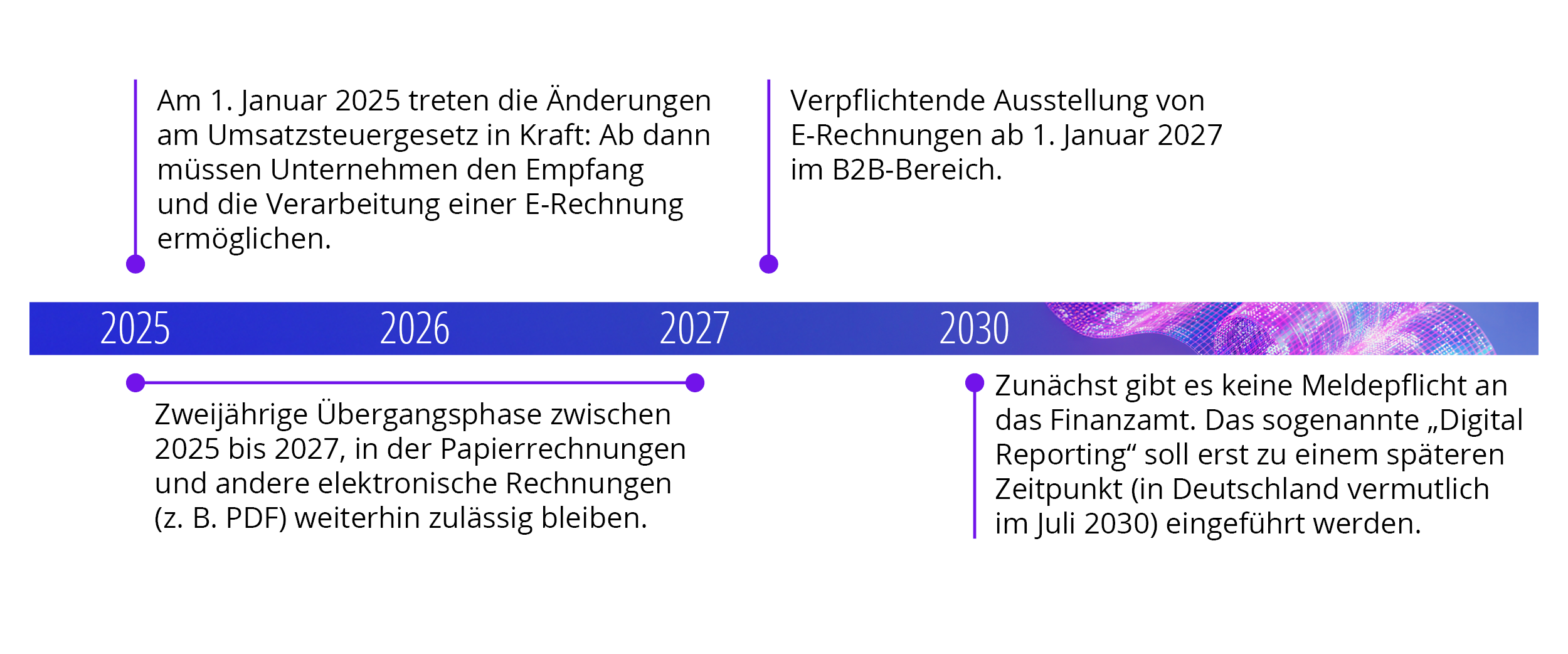
E-invoicing and digitalised invoice processes are intended to ensure faster and more efficient processing of invoices, greater accuracy and a reduction in formal effort. However, the requirements pose challenges for companies: The regulation, which previously only applied to public clients and their invoice issuers in Germany, was extended to the B2B sector on 1 January 2025. Application at EU level as part of the "VAT in the Digital Age" (VIDA) initiative is expected to follow from 2028/2030.
What is an e-bill?
An electronic invoice (e-invoice) is an invoice that is issued, transmitted and received in a structured electronic format and enables electronic processing. An invoice in PDF format does not fulfil this requirement.
Timetable
Transition phase until 2027
The key points of the e-bill at a glance
- Mandatory introduction of the EN16931 invoice format (European CEN standard from the B2G sector), i.e. the XRechnung and ZUGFeRD formats that already exist today will generally also be permitted for the B2B sector.
- The EDI process with other electronic formats will remain permanently permitted if extraction into EN16931 or into a format that is interoperable with EN16931 is possible.
- There are also exceptions. There is no e-invoicing obligation for:
- small value invoices up to a maximum of EUR 250,
- invoices for travel tickets,
- tax-free transactions without the right to deduct input tax,
- B2C transactions.
What companies should do now
- Because of the rapidly evolving heterogeneous regulatory landscape, companies should develop a global strategy for e-invoicing and digital reporting.
In addition to developing a strategy, very concrete steps are required:
How we support you
Our team of tax experts will be happy to support you with all relevant e-invoicing issues, from identifying requirements to selecting and implementing the right solution for you.
Our colleagues from Digital Process Compliance also support you in adapting and creating digital processes and, as auditors, determine the robustness and conformity of your processes. Our experts support you in the transition to electronic invoice formats and in adapting your processes and internal control system.
E-Rechnungen rechtssicher, effizient und zukunftsfähig umsetzen
Newsticker
20 June 2026
E-invoicing summit in Berlin brings together practitioners and policymakers
At the e-invoicing summit in Berlin, representatives from business, government and technology providers will come together to discuss current developments in e-invoicing in Germany and the EU. The focus will be on the national implementation of mandatory e-invoicing, European requirements such as VAT in the Digital Age (ViDA), and best practices for practical implementation in businesses.
1 September 2026
France introduces mandatory e-invoicing for large companies
In France, mandatory e-invoicing for large companies will come into effect on 1 September 2026 – with smaller companies following in stages. The French model is considered particularly complex: for e-reporting to the tax authorities, it is mandatory to engage an external, approved platform provider (‘Plateforme Agréée’, PA), through which the entire reporting process is handled.
Autumn 2026
XRechnung 4.0: new version of the core standard in preparation
XRechnung 4.0 is a new version of the German e-invoicing standard currently being developed, which is closely aligned with the revised EN 16931. Plans include expanded data content, improved interoperability with other European formats and technical updates. Businesses should follow the roadmap and assess in good time which system and process adjustments will be required for the transition.
More KPMG insights for you
Your contacts
Christopher-Ulrich Böcker
Partner, Tax, Indirect Tax Services
KPMG AG Wirtschaftsprüfungsgesellschaft
Andreas Steffens
Director, Audit, Regulatory Advisory, Digital Process Compliance
KPMG AG Wirtschaftsprüfungsgesellschaft
Patrick Stadler
Senior Manager, Audit, Regulatory Advisory, Digital Process Compliance
KPMG AG Wirtschaftsprüfungsgesellschaft