

The recently adopted EU regulation on a deforestation-free supply chain - European Union (EU) Deforestation-free Regulation (EUDR), Regulation (EU) 2023/1115 - marks a significant step in global efforts to curb the devastating effects of deforestation. Adopted by the European Parliament and the Council, the regulation lays down strict due diligence obligations for companies that place certain raw materials and products made from them on the European market or export them. The implementation period has already begun.
Background
Over the past three decades, an area larger than the European Union has been deforested worldwide.1 In addition, agriculture and forestry are responsible for 23 per cent of anthropogenic greenhouse gases in the period from 2007 to 2016.2 In view of these facts, the EU regulation on a deforestation-free supply chain (EUDR) was adopted.
It is not only a fundamental element of the EU Green Deal, but also an integral part of a comprehensive strategy to protect forests. Its overarching goal is to curb the devastating impact of deforestation and forest damage in order to reduce greenhouse gas emissions and preserve biodiversity.
Specifically, the EUDR focuses on limiting the expansion of agricultural land used for the production of commodities such as cattle, cocoa, coffee, oil palm, rubber, soya and timber. The list of affected commodities is regularly updated to reflect changing deforestation patterns.
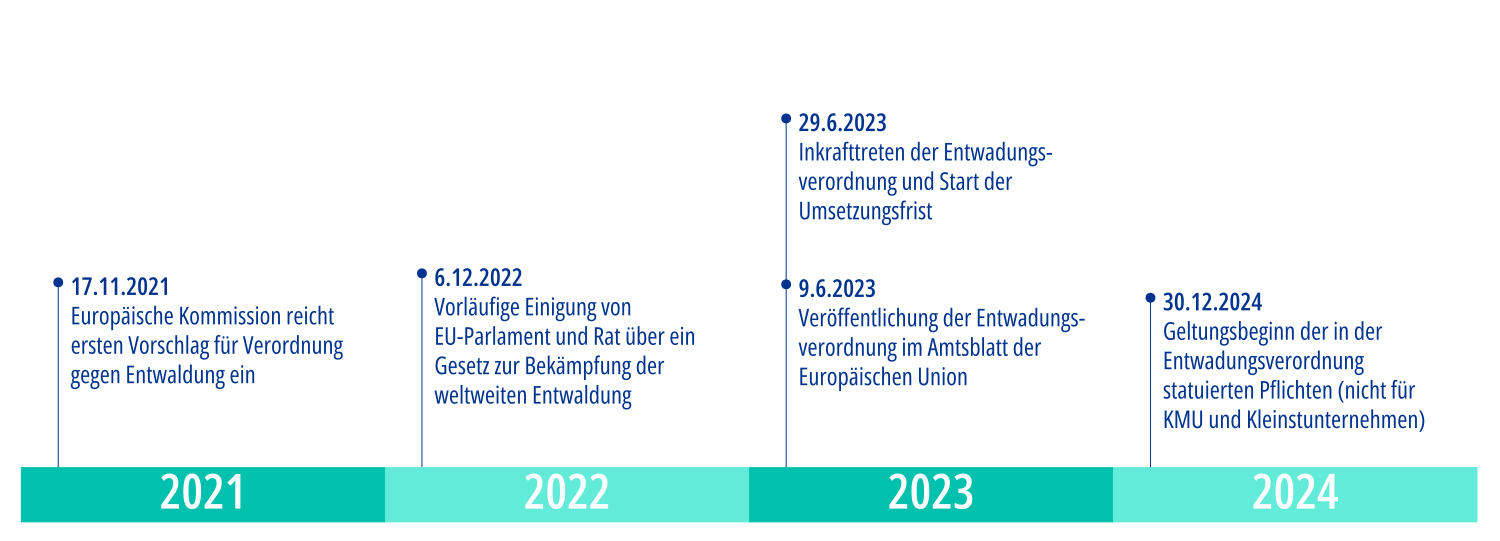
The obligations of this ordinance must be implemented no later than 18 months after entry into force.
The EUDR in detail
The regulation concerns
- Operators (natural and legal persons) who sell relevant products commercially in the EU or export them from the EU, and
- Dealers who provide these products in the supply chain.
The application of the obligations is independent of the legal form and size of the persons.
Limited obligations and longer implementation deadlines apply to SMEs and micro-enterprises.
The regulation prohibits the trade and marketing of raw materials and products such as cattle, cocoa, coffee, oil palm, rubber, soya and wood in the EU unless they fulfil the following conditions:
- Deforestation-free since 2020
- Compliance with the legislation of the country of origin
- Existence of a declaration of due diligence
The implementation takes place through the fulfilment of three consecutive steps:

Mit Steuerthemen den Wandel gestalten
Wie Steuern die Nachhaltigkeit unterstützen können
Companies are also subject to a reporting obligation. The compliance regulations must be reviewed and updated annually. Companies that are not categorised as SMEs are obliged to publicly report on their due diligence regulations, including risk assessments and measures taken. All relevant documentation must be kept for a period of five years and submitted to the authorities if required.
Despite coming into force at the end of December 2024, companies must provide retroactive proof that their raw materials are deforestation-free by 31 December 2020.
Sanctions
The regulation provides for clear sanctions for offences, including profit skimming and fines of up to 4% of annual turnover. The confiscation of the resulting products and the revenue generated from them as well as a temporary ban on the import of raw materials into the EU are also possible. In addition, the company may be temporarily excluded from the award of public contracts in the event of violations.
The challenges
The new regulations present companies with a variety of challenges.
- The procurement of raw materials could become more complex and costly due to the increased demands on suppliers.
- The cost structure and margins of end products could become more opaque due to the increased stock-keeping unit complexity.
- Companies are required to develop adaptable plans and due diligence procedures to identify products and raw materials with a high environmental impact and to adapt to regular regulatory changes.
- It is essential to review the supplier base and revise the supplier code of conduct to align company policies with the impact of the new regulation. Key technologies such as satellite imagery and the selection of suitable partners are fundamental to fact-based traceability.
- Supplier audits are becoming increasingly important. This also includes the use of satellite images to provide evidence for several suppliers or scattered production sites.
Our solution for you
KPMG's Sustainability, Procurement & Supply Chain and Risk & Regulation teams are here to help you navigate the challenges of the EUDR. Our experts will help you understand the potential impact and prepare for it. Together, we develop customised strategies and roadmaps to take targeted action, identify partners and leverage technology to increase the transparency and traceability of your company's goods.
___________________________________
1 ca9825en.pdf (fao.org)
More KPMG insights for you


Your contacts


Julia Kristin Ruf
Partnerin, Deals & Performance, Enterprise Performance
KPMG AG Wirtschaftsprüfungsgesellschaft
- Item 1
- Item 2