Technological developments, geopolitical tensions and ecological challenges are fundamentally changing the framework conditions for international cooperation. This is creating new requirements for global mobility, labour models and talent strategies.

      What will our working world look like in the future? What impact will geopolitical fragmentation have on global cooperation? And will we still be travelling ourselves in 15 years' time or will we be sending our avatars?

      Together with the School of International Business and Entrepreneurship (SIBE) and experts from business and science, we have ventured to look 15 years ahead.

      The aim of the study is to use futurology methods to analyse different visions of the future and support companies in the further development of their global mobility strategies.
      What you can expect from the study

      • Methods of futurology and their benefits for global mobility strategies.
      • Assessments from HR management, business and science on international cooperation up to 2040.
      • Concrete derivations for global mobility teams and prioritised fields of action.

      Download

      Global Mobility 2040 – Zukunft gestalten, Chancen nutzen

      Szenarien für die Zukunft der internationalen Zusammenarbeit sowie Empfehlungen für resiliente  Mobilitätsstrategien 

      Perspectives on global mobility until 2040

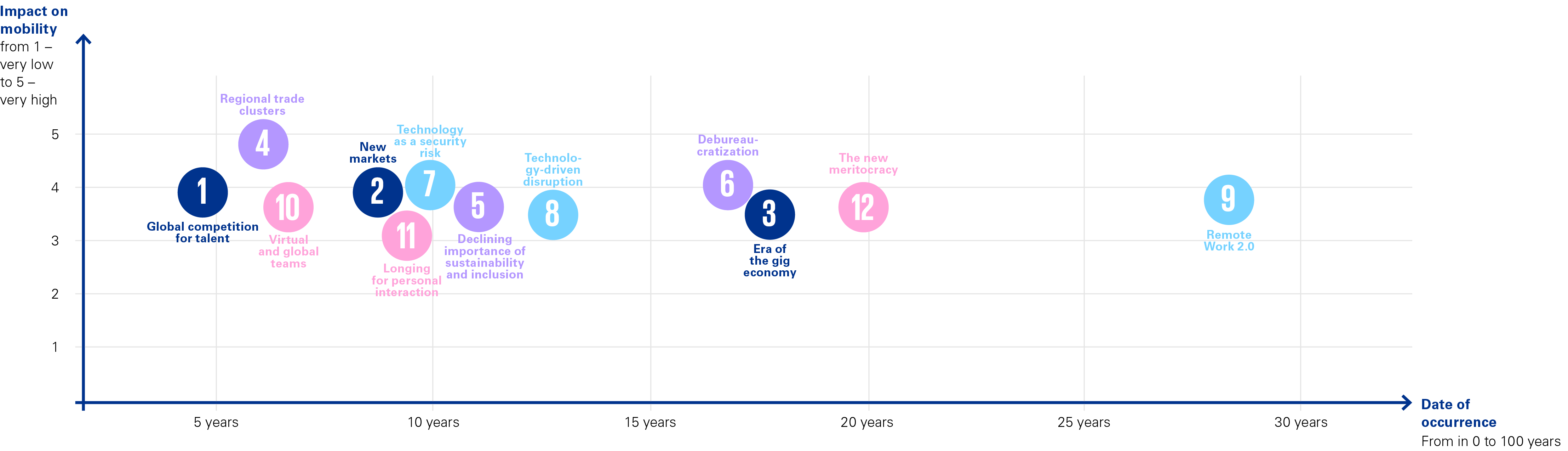
      As part of a Delphi survey, 27 experts assessed twelve key future projections - including their expected time of occurrence (from 0 to 100 years) and their impact on global mobility (from 1 - very low to 5 - very high).

      The following overview visualises the results along a timeline:

      Global Mobility 2040

      Global Mobility 2040Plus

      Vier Szenarien

      Four future scenarios that rethink global mobility

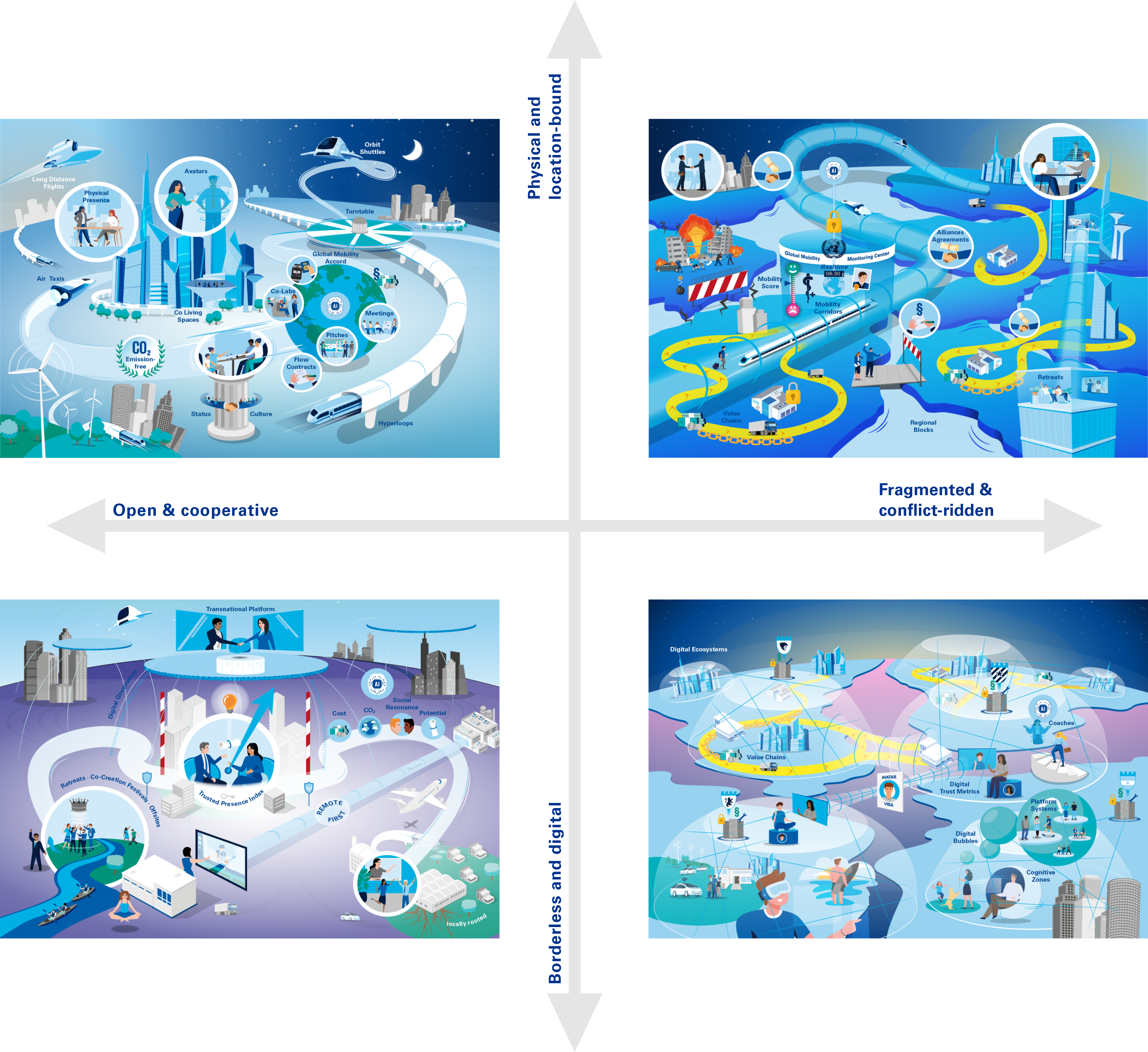
      Four alternative visions of the future were developed on the basis of a scenario analysis. Along the axes of "geopolitical order" (from fragmented to cooperative) and "virtuality of work" (from localised to unbounded), they open up new and sometimes challenging possibilities for 2040. The scenarios show how mobility can be shaped under changed framework conditions and help us to question routines and rethink options.

      • Scenario 1: Global Flow - Mobility as a lived presence

        2040: Global mobility is ubiquitous, spontaneous and culturally anchored. Physical presence is seen as a sign of commitment, influence and belonging - it is no longer a duty, but added value.

      • Scenario 2: Borderless collaboration - trust beats distance

        2040: Less, but targeted mobility. Digital collaboration is the norm, physical proximity becomes a consciously utilised relationship capital.

      • Scenario 3: Geopolitical Flux - Physical trust spaces

        2040: Mobility is selective and security-critical. Anyone who travels does so in a planned, legitimised manner and with a clear mission - in an environment of geopolitical fragmentation.

      • Scenario 4: Digital island worlds - the era of co-presence

        2040: Mobility is primarily virtual. People move between immersive system worlds - physical journeys are rare, risky and culturally decoupled.

      What can be deduced from the results today

      Future developments cannot be clearly predicted. It will therefore be crucial for Global Mobility to clearly define its own role within the company and systematically develop its contribution to the corporate strategy. The study shows key starting points for sharpening this mandate and integrating Global Mobility into strategic decision-making processes. The prerequisite for this is close coordination with relevant corporate divisions in order to recognise requirements at an early stage, make targeted use of potential and clearly define tasks.

      Possible fields of action for global mobility

      The following opportunities for Global Mobility can already be derived from the study:

      Enabler of skills and talent: Global Mobility can develop into a strategic partner for global HR planning. Possible fields of action include the identification of international talent hubs, transparency regarding skills and projects and the targeted use of AI-supported talent marketplaces. Close collaboration with HR, Talent Management and Recruiting supports these opportunities.

      Flexible working models such as work from anywhere, targeted talent programmes, family-friendly offers and standards for sustainability and diversity can help to attract and retain employees in the long term.

      Global Mobility can provide support in opening up new markets, for example in analysing markets, building up local talent pools, securing the necessary infrastructure and taking legal framework conditions into account.

      New technologies, social changes and fragmented working models open up opportunities for flexible forms of deployment. Global mobility can help to define when physical presence is necessary and when hybrid or digital formats might be sufficient.

      Changes in regulation, safety and sustainability can lead to Global Mobility taking a central role in implementing care and safety measures and sustainable practices throughout the mobility cycle.

      Global Mobility 2040Plus: A look into the future

      Strategic foresight is a scientifically based approach that helps companies to think systematically about possible future developments. The aim is not to predict the future, but to identify alternative scenarios and trends. This enables companies to prepare their global mobility strategies and make strategic decisions more robust. Typical methods include trend scanning, Delphi surveys and scenario analyses.

      The study is based on a three-stage foresight process. In phase 1, existing studies were analysed and 20 experts from various specialist areas were interviewed. In phase 2, twelve future projections were developed, which were validated in a Delphi survey with 27 experts from business and science. In addition, four alternative scenarios for global mobility in 2040 were developed. In phase 3, the results were translated into concrete opportunities and recommendations for action for companies.

      Experts consider the following developments to be particularly relevant: the intensification of global competition for talent, increasing geopolitical fragmentation, which could lead to the formation of regional action clusters, and the virtualisation of work through new technologies. Collaboration and digitalisation technologies promote location-independent working and the formation of global, virtual teams, while physical travel and personal encounters could gain new significance.

      The Global Mobility 2040Plus study describes four future scenarios for 2040 along the axes of "geopolitical order" (from fragmented to cooperative) and "virtuality of work" (from localised to borderless): Global Flow, Borderless Collaboration, Geopolitical Flux and Digital Island Worlds. The scenarios illustrate how different framework conditions can affect international mobility, global talent flows and the role of the global mobility function.

      Companies can use futurology to review and validate their strategies. Although the future cannot be predicted exactly, opportunities and risks can be identified by systematically analysing scenarios and trends. An in-depth examination of futurology in the field of global mobility makes it possible to make company-specific deductions, create a concrete opportunity radar and continuously prioritise trends, opportunities and challenges - as a basis for resilient and future-proof global mobility strategies.

      KPMG insights

      AI & Digital transformation

      We combine five key factors to navigate through the complexity and successfully shape your digital future
      Chip

      Your contact


      * Die Rechtsdienstleistungen werden durch die KPMG Law Rechtsanwaltsgesellschaft mbH erbracht.