
Divestments - and therefore also corporate demergers and carve-outs - are an integral part of corporate strategies, particularly in connection with strategic alignment and growth. In the event of major industry-related disruptions or entry into new business areas, a fundamental portfolio reorganisation is required to prioritise future investments, strengthen balance sheets and generate additional funds from IPOs, spin-offs and divestments of non-core business activities.
Deal scenarios
Sellers must take into account the characteristics of potential buyers, especially those characteristics that differentiate financial investors from the capital market (in the case of an IPO) and strategic investors. Financial investors generally require a completely independent transaction perimeter, for example in the case of a spin-off or IPO, which fulfils the requirements for public reporting and stock exchange listing.
In the case of a potential divestment, a distinction is made between three approaches, each of which requires financial, tax and operational carve-out measures as a preparatory phase.
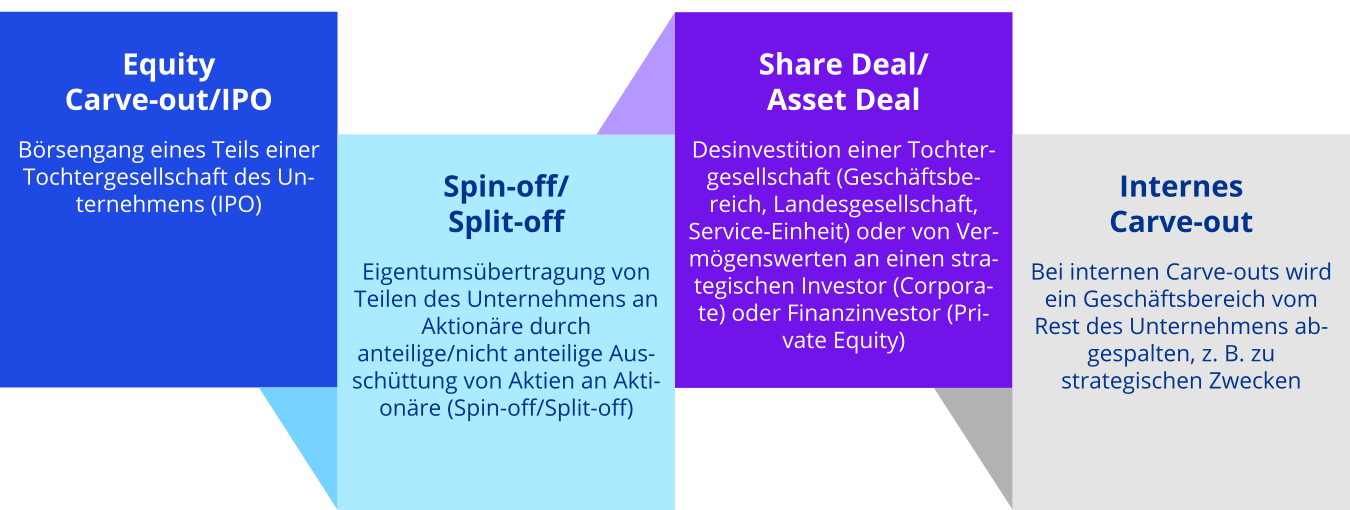
Strategic investors often view acquisitions as complementary to existing businesses and therefore seek to integrate the core assets of the transaction perimeter, while not necessarily being interested in the general and support activities of the assets sold. They are interested in either asset deals or carve-outs with supporting temporary transitional service agreements to ensure business continuity until the acquired part of the business is fully integrated into the buyer's organisation or into a yet-to-be-defined joint venture organisation.
Carve-outs can also be carried out for internal purposes, for example in the case of strategic decisions to restructure a company or to optimise business activities. In these cases, the same level of analysis and planning is required as for a deal-related carve-out. The main difference is that the seller is not looking for a buyer for the asset, but simply wants to separate it from the rest of the company.
Our carve-out approach
In every divestment scenario, the motives (deal rationale) of the seller and the potential buyer must be fully understood. In most cases, sellers overestimate the achievable purchase price and have no clear idea of the costs that would be incurred if the business unit to be sold were to be continued (hold case).
The continuation of mature business units can lead to considerable restructuring and liquidation costs, which often exceed even a low purchase price for the asset. The willingness of the potential group of buyers to purchase the asset depends to a large extent on the value it offers to a potential "best owner". If no strategic investor is available, the financial investors determine the purchase price based on the expected value creation potential compared to the current owner.
Carve-out process
Prior to any divestment decision, we recommend that our clients adopt a strict value-based portfolio approach by formulating a clear portfolio strategy or revising the existing one and optimising their business portfolio accordingly. Both quantitative and qualitative considerations are taken into account, with a particular focus on the trade-off between risk and performance. You should now be in a position to make an informed decision and nothing stands in the way of initiating your carve-out process. This is divided into three phases and usually takes place over a period of 12 to 18 months.
Weitere interessante Inhalte zum Thema


Your contact

Dr. Florian Jung
Partner, Performance & Strategy, Integration & Separation
KPMG AG Wirtschaftsprüfungsgesellschaft


Dr. Jesco Willms
Partner, Performance & Strategy, Head of Integration & Separation
KPMG AG Wirtschaftsprüfungsgesellschaft
- Item 1
- Item 2
- Item 3
Frequently asked questions
A carve-out refers to the separation of a business unit, shareholding or asset from an existing organisation. The aim may be a sale, a spin-off, an initial public offering (IPO) or an internal portfolio restructuring.
A carve-out is appropriate when companies wish to align their portfolio more closely with their core business, free up capital or divest non-strategic business units. A carve-out may also be necessary during restructuring or in preparation for a sale.
A carve-out process typically comprises a transparency phase, a planning phase and an implementation phase. During this process, interdependencies, financial information, IT systems, HR issues and transitional service agreements, amongst other things, are analysed and prepared.
Challenges often arise from complex group interdependencies, incomplete data, IT dependencies, customer and supplier relationships, and issues relating to business continuity. Early planning helps to reduce risks during the sale or separation process.
KPMG supports companies in the analysis, planning and implementation of carve-outs. This includes portfolio valuation, deal preparation, operational separation, due diligence, programme management and support right through to the cut-over.