

- For the first time in history, most people can expect to live beyond 70 years. However, the gap between life expectancy and healthy life expectancy has widened globally from 8.7 years in 2000 to 9.6 years in 2019. This indicates that people are experiencing more years in poor health or with chronic conditions, requiring targeted interventions.
- Society should invest in healthy aging by creating supportive environments that enable individuals to pursue what they value and maintain wellbeing throughout their lives. Integrating gender perspectives in promoting healthy aging is crucial, as lifelong inequities leave women particularly vulnerable in older ages and facing unique challenges. For example, in Japan, women experience a 12-year gap between healthspan and lifespan, are 26 times more likely to develop dementia, and 2.2 times more likely to need long-term care.
- Innovative technologies, such as of using AI, IoT, robotics, and VR/AR, offer significant promise for enhancing older adults’ health, independent living, and wellbeing across all capacity phases, while also supporting their families and optimizing healthcare and long-term care systems.
- Advancing equitable access to ethical solutions necessitates multisectoral collaboration across various stakeholders, including governmental bodies, businesses, private foundations, NGOs, and service providers. Promoting anti-ageism approaches is the key, including co-development with older adults, fair data representation, and inclusive design. It is essential to implement supportive policies and invest in infrastructure to bridge the digital divide.
- In super-aging countries like Japan, successful initiatives have demonstrated the potential of technological innovations to enhance healthy aging. Future efforts should focus on a life-course approach by deploying digital solutions for health promotion and preventive care from an early age, while addressing social determinants of health throughout the lifespan.
Connect with us
Introduction
The global population is aging, but longer lives are not always healthier ones. A growing gap between life span and health span —underscores the urgent need to ensure that added years are lived with dignity, autonomy, and well-being.
In response, the Decade of Healthy Aging was launched in alignment with the Sustainable Development Goals (SDGs) to drive coordinated action for older adults’ well-being. Yet, shifting political landscapes have weakened efforts to address health disparities, and many policies still fall short of meeting the needs of marginalized older populations.
Given these challenges, promoting healthy aging for all is a critical and immediate priority that demands cross-sector collaboration. Digital technologies offer transformative potential to meet this challenge: expanding access to care, enhancing service quality, supporting caregivers, and improving system efficiency. The KPMG Healthcare and Well-being Team (HC&WB), however, believes that without an intentional focus on equity, digital innovations risk reinforcing ageism and other systemic biases in design and delivery, excluding underserved older adults from access and participation, and consequently widening disparities in health outcomes and digital inclusion.
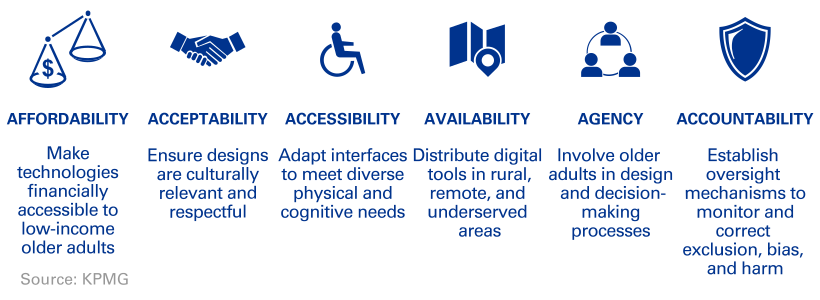
To guide equitable digital health innovation, HC&WB identified the 6 A’s—six strategic drivers for embedding equity into technology design and implementation:
- Affordability: Make technologies financially accessible to older adults, especially those with limited income.
- Acceptability: Ensure cultural relevance and respect in design and delivery.
- Accessibility: Adapt interfaces to meet diverse physical, sensory, and cognitive needs.
- Availability: Expand the reach of digital tools to underserved and remote areas.
- Agency: Involve older adults, particularly from marginalized communities, in design and decision-making processes.
- Accountability: Establish oversight mechanisms to prevent exclusion, bias, and harm.
The 6A’s: six drivers for equitable digital innovation for healthy aging
Contents
- Healthy aging requires targeted interventions
- Equity must be at the heart of healthy aging
- Innovation can advance healthy aging for all
- Digital health must include every older adult
- The 6 A’s guide innovation for all older adults
- Equitable tech demands collective action
- Let’s build a future of equitable healthy aging
Please access the link below for the full report.
Advancing Healthy Aging Through Equitable Tech: Six Strategic Drivers
Authors
KPMG AZSA LLC Healthcare & Well-being (HC&WB)
Michikazu Koshiba
Director– Healthcare & Well-being
Ritsuko Yamagata
Senior Manager
Miho Funatsu
Senior Associate
Tomomi Tose
Associate