

      The report takes cues from the recovery and reconstruction efforts carried out in other war-torn economies such as Syria, Kosovo, Iraq, Croatia, and Kuwait and offers a robust analytical underpinning for a thorough financial and operational strategy and keen to help Ukraine's early recovery and long-term reconstruction.



      post-war-reconstruction-of-economy

      Post-war Reconstruction of Economy

      Case Studies


      "Ukraine must balance and prioritize needs and investments, explore financing options, develop standard systems and procedures to maximum efficiency, ensure the growth of the managerial and technical capacity of implementation units, raise funds for project preparation and create financial strategies for various economic sectors. On other hand, the scale of destruction and financial needs for reconstruction will require a comprehensive and complex coordination mechanism between different actors (IFIs, countries and alliances) that is still in development process. When prepared, all these efforts will truly catapult Ukraine on a path of inclusive, accountable, and sustainable reconstruction and recovery".

      Dmytro Romanovych
      Director, Sustainability and ESG, Head of Government Relations and International Development Assistance Services
      KPMG in Ukraine


      Dmytro Romanovych

      Director, Sustainability and ESG, Head of Government Relations and International Development Assistance Services

      KPMG in Ukraine


      The war disrupted global production and trade of commodities across multiple sectors. The war is estimated to have impacted more than 600,000 businesses globally and could slow down the global economic growth by 0.8 percent by the end of 2022 as compared to 2021. The global economy was impacted due to disruptions in production capabilities of both the countries and global supply chains which in turn created a scenario of global inflation.


      Impact on global productions

      • Due to the war, manufacturers across multiple sectors halted operations in Ukraine as well as Russia
      • For instance, automobile manufacturer, Volkswagen, suspended operations in Russia, while automobile parts manufacturer, Sumitomo, shifted production from Ukraine to Romania and Morocco.

      Disruption of global supply chains

      • Blocking of Ukraine's Black Sea ports and diversion of cargo ships away from Ukrainian ports resulted in supply chain disruptions
      • As a result, raw material supplies to car manufacturers all over the world were disrupted
      • Fertiliser supplies were also majorly impacted

      Rise in commodity prices and inflation

      • The war made the biggest impact to commodity markets in nearly 50 years in countries where Ukraine and Russia used to be the major exporters
      • With an increase of 154.5 percent, fertiliser prices witnessed the highest increase amongst all the commodities between January-March 2022
      • Prices of coal also shot up by 74.7 percent


      US$252 billion


      • The value of total damages and losses due to the war is estimated to be US$252 billion
      • It is further estimated that reconstruction and rebuilding cost could amount to be more than US$349 billion


      US$127 billion


      • The damages due to destruction of residential and non-residential buildings as of September 2022 is US$127 billion
      • Between June and August, the war caused damages worth US$31.5 billion 


      4.8 million


      • Total number of jobs lost in Ukraine since February is 4.8 million 
      • In the event of the war continuing, even more citizens could lose their jobs and millions could be pushed into poverty, which could counteract the country’s development efforts


      Ukraine may follow a similar damage assessment methodology as other war-torn countries followed in the past
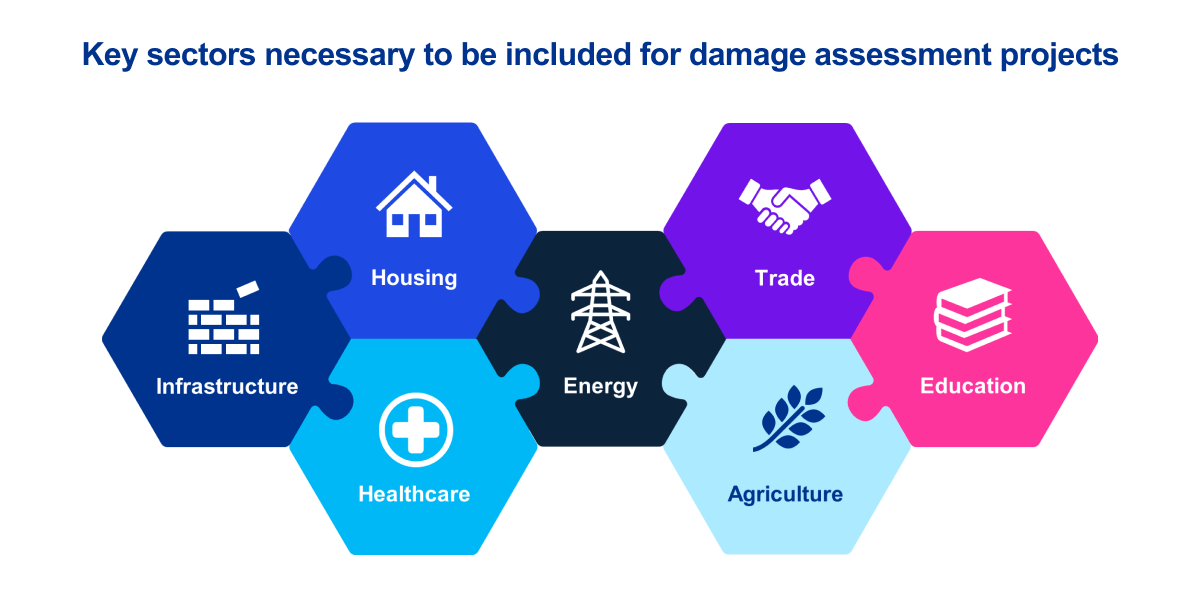
      • Identification of priority sectors
        • Priority economic sectors identified based on the population impacted, factors of production (labor, capital, raw materials and the market for management or entrepreneurial resources), manufacturing capabilities, manufacturing capabilities, exports, imports, contribution to GDP etc.
      • Assessment of damages and losses
        • Assessment of damages and loses across the identified sectors
        • The losses take into consideration the changes in economic flows into the priority sectors owing to the war
      • Estimation of damages, loses and qualitative impacts
        • Each sector specified recovery needs are established which includes the cost of reconstruction of the destroyed assets


      Contact us

      Dmytro Romanovych

      Director, Sustainability and ESG, Head of Government Relations and International Development Assistance Services

      KPMG in Ukraine

      Olena Makarenko

      Partner, Risk Consulting and ESG, Head of Impact Committee, KPMG Insight Academy Leader

      KPMG in Ukraine

      Developing responsible and sustainable strategies, business and operating models, and investments.