

On 19 November, the European Central Bank (ECB) published its new SSM Supervisory Priorities for 2027-2029. This follows established ECB practice of issuing updated priorities each year for the coming three years. The new priorities are based on the ECB’s assessment of the principal risks facing euro area banks and take account of the results of the 2026 Supervisory Review and Evaluation Process (SREP), published in parallel. (See our analysis of the 2026 SREP results here.)
Banks are resilient, but risks remain
As in previous years, the priorities begin with an overall assessment of the European banking sector. The ECB finds banks to be resilient: capital and liquidity buffers are robust, asset quality is stable and profitability solid. This is despite significant economic headwinds from a challenging geopolitical environment.
Nonetheless, the ECB warns of growing challenges facing the European economy and banking system. The geopolitical environment remains highly uncertain. Geopolitical shocks can impact on banks only after some time, depending on exactly how they filter through the various transmission channels to affect the economy, financial markets and individual banks. Similarly, the effects of increasing climate- and nature-related risks may take time to materialize. Meanwhile, high public debt levels could restrict governments’ capacity to cushion the impact of future shock on businesses and households. The ECB therefore emphasized the need for banks to maintain sufficient capital and liquidity buffers to ensure they can absorb future shocks, along with robust internal governance and prudent risk management.
The ECB also highlighted the more challenging operational risk environment in which banks must now function. The development of artificial intelligence (AI)-enabled hacking tools has intensified the risk of cyber attack. Meanwhile European banks’ growing use of cloud and AI services increases their dependencies on a small number of critical third-party IT providers, many based outside the EU. In this environment, the ECB calls on banks to remain agile in tackling these challenges, while ensuring the continuity of critical services and compliance with regulatory requirements including the EU Digital Operational Resilience Act (DORA).
Supervisory priorities
Against this background, the ECB set out two strategic priorities for 2027-2029. In line with previous years, each addresses a set of prioritised vulnerabilities identified by supervisors. These are summarized in the diagram below:
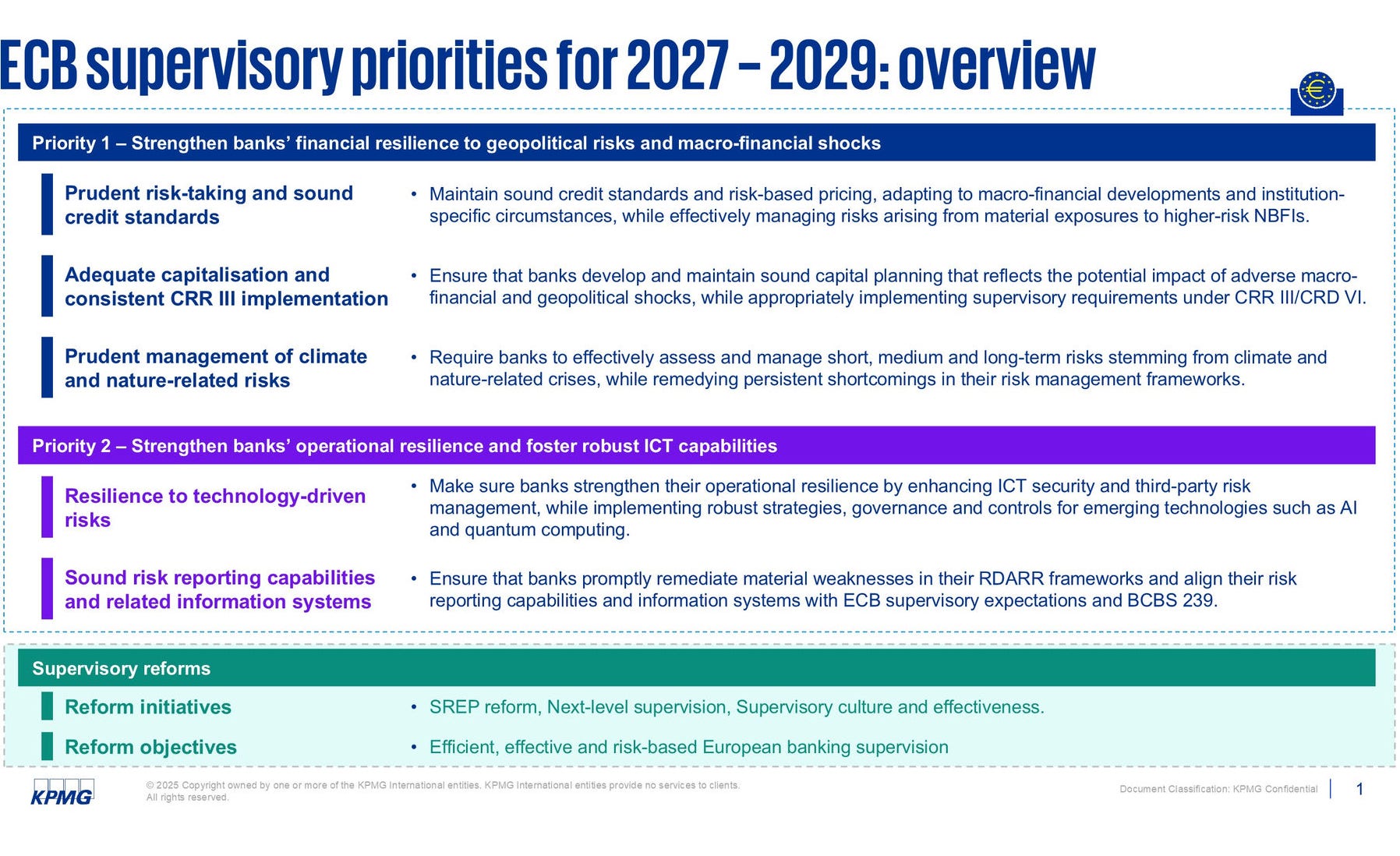
The latest priorities are broadly similar to those from last year. Geopolitical risk and operational resilience remain key themes. The conflict in the Middle East, and rapid advances in AI over the past twelve months, have only intensified the ECB’s focus on these issues.
Within financial resilience, credit risk will remain a priority issue. The ECB will launch a campaign of on-site inspections of banks’ credit underwriting and loan pricing, following up on its 2026 thematic review of underwriting. Supervisors will also probe banks’ exposures to non-bank financial institutions (NBFIs), after last year’s surge in redemption requests from various private market funds. In parallel, the ECB will continue its scrutiny of banks’ implementation of CRR III, with targeted reviews of risk-weighted asset calculations, operational risk capital calculations, and synthetic risk transfer securitisations. The ECB will also continue work on banks’ management of climate- and nature-related risks, with a thematic review and targeted OSIs on prudential transition plans and a deep dive into banks’ physical risk capabilities.
Under operational resilience, cyber security and ICT risk remain central themes. The ECB will launch two OSI campaigns on cyber security and third-party risk management, alongside targeted reviews of banks’ cloud service provider dependencies and ICT change management, and will conduct threat-led penetration tests, in line with DORA requirements. This will be supported by a system-wide strategy on remediation of outstanding ICT risk findings, to ensure persistent deficiencies are addressed. Building on the ECB’s 2026 work to understand banks’ use of AI, supervisors will conduct pilot off- and on-site reviews of banks’ AI use-cases, governance and risk management. And as a new theme, the ECB will examine banks’ readiness for quantum computing, with a survey of preparations for post-quantum cryptography. Finally, the ECB will continue with its RDARR remediation strategy, backed up with targeted RDARR OSIs, to ensure long-standing shortcomings are effectively addressed.
Implications for banks
ECB supervisory activities will thus affect virtually all areas of banks’ operations in the year ahead. KPMG set out our main recommendations for banks on each area of priority and vulnerability that the ECB has identified.
Priority 1: Banks should strengthen their financial resilience to geopolitical risks and macro-financial shocks
- Continue to ensure that geopolitical risks are fully embedded in risk-identification processes, risk-appetite frameworks and internal (ad hoc) scenario analyses and stress testing
- Review credit underwriting and loan pricing frameworks, taking account of feedback from the ECB’s 2026 thematic review were appropriate
- Prepare for OSIs on exposures and links to NBFIs, including funding, brokerage and asset-based lending
- Evaluate RWA calculations and their compliance with CRR III requirements
- Prepare for ECB targeted review operational risk capital requirement calculation under CRR III
- Continue integrating climate- and nature-related risks into their risk management frameworks
- Prepare for ECB scrutiny of prudential transition plans developed in line with CRD VI requirements, including targeted OSIs on transition plans
- Enhance integration of physical risk into wider risk frameworks, and prepare for deep dives into physical risk and potential OSIs on water-related risk integration
Priority 2: Banks should strengthen their operational resilience and foster robust ICT capabilities
- Continue to ensure full DORA compliance, with particular focus on third-party risk management and dependencies on cloud providers
- Prepare for third-party risk management OSIs, targeted review of cloud dependencies and threat-led penetration tests in line with DORA requirements
- Enhance cyber security frameworks to ensure effective controls, detection capabilities and incident management systems, and to address previous supervisory findings
- Review AI governance and risk management frameworks and ensure these are fully documented in anticipation of potential ECB scrutiny
- Prepare for ECB survey of quantum computing readiness and scrutiny of plans for migration to post-quantum cryptography
- Refresh and continue executing RDARR remediation plans and prepare for targeted OSIs assessing progress against ECB RDARR expectations
As in previous years, the ECB emphasizes its readiness to use its full supervisory toolkit – including administrative penalties – to ensure that supervisory findings are addressed effectively and in a timely manner.
KPMG advises banks to analyse the priorities closely, identify areas of greatest challenge (and where forthcoming supervisory activities have already been communicated in supervisory examination plans) and develop action plans in advance. KPMG professionals stand ready to advise and support banks responding to supervisory requirements and in the wider evolution of their business.

