With the European Forum on Pension Communication convening in Brussels on 28 September 2026,1 cross-border pension visibility is back at the top of the EU agenda.

      The upcoming forum builds directly on the 20 November 2025 supplementary pension package2 under the Savings and Investment Union,3 including Commission Recommendation 2025/2384/EU, which urges every member state to build and upgrade a national pension tracking system and connect it to the European Tracking Service (ETS) on Pensions.4

      Europe is about to make it far easier for mobile workers to find pensions across borders, but divergent and rising retirement ages mean that visibility is not the same as simplicity.


      WHY THIS MATTERS

      For the first time, mobile workers will be able to see the pensions they have built up across different member states in one place.

      The ETS, now backed by a formal EU recommendation urging every country to connect a national tracking system, turns scattered, hard-to-find pension information into a single, accessible overview via FindyourPension.eu.

      The transparency makes it far easier to locate providers and see where someone's pensions sit. But coverage is still being rolled out country by country and pillar by pillar, so the tracker is best treated as a starting point for planning, not a complete picture, and, crucially, a gap in the data does not mean a gap in what someone is owed.


      What the ETS Is and Why It Exists

      Pensions are organised nationally, but careers increasingly are not. Around 10 million EU citizens live in another member state and roughly 2 million are cross-border workers.5

      The result is that people who move for work end up with pension rights scattered across several countries, systems, and languages, and often lose track of them. The ETS exists to solve exactly that: to help mobile workers find, understand, and act on the pensions they have built up anywhere in Europe, working to its motto "find, inform, activate."6

      It delivers this through FindyourPension.eu, using two tools: a Pension Compass to locate providers and a Pension Tracker to view the pension a person has built up, via secure personal digital login.

      Where It Is Going

      The ETS is now firmly in its rollout phase, backed by a €4.7m EU grant to connect as many national tracking systems as possible over five years.7

      Belgium was connected first as proof of concept, France went live in February 2025, and the Netherlands is next in line, with Germany, Sweden, and Denmark among those set to follow.

      The direction of travel, reinforced by the November 2025 EU recommendation urging every member state to plug in, is a genuinely pan-European overview, expanding country by country.

      Country Connection Status

      Country

      Tracking body

      Status on Find Your Pension

      Pillars covered

      Belgium

      Sigedis / Federal Pensions Service 

      Live — first connected (proof of concept) 

      Statutory + occupational (P1 + P2) 

      France

      Union Retraite 

      Live — connected Feb 2025 

      Statutory + supplementary (P1 + P2) 

      Netherlands

      Stichting Pensioenregister 

      Connection underway

      P1–P2–P3 (once live) 

      Germany

      DRV – Digitale Rentenübersicht 

      Member; targeted info available, connection pending 

      Statutory led 

      Sweden

      Minpension.se 

      Member; targeted info available, connection pending 

      Multi-pillar 

      Croatia

      Regos 

      Member 

      Statutory 

      The portal currently carries targeted pension information for five countries, with more to follow; “member” reflects ETS Association membership, which precedes full data connection. Pillar coverage varies and is indicative. The completeness caveat (“absence of data ≠ absence of entitlement”) applies.

      Divergent and Rising Retirement Ages

      The ETS is designed to help mobile workers find, inform, and activate. The first two functions are largely addressed: the tools locate providers and display the pension a person has built up. Acting on that information is a separate matter. The tracker is built around accrued entitlements, not eligibility. Where projections are shown, they follow each national system's own assumptions; there is no consolidated view of when rights become payable in each country.

      Statutory retirement age remains a national competence. Each member state sets its own pension age, its own conditions for early and deferred retirement, and, in a growing number of countries, its own mechanism linking the pension age to life expectancy. 

      A worker with rights in several countries may therefore reach eligibility at different ages in each of them, in some cases several years apart. Improved transparency addresses the difficulty of locating pension rights; it does not remove the divergence in eligibility ages, nor the upward trend in those ages across the EEA and Switzerland.

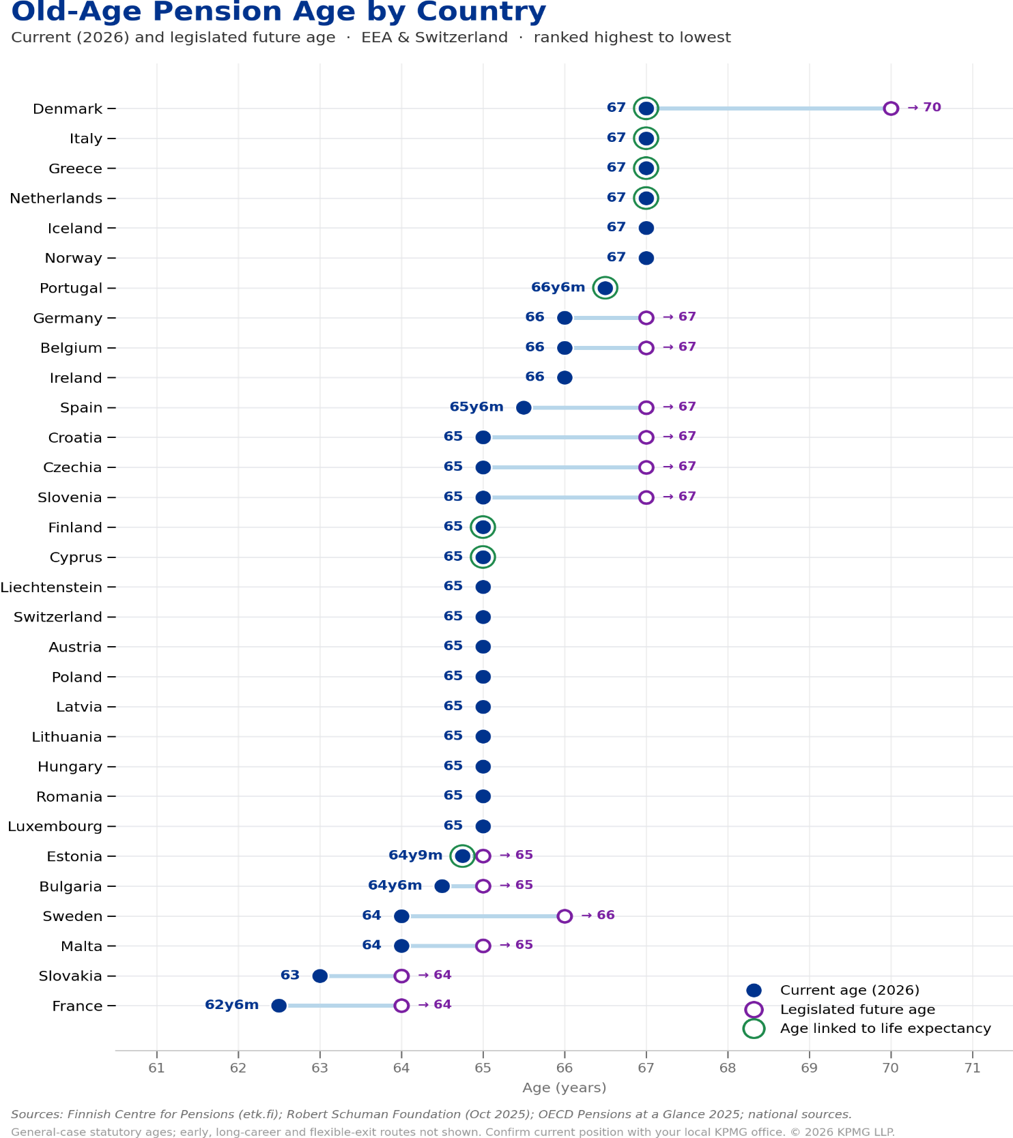
      The chart makes the point plainly: there is no single European retirement age, only a patchwork of national ones, spanning roughly from age 62 to a legislated 70, and most of them still rising. 

      • Most EEA states sit in a 65–67 band today, but the spread is wide, running from France at 62y6m to Denmark, legislated to reach 70 by 2040.
      • Nine systems now index the pension age to life expectancy, so the target keeps moving, and several are still equalising men’s and women’s ages.
      • Early, long-career and flexible-exit routes in Italy, France, Germany, the Nordics, Switzerland and Hungary (the “Women 40” scheme) add a further layer of case-by-case variation.
      • Under Regulation (EC) No 883/2004 for coordination of social security systems, each state pays its own slice at its own age, so one cross-border career can unlock entitlements years apart.

      KPMG INSIGHTS

      This is the most significant practical development in cross-border pensions in years, and it will only get stronger as the Netherlands, Germany, Sweden, and Denmark connect.

      Cross-border pension rights have always existed; what has never existed is a way to see them together in one place. The ETS changes that, and it changes it in the three places that have always been hardest: consolidation, overview, and access.

      • Consolidation. A career built in four countries has meant four registers, four languages, and four sets of credentials. One connected view replaces a search that most people never completed. 
      • Overview. Employees can finally see the whole picture at once instead of assembling it piece by piece, years after the mobility took place.
      • Access. Secure digital login turns pension data from something that had to be requested into something that can simply be opened, which is what makes the other two real. 

      ENDNOTES:

      1  ETS - European Tracking Service: European Forum on Pension Communication 2026.

      2  European Commission: Enhancing the capacity of the EU supplementary pension sector to improve retirement income and supply long-term capital to the EU economy, 20 November 2025.

      3  European Commission: Savings and investments union strategy to enhance financial opportunities for EU citizens and businesses, 19 March 2025.

      4  Official Journal of the European Union: Commission Recommendation (EU) 2025/2384 on pension tracking systems, pension dashboards and auto-enrolment, 20 November 2025.

      5  European Commission: Annual report on intra-EU labour mobility, 19 February 2026.

      6  ETS – European Tracking Service: About ETS, 2026.

      7  ETS- European Tracking Service: 05-2024 ETS Press Release, May 2024. 

      Contacts

      Daida Hadzic

      Director, Washington National Tax – Global Mobility Services

      KPMG in the U.S.

      More Information

      pdf

      Download PDF

      Download and save the PDF version of this GMS Flash Alert.

      GMS Flash Alert reports on recent global mobility-themed developments from around the world to help you better understand what has changed and what that means for you.


      GMS Flash Alert

      Shedding light on evolving policies affecting international assignees and employers, helping make sense of it all.

      alt
      Disclaimer

      The above information is not intended to be “written advice concerning one or more federal tax matters” subject to the requirements of section 10.37(a)(2) of Treasury Department Circular 230 as the content of this document is issued for general informational purposes only.

      The information contained in this newsletter was submitted by the KPMG International member firm in the United States.

      GMS Flash Alert is a Global Mobility Services publication of the KPMG LLP Washington National Tax practice. The KPMG name and logo are trademarks used under license by the independent member firms of the KPMG global organization. KPMG International Limited is a private English company limited by guarantee and does not provide services to clients. No member firm has any authority to obligate or bind KPMG International or any other member firm vis-à-vis third parties, nor does KPMG International have any such authority to obligate or bind any member firm. The information contained herein is of a general nature and is not intended to address the circumstances of any particular individual or entity. Although we endeavor to provide accurate and timely information, there can be no guarantee that such information is accurate as of the date it is received or that it will continue to be accurate in the future. No one should act on such information without appropriate professional advice after a thorough examination of the particular situation.

      © 2026 KPMG LLP, a Delaware limited liability partnership, and its subsidiaries are part of the KPMG global organization of independent member firms affiliated with KPMG International Limited, a private English company limited by guarantee. All rights reserved.