

Some companies have paid tariffs on US imports and may be entitled to a refund. For those that have not received a refund, uncertainty exists over whether and when they would receive it. For those that have, uncertainty may exist over whether they would need to return the amounts received.
The situation continues to evolve. Judgement is required to determine – at the reporting date – whether a refund will be received and can be kept. Clear and transparent disclosures focusing on company-specific uncertainties are critical to providing users of financial statements with relevant information.
An evolving landscape
In 2025, the International Emergency Economic Powers Act (IEEPA) introduced tariffs on some goods imported into the US. These tariffs were subsequently challenged, with the US Supreme Court ruling in February 2026 that IEEPA does not authorise the US President to impose tariffs. However, the Supreme Court did not address the refund of those tariffs. In March 2026, the US Court of International Trade (CIT) ordered the US government1 to refund all tariffs imposed under IEEPA.
Refunds are being processed on a phased basis2. During Phase 1, certain unliquidated entries and those within 80 days of liquidation are being processed. Other entries (e.g. those to be reconciled and finally liquidated entries), as well as more complex scenarios, will be processed in subsequent phases.
However, the government did not waive its right to appeal the CIT order to limit the scope of refunds. In May 2026, the government indicated its intent to appeal the CIT’s order requiring universal refunds and the ‘reliquidation’ of finally liquidated entries. The government then formally appealed in June 2026. As a result, there is ongoing uncertainty in relation to the appeal – e.g. which claims under the CIT order would be refunded.

Unprecedented uncertainty related to tariff refunds makes it challenging to determine when and how to reflect them in the financial statements. Careful assessment based on legal advice, together with clear and transparent
company-specific disclosures in financial reports, is key.
Applying contingent asset guidance
To determine whether and when to recognise a refund not yet received, a company applies the contingent assets3 guidance in IAS 37 Provisions, Contingent Liabilities and Contingent Assets on an entry-by-entry basis. An asset is only recognised if it is ‘virtually certain’ that a refund will be received.
A company performs a separate assessment of any outstanding liabilities for tariffs unpaid at the date of the Supreme Court decision.
Considering the uncertainty
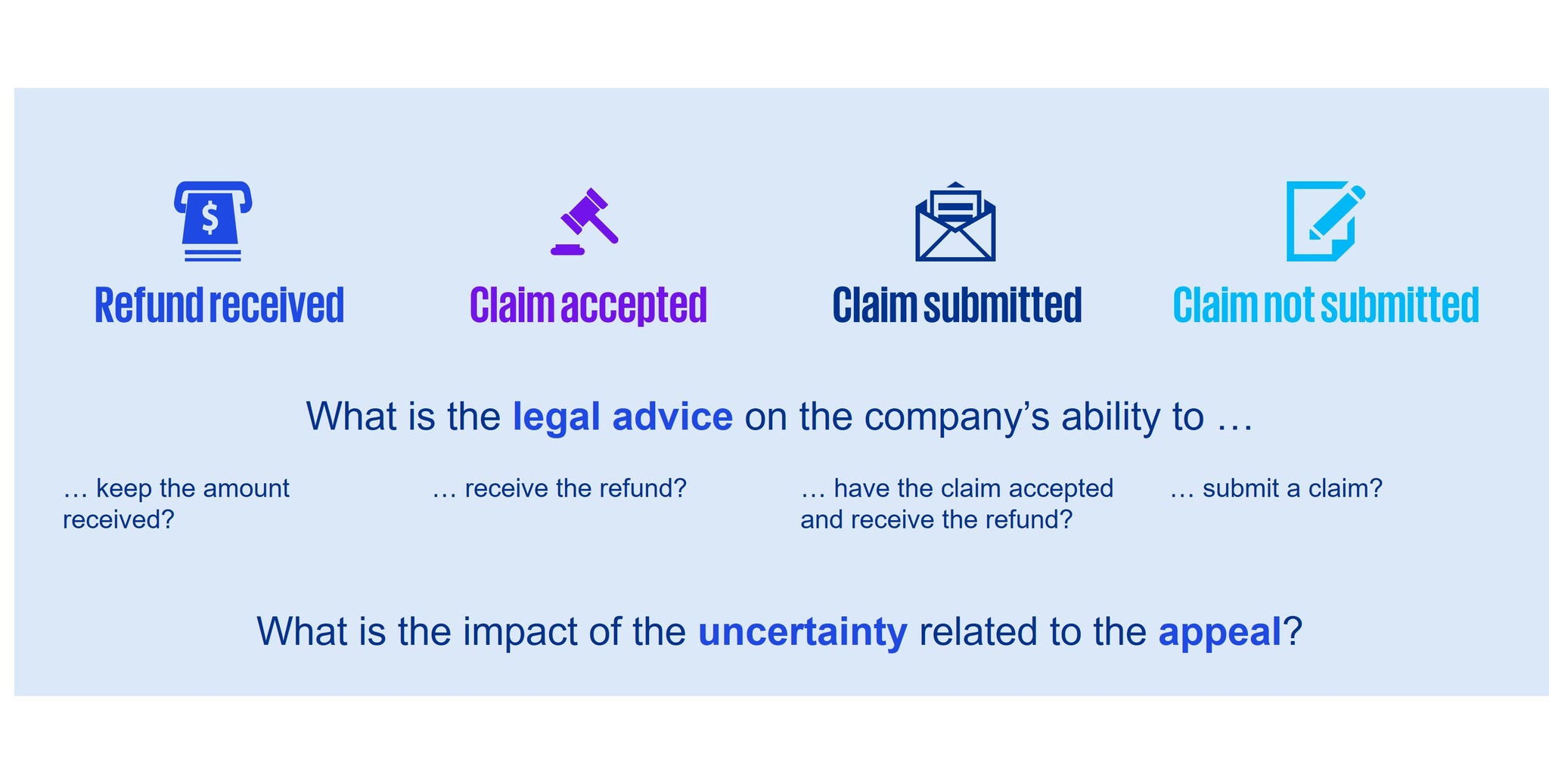
There is significant uncertainty related to tariff refunds and circumstances may change rapidly. A company needs to consider all relevant uncertainties that exist at the reporting date when determining the likelihood of receiving a refund or needing to return the amounts received. Legal advice may help to inform this assessment. If a company made multiple tariff payments, then it may need to perform this assessment separately for different populations of tariffs paid.
The level of uncertainty, including the potential impact of the appeal, may vary depending on which phase the company’s tariff entries are in or whether the company filed a complaint with the CIT. When it becomes virtually certain that a refund will be received, a company recognises the asset and related income4 in that period.
If a company has already received a refund, then it considers any uncertainty – e.g. related to the appeal – in determining how to reflect it in the financial statements.
The following questions will help you identify and assess uncertainties relevant to your company.
Telling a clear and company-specific story
In times of uncertainty, investors and regulators look for clarity in companies’ financial reports, including about refunds for tariffs. They want to understand how a company is affected, the uncertainties it faces, the specific judgements, estimates and assumptions management makes, and how these are reflected in the financial statements.
There is a requirement in IAS 37 to disclose information about a contingent asset if a related inflow of economic benefits is probable. Also, the IFRS® accounting standard related to presentation includes overarching requirements to provide additional information if it is relevant to users of the financial statements.
The appropriate level of disclosure about uncertainty over tariff refunds will depend on the company’s circumstances.
Other considerations
A company needs to consider other potential impacts on financial reporting, including the following.
- Revenue accounting: If a company passed on import tariffs to its customers, then it needs to consider the terms of its contracts with customers and any related ongoing negotiations, and assess the impact. For example:
- does the company have refund obligations to customers for tariff-related amounts, or will it choose to provide refunds voluntarily – e.g. by reducing prices on future purchases;
- does the arrangement impact a completed, an ongoing or a future contract; and
- do changes in tariff costs impact the measure of progress for revenue recognised over time?
- Financing arrangement: If a company sells its rights to future refunds, then it needs to consider whether the cash received from a third party for those rights is a financial liability.
- Presentation of refund income: Companies need to determine the appropriate line item in the statement of profit or loss in which to present the recovery of tariffs when they recognise a related asset.
1 In this article, the ‘government’ refers to the US administration.
2 For further information about the phased approach, see the US Customs and Border Protection (CBP) website.
3 A contingent asset is a possible asset that arises from past events and whose existence will be confirmed only by the occurrence or non-occurrence of one or more uncertain future events not wholly within the control of the company.
4 If the related imported asset is on hand, then the refund reduces the carrying amount of the asset.
© 2026 KPMG IFRG Limited, a UK company, limited by guarantee. All rights reserved.