


Each chapter sets out the trends that emerged from the interviews, the opportunities and challenges identified by participants, and the questions that boards and executive teams should be asking. Many findings will confirm what experienced bankers already suspect, others may challenge established assumptions. In both cases, the real value lies in how banks respond. Technology, and AI in particular, is moving so quickly that some specifics may date quickly. The conclusions, however, are strategic in nature, and we believe they will remain relevant well beyond the next technology cycle.
Banking in Africa has never been a single story. A bank in Dar es Salaam, Lagos, Port Louis or Johannesburg may offer similar products on similar platforms, yet each operates based on its own blend of regulation, macroeconomic conditions, geopolitics and customer behaviour. Driving growth in such complex and varied environments is as much an art as a science.
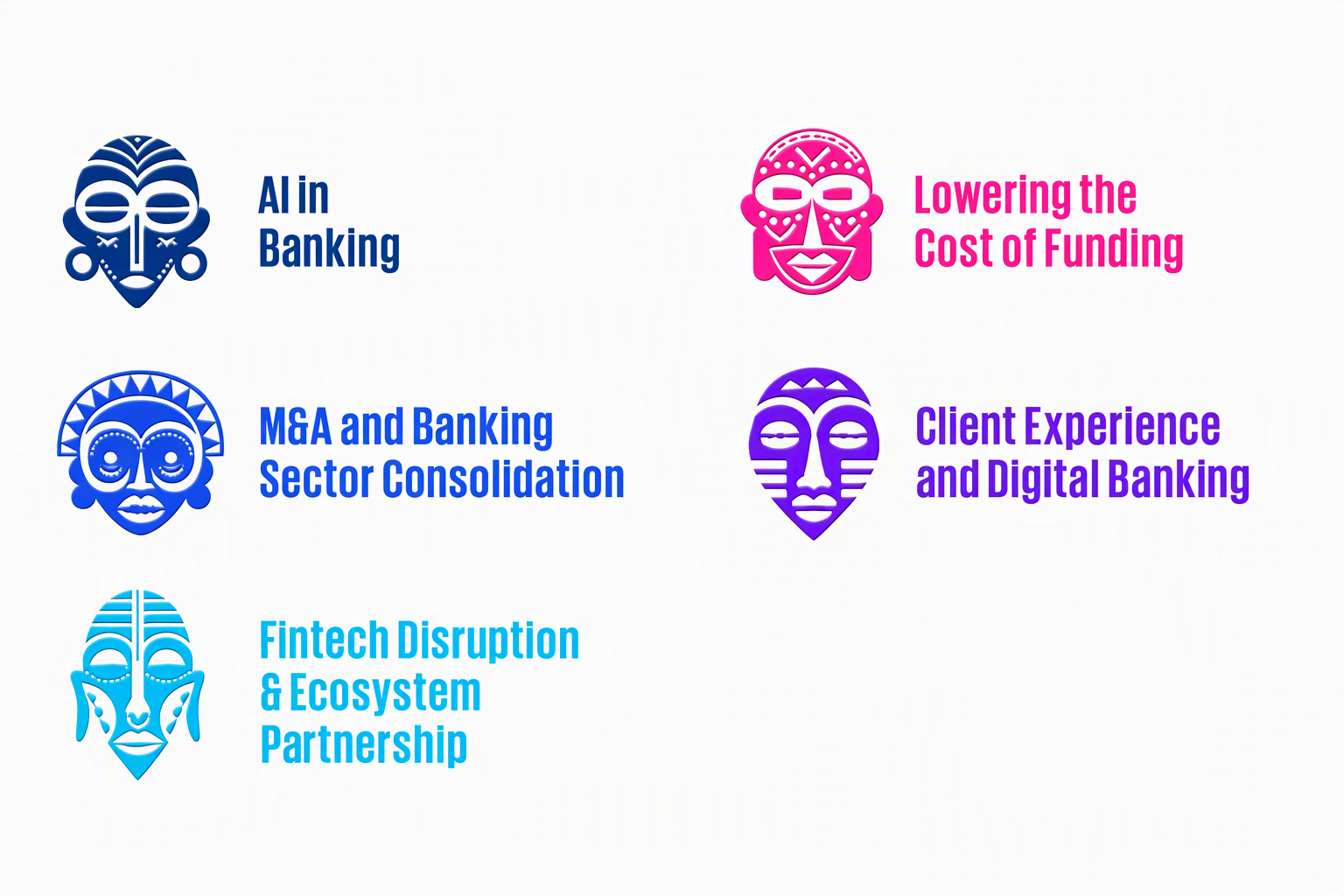
Our previous survey, published in 2024, explored the future of banking on the continent. This edition takes the next step, asking the people who run African banks how they are pursuing growth today, and what stands in their way. We chose five themes to focus on in this edition: the cost of funding, fintech disruption and ecosystem partnerships, artificial intelligence (AI), mergers and acquisitions (M&A) and consolidation, and finally client experience and digital banking.
If you ask a bank CEO or senior executive what is at the top of the agenda, most of these topics will feature. Not only are these subjects of discussion at banking conferences around the world, but they are also shaping how banks across the continent grow and compete. Each topic represents a different lever of growth. Funding is the heart of banking, influencing the cost of every loan and the margins a bank can earn.
AI and fintech are reshaping how banks operate, compete and innovate. M&A can provide banks with the scale required to expand across borders. Client experience is one topic that should be at the top of every bank’s agenda because how a bank treats its customers ultimately determines whether it keeps them.
How we approached the survey
Industry views are often shaped through individual client engagements or global surveys that do not fully reflect African realities. Questionnaires can produce useful numbers, but they often don’t capture the context and nuance behind them. For this edition, we therefore spoke directly with senior banking leaders and invited them to share their experiences and perspectives.
KPMG Africa interviewed executives at 20 banks across East, West and Southern Africa, together with representatives of development finance institutions and industry experts. Participants included banks in South Africa, Kenya, Tanzania, Ethiopia, Nigeria and Mauritius, as well as pan-African and West African banking groups. We looked for a wide range of participants who reflect the diversity and maturity of banking on the continent: small regional banks and pan-African banking groups, established institutions and banks in fast-opening markets. That allowed us to compare the experiences of very different banks, as well as similar institutions with one another.
Participants spoke on condition that their responses would be anonymised, which encouraged candid discussion. Where a view is attributed, the bank is described by region and profile rather than by name. The result is not a statement of fact, but rather a compilation of the perspectives shared by the participants. At times their views differ sharply, and those differences are often as revealing as the points on which they agree



Our people


Joseph Kariuki
Partner, Audit Services and Head of Financial Services Industry, KPMG East Africa
KPMG in Kenya