

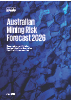
KPMG’s annual mining risk analysis highlights a shift towards more interconnected, faster-moving challenges across the Australian mining industry.
While the mix of key risks in the mining sector remains broadly consistent with previous years, their importance and impact has shifted significantly. Success is now increasingly dependent on managing multiple risks at once. Financial risk remains the top concern, alongside a sharp rise in regulatory pressure and a renewed focus on operational resilience.
The data used for this analysis is based on self-reported risks from ASX 300 companies for FY25/26. Given the global pace of change since the reporting period ended, this report is supplemented with KPMG’s Dynamic Risk Assessment approach, showing how risks may connect and impact operations, supply chains and financial performance going forward.
Top mining industry risks for 2026
The top 10 risks leaders in the mining sector have outlined as key board-level challenges for 2026.

Financial risk: the number one risk in the Australian mining sector
Financial risk remains the top concern for mining companies in Australia, driven by ongoing cost pressures, tough capital decisions and the need to maintain funding flexibility.
Increasingly, this risk is shaped by future commitments, especially spending on decarbonisation and growth, which directly affects returns, cash flow and access to capital.
Geopolitical tensions are adding to this pressure, with disruption and policy changes flowing into costs, supply chains and financing conditions. As a result, financial performance is now closely tied to how well companies balance investment, risk and resilience in a changing environment.
Four critical risk scenarios to watch
New to our report is an exploration of key forward-looking scenarios for the mining sector over the next four years.
Powering down
Energy disruptions can act as a systemic risk, triggering supply chain breakdowns, logistics constraints and cost escalation. Organisations face cost pressures as energy security directly impacts operations, productivity and financial resilience.
Discover the early warning indicators and opportunities for the 'Powering down' scenario in our report.
The productivity trap
Rising costs, labour constraints and changing organisational structures are impacting prpductivity. Organisations risk declining margins as traditional operating models struggle to adapt to disruption, new technologies and evolving workforce demands.
Discover the early warning indicators and opportunities for 'The productivity trap' scenario in our report.
Geopolitical risk equation
Increased global government intervention is reshaping markets through trade restrictions and resource controls. Mining companies face disrupted supply chains, rising costs and limited market access in an increasingly fragmented global environment.
Discover the early warning indicators and opportunities for the 'Geopolitical risk equation' scenario in our report.
Between carbon and capital
Balancing decarbonisation and financial performance is critical. Both over- and under-investment in transition strategies can impact competitiveness, capital access and long-term viability.
Discover the early warning indicators and opportunities for the 'Between carbon and capital' scenario in our report.
Powering down
Energy disruptions can act as a systemic risk, triggering supply chain breakdowns, logistics constraints and cost escalation. Organisations face cost pressures as energy security directly impacts operations, productivity and financial resilience.
Discover the early warning indicators and opportunities for the 'Powering down' scenario in our report.
The productivity trap
Rising costs, labour constraints and changing organisational structures are impacting prpductivity. Organisations risk declining margins as traditional operating models struggle to adapt to disruption, new technologies and evolving workforce demands.
Discover the early warning indicators and opportunities for 'The productivity trap' scenario in our report.
Geopolitical risk equation
Increased global government intervention is reshaping markets through trade restrictions and resource controls. Mining companies face disrupted supply chains, rising costs and limited market access in an increasingly fragmented global environment.
Discover the early warning indicators and opportunities for the 'Geopolitical risk equation' scenario in our report.
Between carbon and capital
Balancing decarbonisation and financial performance is critical. Both over- and under-investment in transition strategies can impact competitiveness, capital access and long-term viability.
Discover the early warning indicators and opportunities for the 'Between carbon and capital' scenario in our report.
Outlook for 2026 and beyond
Australia’s mining sector is entering a more complex phase, where risks are faster-moving, more connected, and increasingly shaped by external disruption and internal decision-making.
This report shows how financial, operational, regulatory and climate pressures are converging to reshape performance, resilience and growth. It also highlights that success now depends on understanding how risks interact, not just how they rank.
For boards and executives, the challenge is to stay ahead of shifting conditions while making risk informed, strategic decisions.
Read the full report to explore the insights, trends and forward-looking scenarios shaping the mining sector in 2026 and beyond.
Download the report
Access KPMG’s analysis to see how interconnected risks translate into clearer priorities and smarter decisions.

How KPMG can help
KPMG helps mining organisations turn complexity into clear, confident decisions. Combining deep industry experience with capabilities across mining operations, decarbonisation and ESG, we support companies to manage risk, improve performance and unlock long-term value.
Our Mining & Metals team works alongside clients to strengthen operational resilience, manage cost pressures and drive growth. At the same time, our decarbonisation specialists help mining organisations plan, fund and deliver transition strategies that balance emissions targets with commercial outcomes.
Together, we bring a practical, end-to-end approach, helping mining leaders navigate change, align strategy, and make better decisions in a rapidly evolving environment.
Related services


Meet KPMG’s risk, mining and metal leaders

Caron Sugars
Partner, Governance, Risk & Controls Advisory and Board Advisory Services
KPMG Australia


- Item 1
- Item 2
- Item 3
Contact us
If you would like to discuss the report or have a question about how KPMG can support your organisation, please get in touch.
Frequently asked questions
The mining outlook in Australia is defined by rising complexity, with risks becoming more interconnected and faster-moving. Success depends on managing cost pressures, operational resilience and policy uncertainty while adapting to energy transition and changing market conditions.
The top risks include financial pressure, regulatory change, operational disruption, resource access, and geopolitical and economic uncertainty. These risks are increasingly interconnected, with impacts flowing across operations, supply chains and financial performance.
Decarbonisation is driving major capital investment decisions, creating pressure on returns, funding and competitiveness. It is now embedded in financial planning, requiring companies to balance emissions targets with cost, resilience and long-term value.
ESG risks include climate impacts, water availability, community expectations and regulatory compliance. These factors can affect access to resources, approvals and operations, making them critical to long-term performance and social licence.
Key challenges include managing cost inflation, securing funding, navigating regulatory change, maintaining reliable operations and responding to geopolitical disruption. These challenges are increasingly linked, requiring more integrated and agile decision-making.