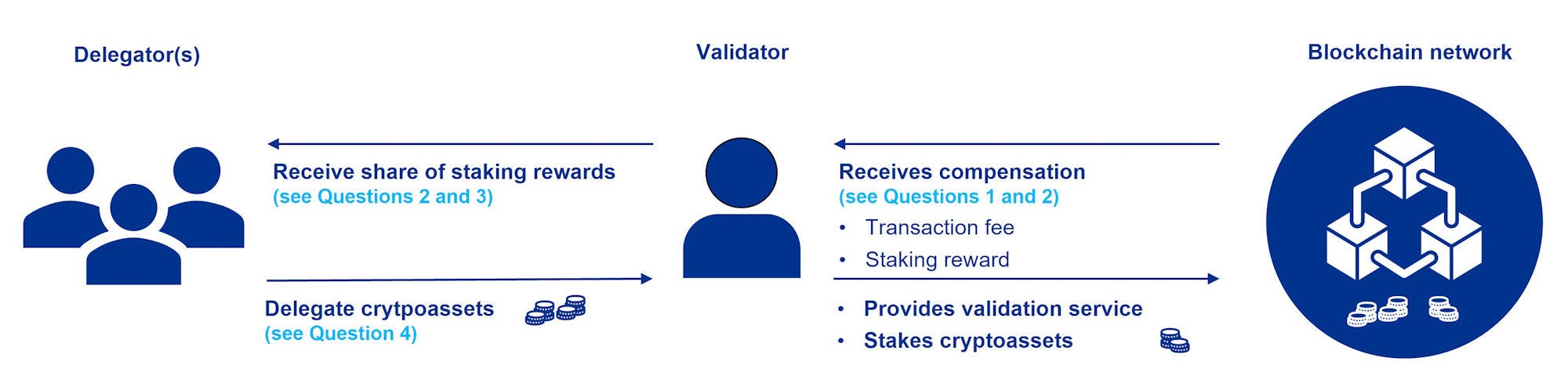
Staking activities refer to the process used in a proof-of-stake blockchain (e.g. Ethereum) to validate transactions and secure the blockchain. A company can earn rewards for staking activities by acting as either a validator or a delegator.
Only holders of the blockchain’s cryptoassets are permitted to validate transactions (i.e. act as validator). Validators are required to post cryptoassets as collateral with the blockchain (referred to as a stake) to be eligible for selection to validate blocks.
The process to select the validator of the next block uses probability and is based on the size of the stake relative to the total amount staked. Therefore, the larger a validator’s stake, the higher the chance of being selected. However, the exact protocols can vary by blockchain.
For validating and adding the next block to the blockchain, the selected validator receives non-cash consideration in the form of a staking reward and transaction fee. When considering how to account for that non-cash consideration, a validator needs to assess whether part or all of the arrangement is in the scope of IFRS 15 Revenue from Contracts with Customers.
If a company aims to earn staking rewards but does not intend to act as a validator, then it can delegate cryptoassets to a validator for inclusion in the validator’s stake. Companies applying this approach are referred to as delegators.
To determine the appropriate accounting for a delegation arrangement, a delegator needs to evaluate its relationship with both the validator and the blockchain network.