

Resilience is no longer about planning for the remote possibility of disruption; it is about being ready for disruption as a constant reality.
Organizations are navigating geopolitical tension, trade wars, technology innovation, new regulations, volatile markets and shifting business conditions while also having to maintain operational continuity, protect financial stability, and manage evolving cyber, technology, and third-party incidents.
Receive insights, events and more to your inbox
Nearly three-quarters of global leaders identify risk, security and privacy as top concerns, yet only 24% embed them into strategy and technology.1
25% of Canadian CEOs identify supply-chain resilience and pressure to maintain or increase production as top threats to growth.2
83% of organizations plan to expand their partner networks, yet only 18% have fully integrated third-party risk with enterprise risk management.3
72% of Canadian business leaders say AI-powered fraud attacks had cost their organization between 1% and 5% of business profits during the previous 12 months.4
What is business resilience?
Business resilience is an organization’s ability to sustain operations and thrive amid ongoing disruption—not just prepare for isolated events. Resilient organizations are better positioned to navigate disruption, protect value and seize opportunities in periods of change.
How KPMG helps organizations build business resilience
KPMG helps clients gain a clearer view of their most critical operations, dependencies and vulnerabilities so they can close performance gaps, prioritize actions and strengthen resilience across their operations, technology, controls, and culture.
Through KPMG’s Business Resilience Framework, businesses can shift from reactive response to proactive resilience, improving readiness, reducing exposure, supporting business continuity and building confidence to readily adapt through disruption.
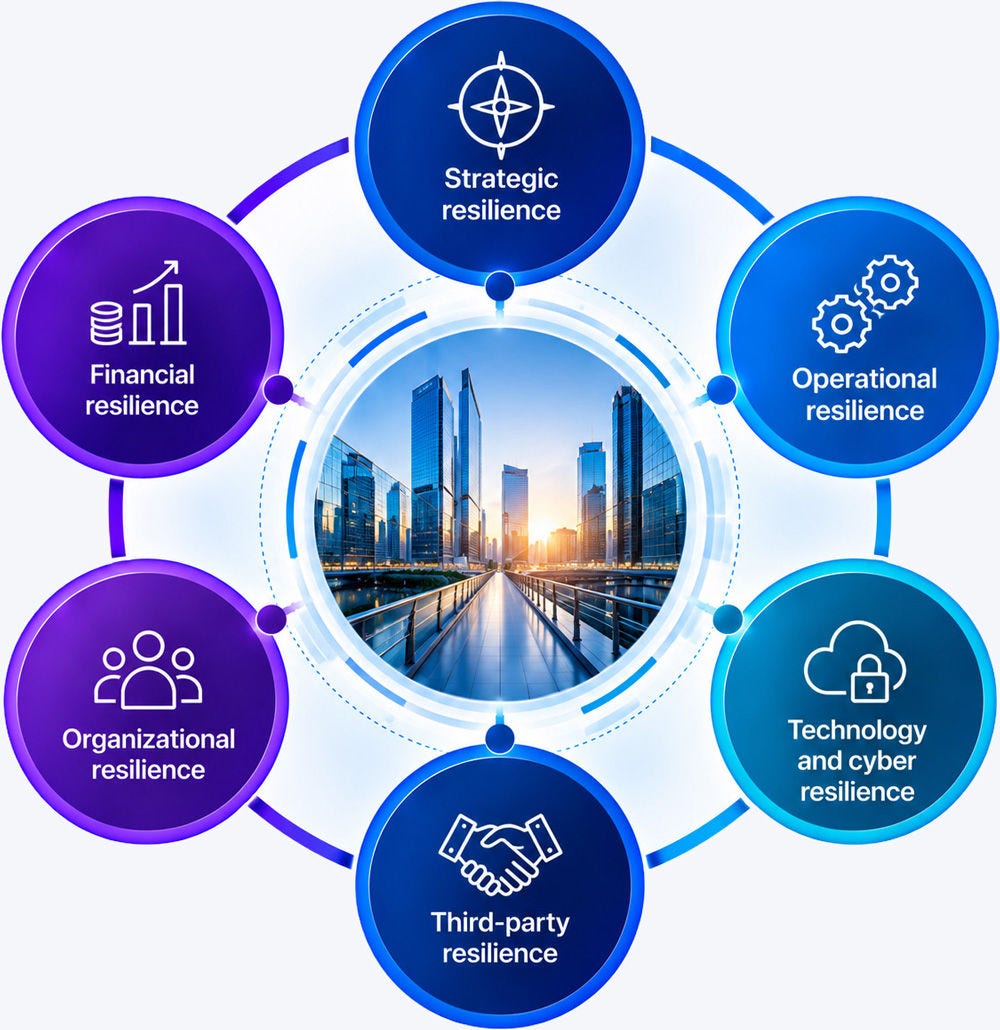
KPMG’s Business Resilience Framework covers six pillars
KPMG’s Business Resilience Framework focuses on six critical areas that collectively strengthen an organization’s ability to withstand disruptions.
Building resilience starts at the top, with strategy. In an environment of accelerating change and uncertainty, organizations need strategies that are risk-adjusted, adaptable and able to deliver through disruption. This requires continuously challenging assumptions, pressure-testing strategic choices, and adjusting priorities, business goals and performance measures as conditions evolve.
Embedding resilience into strategy enables organizations to design strategies that remain viable across changing conditions, protect value, adapt with confidence and capitalize on change and adversity.
Ultimately, enterprise strategy is the anchor for resilience. It defines what matters most and provides the foundation for where and how resilience must be built across the enterprise.
Priority actions:
- Embed uncertainty into strategy: Incorporate risk, uncertainty and scenario thinking into strategy development to support more informed choices and build adaptability into the organization’s direction and core operations.
- Pressure-test strategic choices: Test key assumptions, priorities and business models against plausible disruptions to identify vulnerabilities and determine where greater flexibility is needed.
- Anticipate market and competitive shifts: Monitor evolving customer, market and competitive dynamics to adapt strategic priorities and capture emerging opportunities.
- Assess geopolitical trends and exposures: Evaluate how geopolitical developments could affect the business, operations, customers, suppliers, markets, and growth objectives and incorporate these implications into strategic decision-making.
- Adapt the portfolio: Continually reassess products, services, investments, and capital allocation decisions against changing demand, customer preferences and strategic priorities.
- Prepare for regulatory transformation: Monitor tax and regulatory requirements and assess their impact on the business and operations to manage legal and compliance risks.
- Build resilience into the supply chain: Align supply chain strategy with enterprise priorities to balance efficiency, cost, optionality and the ability to respond to disruption.
- Anchor resilience programs in enterprise strategy: Use the enterprise strategy to define and align financial, operational, reputational, third-party and other resilience programs, ensuring they collectively protect the organization’s ability to deliver on its strategic priorities.
Connect with us

Edouard Bertin-Mourot
Partner, National Service Line Leader, Governance, Risk & Compliance
Toronto
KPMG Canada
Assessing and enhancing an organization's financial health and its ability to withstand economic shocks is imperative in turbulent climates.
Priority actions:
- Evaluate profitability and margins: Regularly evaluate margins and operational efficiency to help the organization sustain financial performance during downturns.
- Strengthen capital and financial risk management: Maintain adequate capital through robust processes, including Internal Capital Adequacy Assessment Process (ICAAP) and Own Risk and Solvency Assessment (ORSA), and actively manage credit and insurance risks to withstand financial stress.
- Maintain liquidity and cash flow: Maintain adequate liquidity and strong cash flow management to safeguard against financial challenges and respond quickly to emerging opportunities.
- Prioritize strategic investments: Invest in growth initiatives and innovation to support long-term financial health and adaptability.
- Develop hedging strategies: Use effective hedging strategies to mitigate currency risks and broader market volatility.
- Manage and diversify assets: Manage and diversify assets to help withstand economic shocks and maintain stability during turbulent conditions.
Connect with us

Organizational resilience starts with people. Organizations that cultivate adaptable leaders, invest in workforce capabilities, foster employee engagement, and retain critical talent are better positioned to navigate disruption, preserve institutional knowledge, accelerate change adoption, and sustain business performance in uncertain environments.
Priority actions:
- Embrace organizational change: Foster a culture that encourages adaptability, innovation, and continuous improvement.
- Build future-ready capabilities: Invest in targeted upskilling and reskilling programs that prepare employees for evolving business, technology, and workforce demands.
- Strengthen employee engagement and retention: Create meaningful career development opportunities, involve employees in organizational change, and foster mentorship, feedback, and succession planning programs that improve engagement, retain critical talent, and preserve institutional knowledge.
- Build adaptive leadership: Equip leaders to communicate clearly, navigate uncertainty, support their teams through change, and inspire confidence during periods of disruption.
- Enable workforce wellbeing and flexibility: Provide the support, flexibility, and resources employees need to remain productive, engaged, and resilient in a changing environment.
Connect with us

Operational resilience is the ability to continue delivering critical operations through disruption. It requires organizations to understand which operations matter most, identify the key dependencies that support them, assess vulnerabilities across resilience risk domains, test whether response and recovery capabilities are effective, and enable the organization to remain within its established tolerance for disruption.
For regulated sectors, this also supports alignment with newer expectations such as OSFI’s Guidelines E-21, B-13, B-10, and Integrity and Security Guideline.
Priority actions:
- Identify critical operations and dependencies: Determine which operations are most important to the organization and map the people, processes, technology, data and third parties that support them.
- Set tolerances for disruption: For each critical operation, establish the maximum adverse impact that can be withstood in terms of time, customer impact or other relevant measures.
- Assess resilience across key risk domains: Evaluate resilience capabilities across business continuity, crisis management, change management, data, third-party, technology and cyber risks.
- Align plans and response capabilities: Connect business continuity, crisis management, disaster recovery, cyber response and third-party response processes to support coordinated action during disruption.
- Identify vulnerabilities and remediation priorities: Understand where current capabilities, dependencies or controls may create exposure and prioritize practical improvements.
- Test resilience through scenarios: Use severe but plausible scenarios, tabletop exercises and operational testing to validate whether critical operations can continue or recover within expected timeframes.
- Enhance the key areas of operational risk management: Strengthen the interconnected capabilities that help critical operations withstand and recover from disruption, including business continuity, disaster recovery, crisis and change management, technology and cyber risk, third-party risk, and data risk management.
Connect with us

Technology and cyber resilience enables organizations to anticipate emerging risks, protect critical systems, model potential impacts, respond effectively to disruptions and recover essential services.
Effective tech and cyber resilience goes beyond prevention. It ensures critical business processes can continue, or be restored, within defined recovery timelines while supporting alignment with tech regulatory requirements, including OSFI Guidelines E-21, B-13, and B-10.
Priority actions:
- Strengthen trusted data: Improve data reliability, integrity, security and governance of data to enable better decision-making and trusted outcomes.
- Protect systems and information: Apply layered security controls, continuous monitoring, recovery testing and regular vulnerability and penetration testing to reduce cyber exposure and maintain stakeholder trust.
- Invest strategically in technology and innovation: Focus technology investments on initiatives that improve productivity, operational efficiency, adaptability and competitive advantage, supported by effective change management to maximize adoption and long-term value.
- Strengthen disaster recovery capabilities: Build resilient architecture, identify and map critical technology components and dependencies that support key operations, align disaster recovery capabilities (i.e. RTOs and RPOs) with business objectives, establish coordinated incident response and recovery capabilities, and regularly test the ability to restore critical services within established recovery timeframes.
- Enhance crisis and continuity planning: Integrate technology and cyber resilience capabilities into crisis management and business continuity planning to align recovery strategies, business expectations, and technologies constraints, ensuring coordinate response and recovery during disruption.
- Build trusted AI adoption: Adopt AI to help operationalize your business resilience plans. Apply appropriate governance, testing and monitoring across AI systems, data, models and third-party dependencies to manage emerging risks and prevent new points of failure and technology constraints, ensuring coordinated response and recovery during disruption.
Connect with us

Kareem Sadek
Partner, Advisory, Tech Risk, Trusted AI and Digital Assets National Leader
Toronto
KPMG Canada

Third-party resilience is the ability to maintain critical operations and protect value when third-party ecosystems are disrupted. Isolated methods to managing third‑party risk are no longer viable in an environment defined by continuous disruption. It requires risk-based oversight across the third-party lifecycle, clear accountability, visibility into critical dependencies and coordinated response and recovery capabilities.
Priority actions:
- Identify critical third parties and dependencies: Maintain a complete inventory, assess risk and criticality, map third parties and subcontractors, concentration points and dependencies that support critical operations.
- Apply risk-based due diligence and contracting: Evaluate financial, operational, cyber, privacy, compliance and resilience risks before onboarding, and embed clear control, access, notification, audit and exit requirements in contracts.
- Continuously monitor risk and performance: Use reliable data, indicators and ongoing assessments to detect changes in third-party risk, control effectiveness and service performance throughout the third-party lifecycle.
- Manage concentration and subcontractor risk: Assess exposure to common providers, locations, technologies and fourth parties, and develop practical mitigations for material concentrations.
- Test disruption, recovery and exit plans: Coordinate incident response with critical providers, test severe but plausible scenarios, and maintain contingency, transition and exit plans that support continuity within established tolerances.

KPMG can help enable stronger, more resilient businesses
At KPMG Canada, we take a multidisciplinary approach to business resilience to create and implement tailored strategies that reflect the unique needs of organizations.
Our specialists integrate capabilities across regulatory readiness, operational resilience, digital transformation, cybersecurity, third-party risk, trusted data and AI, financial risk, organizational change, fraud, crisis preparedness and other disciplines to deliver practical, coordinated and measurable results.
Don’t leave your organization’s future to chance. Build a more resilient, adaptable future for your business.
Insights


Client stories


Frequently asked questions
Business continuity focuses on maintaining or restoring critical operations during a disruption. Business resilience is broader, helping the entire organization anticipate, withstand and adapt to ongoing change.
A strong business resilience framework connects six key areas: strategic, organizational, operational, financial, technological, and third-party resilience. Together, they help identify vulnerabilities, strengthen critical capabilities and support coordinated decision-making.
Canadian businesses are facing constant economic, geopolitical, regulatory, cyber and supply-chain disruption. Strong resilience helps them protect critical operations and value, adapt faster and pursue opportunities with greater confidence.
Connect with us


Edouard Bertin-Mourot
Partner, National Service Line Leader, Governance, Risk & Compliance
Toronto
KPMG Canada
Kareem Sadek
Partner, Advisory, Tech Risk, Trusted AI and Digital Assets National Leader
Toronto
KPMG Canada
- Hartaj
- Edouard
- Paul
- Stavros
- Linda
- Kareem
- Adil
- Sonu
- AI trust and governance emerge as the real competitive edge in business transformation, KPMG study finds, KPMG International, June 2026.
- Growth from the outside in, KPMG CEO Outlook 2026, KPMG Canada, October 2026
- The 2026 KPMG Global Third-Party Risk Management Survey, KPMG International
- AI fraud hits Canadian companies’ bottom lines, KPMG Canada, March 2, 2026