
      Canadian organizations are investing more in technology solutions than their global peers and seeing impressive returns on their investments, according to the 2024 KPMG Global Tech Survey.

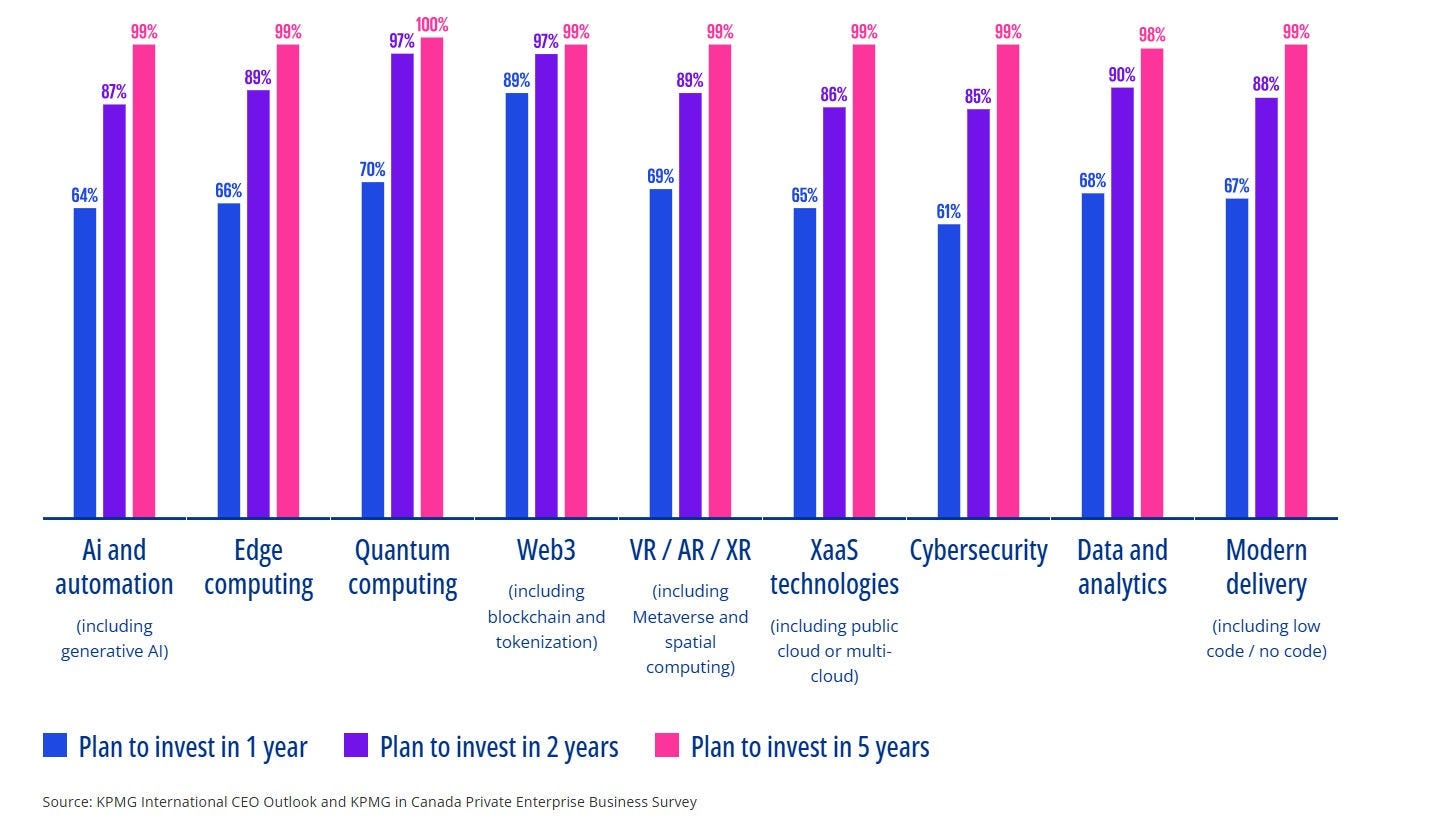
      The survey of 150 C-suite technology executives and senior leaders from large organizations across Canada showed respondents are currently investing in or planning near-term investments in technologies such as AI and automation, edge computing, quantum computing, cybersecurity, Web 3, data and analytics, cloud computing and other solutions in the next year to support their growth ambitions – outspending their global peers.

      “After years of relative underinvestment, Canadian organizations have done a major pivot and are now investing more in technology than their global peers - this is a significant leap forward. With more sustained investments like this, Canada’s productivity could finally see a meaningful boost,” says Stephanie Terrill, KPMG’s Canadian Managing Partner of Digital and Transformation.

      Nearly nine in 10 (89 per cent) respondents said their technology investments were driven by successful pilot projects and proof-of-concept testing of various solutions. Among the most profitable technologies over the past two years were artificial intelligence, where more than half (56 per cent) of respondents saw a 10 per cent or more profit increase from their investments; cybersecurity (56 per cent) and data and analytics (53 per cent).

      “Experimenting with different technologies not only gives business leaders the confidence to make further tech investments, it also helps build a culture of innovation, and innovative organizations are more productive and profitable,” Ms. Terrill says.

      “Canada’s productivity crisis is underpinned by chronically low business investment, and our survey clearly shows that when businesses make investments in technology, they improve their productivity and profitability. Canada can advance its competitive position in the world if more businesses commit to making sustainable, long-term investments in technology.”
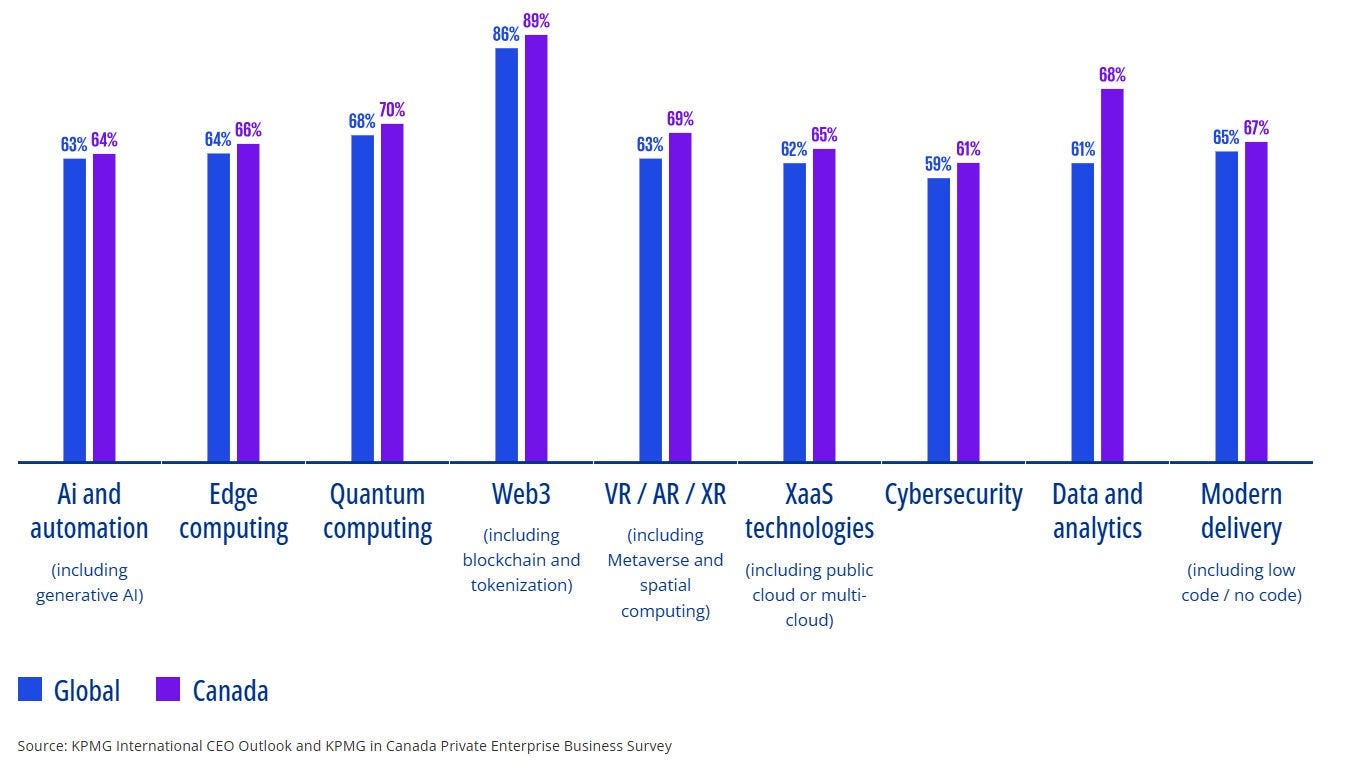
      Canadian organizations investing more on technology than global peers


      Source: KPMG International CEO Outlook and KPMG in Canada Private Enterprise Business Survey


      Future technology investments


      Source: KPMG International CEO Outlook and KPMG in Canada Private Enterprise Business Survey


      AI gets and gives a boost


      Over the past year, more Canadian organizations have accelerated technology implementations in data and analytics, cybersecurity and cloud computing; but the largest increase was in AI and automation (including generative AI), where nearly all (99 per cent) respondents said they had started implementing AI – a 39 per cent increase from last year.

      Nearly eight in 10 (79 per cent) said they have AI use cases that are either running, in production or being scaled across their organization, and they’re achieving a return on investment. Nearly all (93 per cent) respondents said transformation efforts involving AI and generative AI positively impacted their organization’s profitability.

      “Canadian technology leaders understand why implementing AI is transformative for their organizations: nearly eight in 10 said AI is helping knowledge workers in their organization become more productive, leading to improved overall performance,” says Ven Adamov, Partner and National Leader of KPMG in Canada’s Data and Analytics Risk Services.

      However, Mr. Adamov notes that among respondents that have started implementing AI, only 38 per cent are proactively progressing against their strategy, while more than half (56 per cent) are either behind schedule or being held up by investment approvals.

      “Organizations that are behind in their AI implementations need to address and remove the barriers that are holding them back. Often, AI investments are delayed because certain risks have not been addressed, or because new or unanticipated risks emerge. Implementing a trusted AI framework from the outset can help reduce the number of unexpected hurdles that pop up during the AI implementation phase. In the absence of prescriptive regulations, there are proven best practices that can be adopted for that purpose,” he adds.


      Trusted AI

      Empower your AI strategy with ethical and responsible AI solutions.
      Woman on tablet

      Barriers to transformation: risk aversion and fear of overspending


      Despite increased investments in technologies like AI and the benefits they’re creating for Canadian organizations, nearly eight in 10 (78 per cent) respondents expressed fear of overspending on technology, 11 percentage points higher than the global average.

      That fear could stem from risk aversion: more than six in 10 (63 per cent) respondents said risk aversion makes their senior leadership move more slowly than competitors in embracing new technology – seven percentage points higher than the global average.

      Sanjay Pathak, Partner and National Leader of Technology Strategy and Digital Transformation Services, says that with new technologies like generative AI evolving quickly, there are heightened expectations on IT leaders as well as CEOs and boards to have a deeper level of understanding about new technologies, and if business leaders feel they don’t know enough about technology, it can create a sense of nervousness, hesitation and fear of taking risks.

      “Education can help quell those fears and help business leaders become more comfortable with experimenting with and embracing new technologies. The technology function can play a leading role in improving an organization’s technology literacy. Organizations that empower technology executives and give them a voice at the decision-making table are digital leaders. This goes a long way in helping the C-suite, board and workforce understand how to harness new technologies to deliver value,” Mr. Pathak says.

      Mr. Pathak recommends the following strategies for organizations to gain more value from their technology investments:

      • Tighter alignment between technology and business leaders and business strategy
      • Taking inspiration from industry peers and organizations in other industries
      • Adopting a “learn fast/fail fast” ethos that encourages experimentation with new technologies in small, controlled use cases.

      About the Global Tech Survey


      KPMG International surveyed 2,450 technology leaders between May 3 and June 26, 2024. 150 respondents were from Canada, with more than half (52 per cent) identifying as members of the C-suite. 34 per cent were in the consumer and retail sector, 27 per cent in technology, 20 per cent in financial services and the rest from other industries. More than half (53 per cent) had between 1,000 to 9,999 employees, and 30 per cent had 10,000 or more employees. Almost half (47 per cent) of respondents reported annual revenues of US$50 billion to US$99.99 billion; one third reported annual revenues of US$1 billion to US$9.99 billion and 13 per cent reported annual revenues between US $10 billion to US$19.99 billion.


      A new dawn: Canadian tech transformation strategies driving change

      An overview of the Canadian findings from the 2024 KPMG Global Tech Survey.
      Woman with glasses looking at tablet and statistics