Skip to navigation

      Swiss SMEs are increasingly asked to provide structured sustainability and ESG information – whether by large customers subject to CSRD, by banks assessing ESG risks, or by business partners and investors with growing transparency expectations.

      While many SMEs are not legally required to report under CSRD or Swiss Code of Obligations thresholds, sustainability reporting is becoming a de‑facto market expectation.

      The Voluntary Sustainability Reporting Standard for non‑listed SMEs (VSME) offers a practical, proportionate response. Developed by EFRAG and recommended by the European Commission, the VSME provides a standardized and internationally recognized framework tailored to SME realities. It focuses on the most relevant environmental, social and governance topics, without excessive complexity or cost. For Swiss SMEs, the VSME enables consistent responses to ESG data requests, strengthens stakeholder communication and supports future‑ready sustainability management.

      Theresa Tiersch

      Director, Corporate Sustainability Services

      KPMG Switzerland

      What is the VSME standard?


      The VSME is a voluntary sustainability reporting framework tailored to micro-, small- and medium-sized enterprises not subject to CSRD.

      It is aligned with the ESRS structure but significantly simplified to reflect SME realities.

      It provides a clear, comparable and internationally recognized approach to reporting ESG information while remaining proportionate in terms of effort, cost and complexity.

      The VSME as delivered by EFRAG, as well as additional guidance on the application can be found here: Voluntary reporting standard for SMEs (VSME), Concluded

      search

      EFRAG's sustainability report

      The VSME in practical application: EFRAG itself also published its first Sustainability Report in April 2026 applying the VSME framework. The report showcases how sustainability is embedded across EFRAG’s activities, governance, and internal practices.

      EFRAG publishes its first Sustainability Report (VSME based)

      Who should consider VSME reporting?

      The VSME is particularly relevant for: 

      • Companies not subject to CSRD/Swiss CO reporting requirements that still wish to report on their sustainability performance 
      • Companies within the supply chains of large, reporting‑obligated organizations needing to meet transparency requirements 
      • SMEs with stakeholders increasingly requesting sustainability information (e.g., investors, customers, business partners) 

      Why does VSME matter for Swiss SMEs?

      Choosing to report under the VSME is a voluntary decision - and increasingly, a strategically smart one. Swiss SMEs across sectors are fielding more ESG data requests, from more directions, with less tolerance for inconsistent or ad-hoc responses. The VSME provides a single, structured answer to that challenge.
       

      • Continued ESG data requests from large customers (value‑chain pressure)

        Large companies subject to CSRD must collect ESG information from their suppliers, often through inconsistent, bespoke questionnaires. 

        The EU Omnibus framework introduced a “value chain cap”, meaning large companies should not request data from SMEs that go beyond the disclosures as of the comprehensive module of the standard. This cap provides SMEs with legal protection against excessive data requests.


        The VSME, in turn, gives SMEs a recognized, standardized format to respond efficiently to legitimate requests – reducing administrative burden and ensuring comparability across the value chain. 

      • Increasing relevance in banking and financing

        Banks and financial institutions increasingly assess ESG performance through structured questionnaires and scoring models. Lack of information can lead to weaker ESG ratings and can negatively influence financing conditions.

        → A VSME-aligned report helps SMEs respond consistently to banking requirements and demonstrate proactive sustainability management. 

      • Rising stakeholder expectations

        Even in the absence of legal obligations, expectations for ESG transparency are growing across all stakeholder groups. 

        → VSME helps SMEs build credibility, transparency and trust with partners, customers and talent that increasingly factor sustainability into their decisions. 

      • Preparing early for future regulatory developments

        EU sustainability regulations continue to evolve, and Switzerland is expected to align step‑by‑step with European frameworks. What is voluntary today may become mandatory tomorrow.

        → Early adoption of the VSME helps SMEs build processes, data structures and internal responsibilities that support ongoing and potential future reporting needs. 


      What are the VSME Basic and Comprehensive Modules?

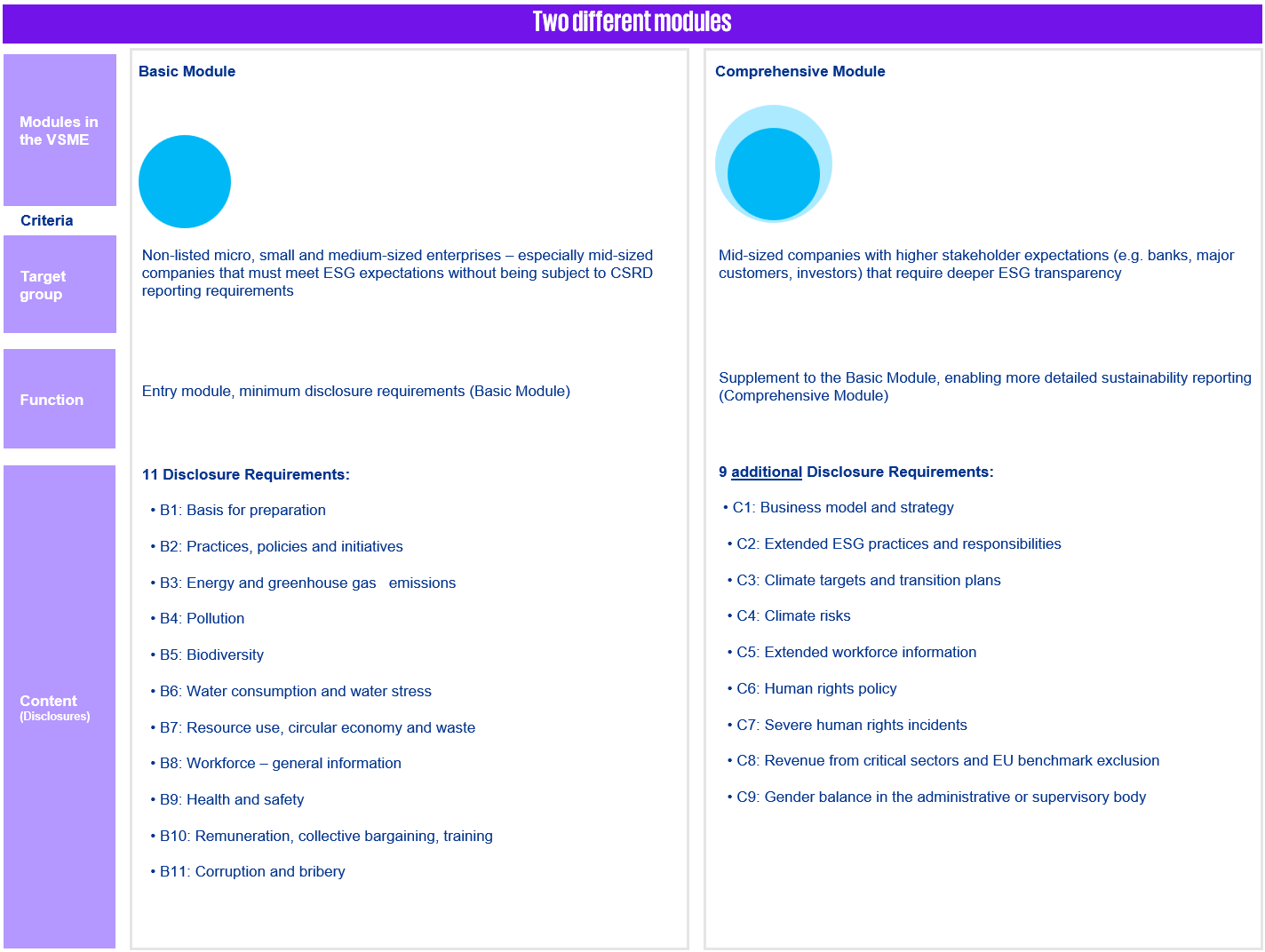
      The VSME consists of two modules: the Basic Module (B1–B11), covering fundamental disclosures across environmental, social and governance topics; and the Comprehensive Module (C1–C9), which adds deeper insights into strategy, climate targets, risks, human rights and governance. Companies may begin with the Basic Module and scale up as needed. 

      The VSME sets out a defined set of ESG disclosure requirements covering core environmental, social and governance topics.

      The overview below highlights the main disclosure areas included under each module.

      How can companies get started with VSME reporting?

      The path to VSME reporting typically involves:
       

      • Define scope & module

        Select entities/sites and decide on Basic vs Comprehensive based on stakeholder needs and capacity.

      • Assess and select topics

        Use a pragmatic materiality lens to select relevant topics (e.g., energy, CO₂, workforce, supply chain, governance). Where a double materiality assessment has already been conducted, its findings can be drawn on directly to inform topic selection.

      • Identify gaps

        Identify gaps in data availability, processes, and responsibilities relative to the selected topics; align on priorities and timeline to close these gaps effectively.

      • Collect data & set processes

        Assign responsibilities, apply consistent methods, document sources and use templates/tools to gather ESG data.

      • Prepare the report

        Use the VSME structure; avoid marketing language; explain assumptions and methods.

      • Publish & communicate

        Share with relevant stakeholders (e.g. customers, banks, partners) and ensure appropriate access;

        VSME serves as a standardized response format.

      • Improve continuously

        Track KPIs, refine policies and controls, and adjust as needed; expand to the Comprehensive Module as maturity grows.


      What developments should companies monitor next?

      Swiss SMEs should monitor regulatory developments in the EU, changing ESG data requests from customers and banks, and further clarifications around VSME and a potential Voluntary Standard (VS). 

      Update “Voluntary Standard”


      In May 2026, the European Commission published a draft of its “Sustainability Reporting Standards for Voluntary Use” (VS) alongside the revised ESRS.

      The VS build directly on the VSME Standard developed by EFRAG, extending its reporting logic beyond SMEs and positioning it as a common reference framework for voluntary sustainability reporting outside the CSRD scope.

      The introduction of the VS is closely linked to the “value chain cap” under the revised CSRD.

      This mechanism limits the ESG information that in-scope companies may request from smaller, non‑in‑scope entities.


      While application remains voluntary, the delegated act establishes a legal framework for these limits, positioning the VS as the reference point for value chain-related data requests.

      Compared to the VSME, the VS introduce targeted refinements, in particular alignment with the simplified ESRS and a clear categorisation of datapoints (“necessary”, “if applicable”, “voluntary”), with only “necessary” datapoints falling under the value chain cap. Additional simplifications apply for micro‑entities.

      At the same time, the core VSME structure remains unchanged, including the two‑module setup and overall reporting logic.

      The draft VS is subject to a four‑week consultation and expected to be finalised as a delegated act thereafter.

      See: Sustainability reporting standard for voluntary use

      How KPMG Switzerland can support

      KPMG takes a pragmatic, outcome‑focused approach tailored to SMEs, combining ESG technical expertise with reporting and assurance know‑how.

      We guide clients through every stage of the process – from kick-off workshops and topic selection to gap assessments, VSME data collection, report drafting, review, and optional limited assurance.

      Throughout, we draw on best-practice examples and provide targeted training to build lasting internal capability.

      Ready to get started?

      Contact the KPMG Switzerland Corporate Sustainability Services team to discuss a right‑sized path to your first VSME report and how to build from there.

      FAQ on VSME

      VSME is a voluntary sustainability reporting standard for non‑listed SMEs. It aligns with ESRS logic but is simplified, proportionate and designed for cost‑effective ESG reporting. 

      VSME is relevant for SMEs not subject to CSRD or Swiss CO requirements that still face ESG expectations from customers, banks, investors or other stakeholders.

      The VSME is voluntary. Companies choose to apply it to respond to market, value‑chain or financing expectations.

      The VSME follows the ESRS logic but is significantly simplified, with fewer disclosures and reduced complexity tailored to SMEs.

      The VSME supports SMEs in responding to value‑chain ESG requests from companies that are in scope of CSRD, offering a reference framework for proportionate and comparable disclosures.

      VSME consists of a Basic Module with core ESG disclosures and a voluntary Comprehensive Module for deeper insights into strategy, climate, governance and human rights.

      SMEs typically start by defining scope, selecting the appropriate module, assessing gaps, collecting ESG data and preparing a concise, factual VSME‑aligned report.

      EFRAG provides the VSME standard, supporting guidance and illustrative templates to structure disclosures. Many companies also use internal checklists, simple data collection tools and reporting templates aligned to the VSME modules.

      VSME does not require a formal double materiality assessment as defined under CSRD. However, companies are expected to apply a pragmatic relevance lens to determine which sustainability topics and disclosures are most appropriate.

      VSME reports are generally updated annually, based on fiscal year sustainability and ESG data, in line with financial reporting cycles. Updates may also be made when significant changes occur in business activities, risks or sustainability performance.


      Explore more insights on ESG reporting

      Companies worldwide are preparing for the advent of mandatory reporting on sustainability, according to the 2024 edition of KPMG’s Survey of Sustainability Reporting.

      The EU Omnibus Package streamlines sustainability rules, easing reporting burdens and reshaping CSRD/CSDDD with implications for Swiss companies.

      Switzerland is tightening and expanding non‑financial reporting, bringing more companies under stricter, audited sustainability rules.


      Our capabilities

      • Sustainability reporting & VSME advisory

        Support with VSME scoping, module selection, gap assessments and report preparation, ensuring proportionate, high‑quality and decision‑useful sustainability disclosures

      • ESG data, controls & reporting processes

        Design and implementation of pragmatic ESG data collection processes, controls and documentation tailored to SME structures and available resources.

      • Independent assurance

        Independent reviews and optional limited assurance over sustainability information and VSME reports, enhancing credibility with banks and business partners.


      Haven't found what you were looking for?

      Explore KPMG Switzerland’s insights on sustainability reporting, assurance and evolving ESG requirements.

      Our Reporting & Assurance hub provides practical guidance on regulatory developments, reporting frameworks and assurance‑ready ESG disclosures. 

      ESG Reporting & Assurance Insights

      Discover our latest insights on sustainability reporting and ESG assurance. Learn how companies can navigate evolving reporting standards, respond to stakeholder expectations and enhance the credibility of sustainability information through independent review.