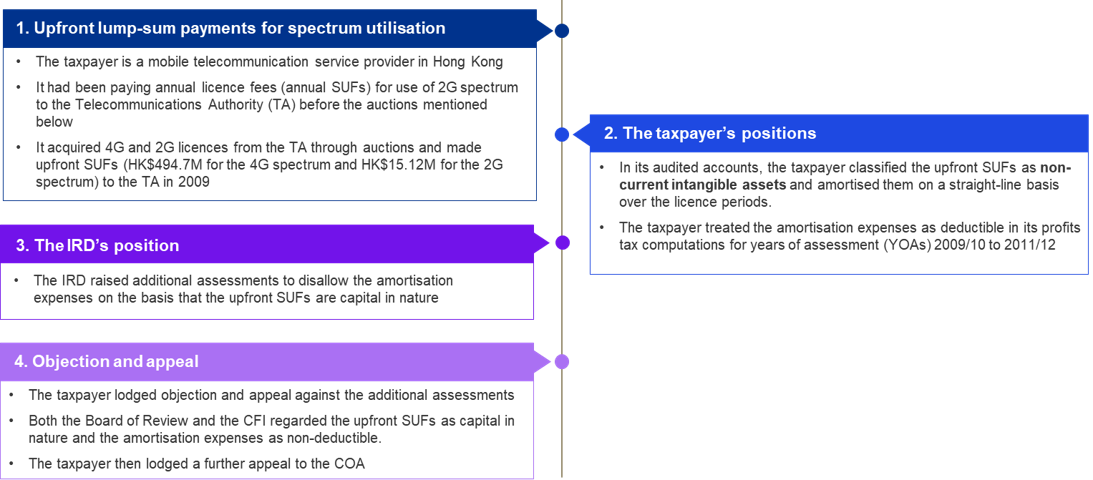
Below is a summary of the COA’s analysis and comments:
The COA rejected the new argument put forward by the taxpayer on the bases that:
- the new contention was not argued before the Board of Review and no evidence was adduced before the Board for it to make a finding of facts about it; and
- an appeal against a Board’s decision to a court should be on a ground involving only a question of law and the court must not receive any further evidence on questions of fact on hearing of an appeal.
On the distinction between payments for “right to use” and “for use” of the spectra, the COA held that:
- There is no error in the CFI judge’s approach for not recognising the distinction between payments made for “right to use” and “for use” of the spectra as decisive since there is no single decisive test to determine whether a payment is capital or revenue in nature.
- The proper construction of the Telecommunications Ordinance (TO) and the subsidiary legislation suggests that the legislature does not intend to make such a distinction and there is nothing in the TO suggesting that the obligation to pay the upfront SUFs only arises upon actual use of the spectra either by the taxpayer or its customers.
- The upfront SUFs were paid for the valuable exclusive right granted to the taxpayer to use the designated spectra assigned to it for 12-15 years. They were costs for acquiring or enlarging the profit-earning structure of the taxpayer’s business. The payments brought into existence fixed assets of an enduring nature which are held and used by the taxpayer in its business.
- The distinction between payment as a condition for the assignment of the designated spectra and payment as consideration for the assignment is of little relevance. Such distinction is a too narrow focus for answering the question of what the upfront SUFs were really paid for.
- The upfront SUFs did not fulfil exactly the same business and economic function as annual SUFs (which were periodic payments for the use of or the right to use spectrum for a short period only) and cannot be regarded as compounded annual payments.
Accordingly, the COA dismissed the taxpayer’s appeal and held that the upfront SUFs are capital in nature and not deductible.