Summary

      The draft legislation to implement the enhanced stamp duty relief for intra-group asset transfer under section 45 of the Stamp Duty Ordinance (the section 45 relief) was published in the Gazette on 2 October 2026.  Subject to the enactment of the draft legislation, the enhanced section 45 relief applies to the relevant instruments executed on or after 25 February 2026.

      In this tax alert, we discuss the key enhancements to the section 45 relief and share our observations. 


      Background

      Following the Court of Final Appeal judgment in John Wiley & Sons UK2 LLP and Another v The Collector of Stamp Revenue1 , the HKSAR Government announced in the 2026/27 Budget2 that the scope of the section 45 relief would be expanded.

      The Inland Revenue Department (IRD) then set out the proposed enhancements to the section 45 relief on its website and introduced a transitional arrangement whereby duty payers can submit adjudication requests for instruments qualifying for a stamp duty relief under the enhanced relief regime without paying any stamp duty upfront3.

      On 2 October 2026, the Stamp Duty (Amendment) (No. 3) Bill 20264 (the Bill) was gazetted to provide for the detailed legislative amendments for enhancing the section 45 relief.

      The enhanced section 45 relief

      The two enhancements 


      The Bill seeks to implement the following two enhancements to the section 45 relief:

      1.  to expand the scope of business entities eligible for the relief to include bodies corporate that do not issue or allot share capital (e.g. limited liability partnerships) which have separate legal personality; and

      2.  to lower the minimum threshold for association between the transferor and the transferee from 90% to 75%. 

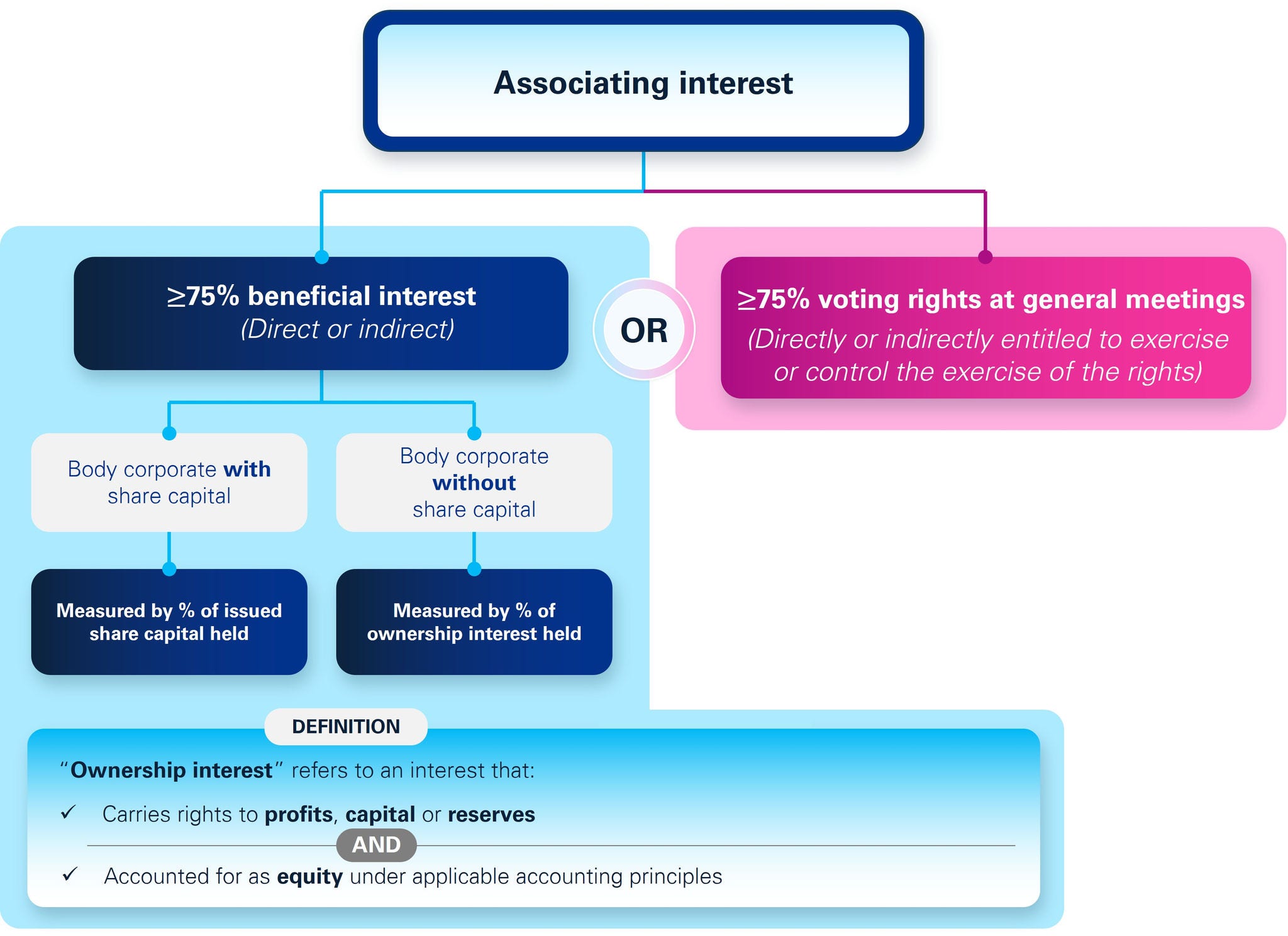
      Under the enhanced relief regime, two bodies corporate would be regarded as associated if one body corporate has an associating interest in the other body corporate or a third body corporate has an associating interest in both of them. We summarise in the diagram below when a body corporate would be regarded as having an associating interest in another body corporate.

      The anti-abuse and claw-back provisions

      • The existing anti-abuse provisions would continue to apply. In particular, no relief would be available if the asset transfer forms part of an arrangement under which the transferor and transferee cease to be associated.
      • Similarly, the existing claw-back provisions and notification requirement would continue to apply. In particular, if the transferor and transferee cease to be associated within two years of the transfer because of one of the following reasons:

      i.  a change in the percentage of the transferor’s or a third body corporate’s direct or indirect beneficial interest in the transferee, or

      ii. a change in the percentage of the voting rights in the transferee that the transferor or a third body corporate is directly or indirectly entitled (i) to exercise or (ii) to control the exercise,

      any relief granted will be deemed to have been withdrawn, and the transferor and transferee would need to notify the Stamp Office and pay the amount of stamp duty chargeable within 30 days after the date of the cessation.

      Implementation timeline 

      • The Bill will be introduced into the Legislative Council on 14 October 2026.  Subject to the enactment of the Bill, the enhanced section 45 relief applies to instruments for sale and purchase or transfer of assets executed on or after 25 February 2026.
      • The Stamp Office will formally make adjudication for the instruments submitted and decide whether the stamp duty relief would be approved upon the enactment of the Amendment Ordinance. 

      KPMG observations

      • We welcome the government’s initiative to enhance the section 45 relief by extending it to bodies corporate without share capital and lowering the association threshold to 75%, which has responded to concerns raised by various stakeholders (including us).
      • The lowered association threshold will put Hong Kong on par with other jurisdictions such as Singapore and the UK. By reducing stamp duty costs for internal reorganisations, the enhanced relief regime should further strengthen the position of Hong Kong as an international financial centre and investment holding hub.
      • However, there are several areas where further clarifications from the government would be welcomed:
        • The term “body corporate” remains undefined in the Bill. As overseas entities can take many different legal forms, it may not always be clear whether a particular entity form qualifies as a body corporate. To provide greater certainty, it would be helpful for the IRD to publish a non-exhaustive list of common entity types that qualify as bodies corporate for the purposes of the enhanced section 45 relief.
        • Under the existing anti-abuse provisions, if an intermediate parent company (transferor) transfers an asset to its wholly-owned subsidiary (transferee) and is then wound up within 2 years of the transfer, the stamp duty relief would not be withdrawn provided that the ultimate parent company that holds the intermediate parent company continues to exist and maintains a 90% association with the subsidiary.
          A clarification that similar treatment would apply despite the revised drafting of the anti-abuse provisions would be welcomed - i.e. the situation described above is not a case where the transferor and the transferee cease to be associated by reason of a change in the transferor’s beneficial interest in the transferee or a change in the voting rights in the transferee that the transferor is entitled to exercise.
        • “Ownership interest” in a body corporate is defined as an interest that carries rights to the profits, capital or reserves of the body corporate and is accounted for as equity. In practice, an equity interest may carry different rights to profits, capital and reserves of an entity. Further guidance will therefore be required on how to determine the percentage of ownership interest held where the rights are not identical across these three dimensions5.

      If you have any questions or require assistance regarding the above developments, please feel free to contact us via taxservicesenquiry@kpmg.com.


      1. For more details of the case, please refer to our previously issued Hong Kong SAR Tax Alert – Issue 4, June 2025.

      2. The 2026/27 Budget can be accessed via this link: https://www.budget.gov.hk/2026/eng/index.html

      3. For more details, please refer to our previously issued Hong Kong SAR Tax Alert – Issue 4, March 2026.

      4. The Bill can be accessed via this link: https://www.legco.gov.hk/yr2026/english/bills/b202610023.pdf

      5. The same issue may exist for the purposes of the intra-group transfer relief for foreign-sourced gains derived from disposal of assets under the foreign-sourced income exemption (FSIE) regime as the same association test is adopted, despite the term “ownership interest” is not defined under the FSIE regime.


      Hong Kong SAR Tax Alert —— Issue 17, Oct 2026

      The draft legislation to implement the enhanced stamp duty relief for intra-group asset transfer

      Hong Kong SAR Tax Alert - Issue 17, October 2026

      Hong Kong SAR Tax Alerts

      These are ad hoc newsletters covering topical tax issues in Hong Kong

      Submit RFP

      Find out how KPMG's expertise can help you and your company.