
      Detecting white-collar crime quickly and effectively is now an important part of any transaction monitoring process. KPMG is disrupting and changing the future of transaction monitoring with new automated solutions.

      The current challenge for banks is a combination of ever-growing and evolving regulations and laws that create a complex regulatory environment in which to operate and comply. Ineffective compliance is therefore no longer an option.
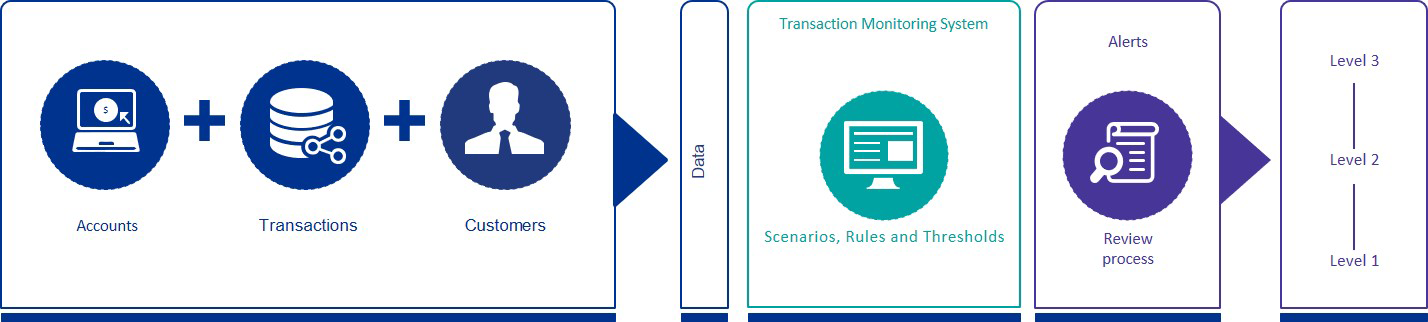
      Optimisation of transaction monitoring systems is highly complex

      Optimising transaction monitoring systems is a complex task, made even more so by the increased expectations of regulators. Financial institutions often perform regular reconciliations based on simplified tests. Inefficient systems lead to a large number of alerts. Globally, banks manually review millions of alerts per month related to potential white-collar crime, with almost 95% of alerts triggered being "inconspicuous".

      The review process of current alerts often requires large teams of staff, often spread across different geographical locations. Many of the compliance experts surveyed expect a further increase in the number of employees this year in order to maintain the current level of compliance.

      Our solutions

      In the face of increasing and changing regulation and guidelines, rising transaction volumes and the identification of new money laundering typologies, KPMG has developed solutions aimed at both system optimisation and hit verification processes. The aim is to improve the quality of monitoring system performance and provide faster, more accurate and more consistent verification of hit reports, helping financial institutions to fulfil their transaction monitoring obligations with higher quality and less effort.

      Automated optimisations

      Continuous review and optimisation of transaction monitoring systems can result in lower volumes of higher quality alerts being produced, which can be more easily verified, whether by humans or the use of the Transaction Monitoring Alert Classifier.

      • Automated optimisation is based on the use of machine learning to run thousands of what-if scenarios to determine the optimal state for client segmentation, scenarios, rules and thresholds.
      • These recommendations can be reviewed by experienced users to determine if adjustments should be made to the transaction monitoring system according to the client's risk appetite.
      • The automated optimisation tool can also be used to model business changes to determine the impact on current monitoring scenarios. This insight enables informed decisions about business changes, resource requirements and the management of a high number of hit reports.

      Transaction Monitoring Alert Classifier

      The Transaction Monitoring Alert Classifier automates the decision-making process when checking hits within the first line of defence.

      • Using advanced machine learning methods, the tool automates the identification of alerts that are likely to require further investigation (Automatic Escalation of Critical Alerts) and alerts that are not suspicious (Automatic Closure), allowing analysts to focus on high-risk activities.
      • Each alert review decision has a confidence-security level and is supported by a human-readable decision base. Clients can therefore customise the deployment to set coverage and accuracy rates that support their risk appetite.
      • The use of supervised machine learning ensures that decisions are transparent and can be tracked and reviewed by auditors and regulators.

      Management information and analytics

      Management information and analytics provide insights into system performance, data quality and additional knowledge that can be important for controls against white-collar crime.

      • Software packages can be developed to provide insight into payment activity and highlight risk areas in transaction behaviour.
      • Visually appealing, customisable dashboards present management information in a way that highlights key insights and enables data-driven decisions.

      The advantages

      KPMG has combined expertise in financial services, transaction monitoring and technology with world-class data science experts to develop advanced technology solutions for transaction monitoring systems. Experience working with clients around the world has helped KPMG's technology solutions evolve rapidly to meet the needs of regulators while addressing the challenges of clients.

      • Risk-based - Customer segmentation can be more accurate and aligned with the customer's risk-based approach.
      • Effectiveness and efficiency - An AI tests thousands of different "what-if" scenarios and makes recommendations based on these for optimal calibration of customer segmentation, rules, scenarios and thresholds. The optimised system greatly reduces the rate of "non-suspicious" alerts.
      • Cost reduction - Optimised transaction monitoring systems generate fewer "false" alerts that require time-consuming manual review. Automated Level 1 review minimises the requirement for dual control, depending on risk appetite.
      • Regulatory compliance - Automated detection of "suspicious" alerts enables faster routing of high risk cases to compliance. Documented, transparent and auditable system testing and alerting processes demonstrate regulatory compliance.
      • Insightful - management information and analytics identify links, patterns and behaviours to provide real insights.

      More KPMG Insights


      Your contact

      Timo Purkott

      Partner, Financial Services

      KPMG AG Wirtschaftsprüfungsgesellschaft