
The reorganisation of the transport of people and goods is one of the key issues of our time. New concepts, ideas and technologies will fundamentally change the topic of mobility in the coming years.
Mobility 2030
This transformation is being driven by three major trends
- eMobility: Switching to alternative drive systems in order to fulfil the desire to protect the environment (CO2 reduction, noise protection, etc.).
- SmartMobility: The future belongs to networked and autonomous means of transport; increasing digitalisation and automation make both possible
- SharedMobility/MaaS: Mobility as a service in a wide variety of combinations (e.g. ride sharing, ride hailing, ride hailing).Ride sharing, ride hailing or ride pooling) will make it easier to do without your own vehicle
It is not yet possible to predict how these developments will affect the various industries and companies. However, there will be massive changes and new structures.

eMobility
The transport and traffic sector is one of the highest emitters of CO2. In order to reduce pollutant emissions, it is necessary to move away from the internal combustion engine. The EU has now set clear targets for vehicle manufacturers in order to enshrine the achievement of this goal in regulation: CO2 emissions from passenger car fleets must be reduced by 37.5 per cent by 2030 compared to 2021, and the fleet consumption value has been lowered to 59 grams.
These ambitious targets can only be achieved if large parts of the OEMs' product portfolios are electrically powered in the future. The challenges posed by these transformations are immense: from the development of storage technology to the charging infrastructure and safety-related issues.
The number of new registrations for electric vehicles in Germany almost tripled in 2020, most vehicle manufacturers have defined specific dates for the end of the combustion engine and the EU's regulatory requirements have been tightened once again. There is no doubt about it: the transformation to electromobility can no longer be stopped.
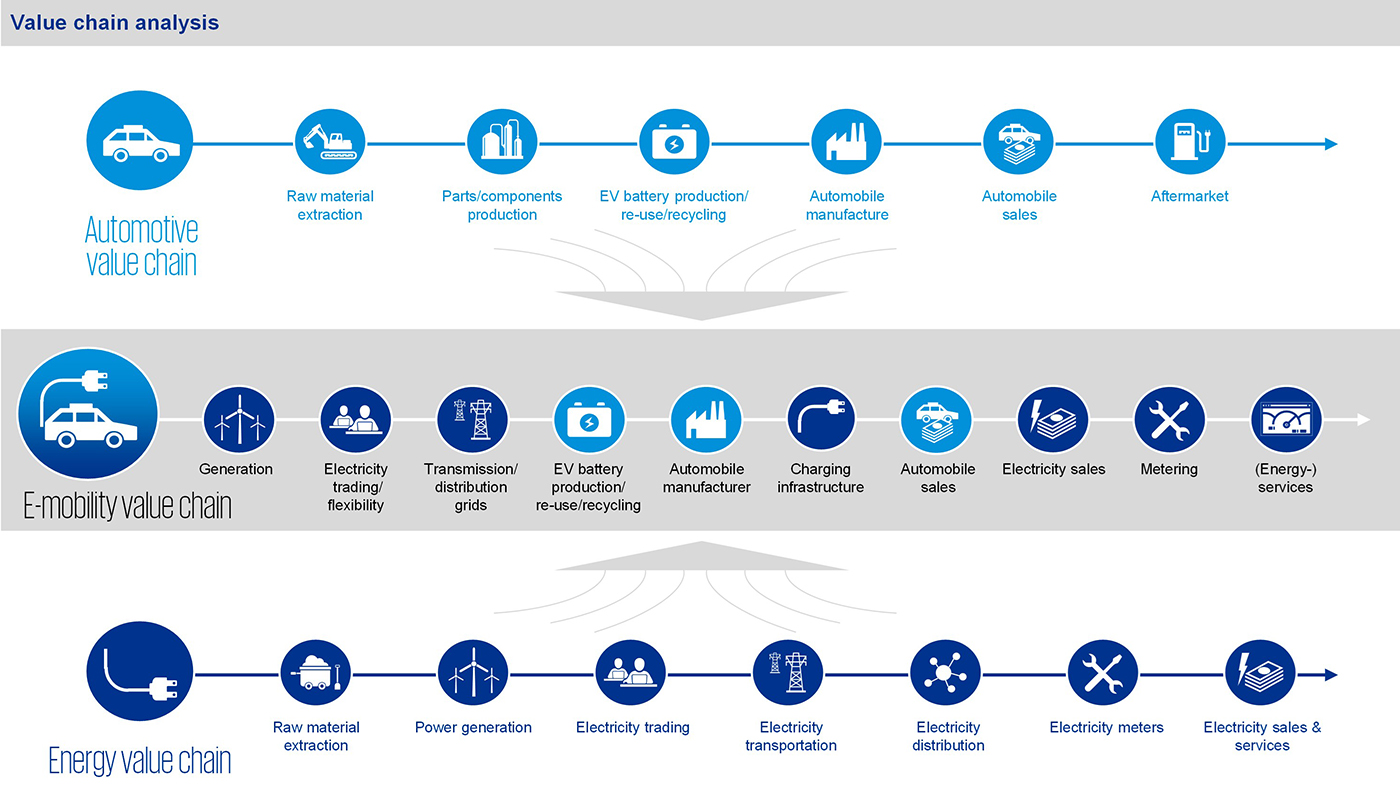
At the same time, however, the challenges that all market participants in the newly emerging "electromobility" ecosystem must face are becoming clear. Among other things, the value chains of the automotive industry and the energy industry are merging to form a new "eMobility Value Chain". This consists of the generation, trading and distribution of the required energy, the production, use and disposal of batteries, the production and distribution of the vehicle, the charging infrastructure and the sale or billing of the energy output. The topic of charging infrastructure is particularly crucial, as in this year's Automotive Executive Survey, both top managers and customers see this topic as a key element for the success of electric vehicles. In addition, further technological innovations in battery development and utilisation are necessary in order to increase the range of the vehicles.
However, the technical and structural issues are only part of the challenges. The development of new business and revenue models, portfolio optimisation, the question of the right alliance partners and safety aspects must also be resolved by the companies in order to successfully master the transformation and offer customers a viable overall concept.

SmartMobility
In many mobility concepts, key functionalities are based on availability and operating data as well as location information, so-called geodata. This requires the vehicles to be networked - i.e. equipped with internet access and Wi-Fi to make precisely this data available to customers, operators and control centres in real time.
This means that both vehicle-related and user-related data can be collected from a vehicle. Vehicle-related data includes safety information (accidents, deployed airbags), the functional status of the vehicle (battery charge status, malfunctions), information on driving behaviour (fuel consumption, speed, use of brake and accelerator pedals, steering wheel movement) and the location of the vehicle and its surroundings (outside temperature).
In addition, user-related data such as infotainment settings, journey destinations and journey duration can be collected. These smart mobility concepts will probably only reach their final stage of development with the widespread use of autonomous vehicles (AVs).

Shared Mobility/Mobility as a Service
Mobility-as-a-Service (MaaS) concepts will enable users and companies to switch from private vehicle ownership to a service-based form of mobility. This demand-led mobility is characterised by a multimodal aggregation of modes of transport (linking and networking of available means of transport) and is offered integrated on a digital platform. In future, every publicly available means of transport will be displayed in an app at any time and for any location. This will be used to process bookings and payments and provide users with real-time route planning information.
More KPMG insights for you


Your contacts

Dr. Tobias Naujoks
Partner, Performance & Strategy, Integration & Separation, Leiter Strategy Group
KPMG AG Wirtschaftsprüfungsgesellschaft

Christian Willmes
Partner, Consulting, Head of Technology Transformation
KPMG AG Wirtschaftsprüfungsgesellschaft


Sascha Glemser
Partner, Performance & Strategy, Head of Enterprise Performance
KPMG AG Wirtschaftsprüfungsgesellschaft

Dr. Moritz Püstow *
Partner, Solution Line Head Public Sector Leiter Öffentliches Recht
KPMG Law Rechtsanwaltsgesellschaft mbH
- Item 1
- Item 2
- Item 3
- Item 4
- Item 5
- Item 6
* Die Rechtsdienstleistungen werden durch die KPMG Law Rechtsanwaltsgesellschaft mbH erbracht.