German transfer pricing rules for cross‑border business restructurings were significantly revised as of 1 January 2022 with the introduction of § 1(3b) of the German Foreign Tax Act (Außensteuergesetz, AStG) and the update of the Transfer of Functions Ordinance (Funktionsverlagerungsverordnung, FVerlV) of 18 October 2022. The new German regulations on the transfer of functions clarify that a transfer of functions can now already exist if a function is transferred, including the associated opportunities and risks as well as the transferred or provided assets or [previously: and] other benefits.

      A number of recent court decisions continue to address restructurings that were assessed under the previous version of § 1 AStG, which remained in force until 31 December 2021. The following sections provide an overview of selected cases and the courts’ reasoning under the former legal status.

      While there is no case law under the revised § 1(3b) AStG until today, the principles developed by the courts under the former rules continue to guide the interpretation of key elements such as functional delineation, the identification of assets and other benefits, and the assessment of causal links in restructuring scenarios.
      1. Judgment of the Lower Saxony Fiscal Court (FG Niedersachsen, 10 K 310/19, 16 March 2023) – Relocation of a production function performed exclusively for affiliated companies


      Visual representation of the 1st judgment

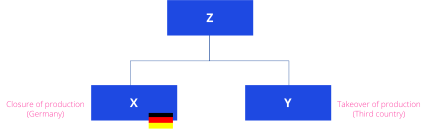
      In this case, Z, the group parent, decided to discontinue production at the German entity X. Production volumes had always been allocated to X by Z without contractual entitlement. When the site was closed, X sold its equipment—where usable—to other group companies. The foreign entity Y took over the production function and assumed the shutdown costs. No further compensation payments were made to X.

      The tax authorities treated these transactions as a transfer of functions from X to Y. The court rejected this view, holding that no assets, intangible advantages, or business opportunities had been transferred from X to Y. X did not possess an independent market position, as it relied on internal production allocations from Z. Y had already been capable of producing comparable goods prior to the restructuring, and no causal link existed between the termination of production at X and any transfer of functional capability. On this basis, the court found neither a transfer of functions nor a hidden distribution of profits.


      2. Judgment of the Lower Saxony Fiscal Court (FG Niedersachsen, 10 K 117/20, 3 August 2023) – Conversion of the business model to a European principal structure


      Visual representation of the 2nd judgment

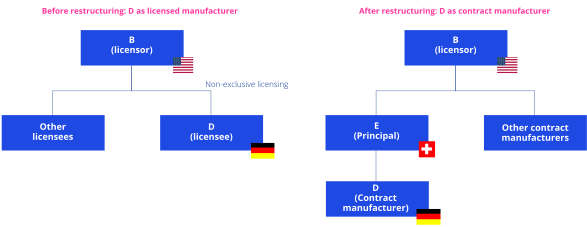
      This case concerned the implementation of a European principal structure. The German operating entities (collectively D) carried out manufacturing and distribution activities under a non‑exclusive license granted by B, the group licensor. Strategic and procurement‑related functions were exercised by foreign entities.

      From 2011, the Swiss entity E assumed the entrepreneurial role and D continued to operate as contract manufacturers and limited‑risk distributors. D received compensation payments amounting to one third of the expected profits for the premature abandonment of its own production and for the transfer of its customer base. However, major customers were not served by D in the old structure.

      The tax authorities viewed the restructuring as a transfer of functions. The court disagreed. It held that D’s operational activities remained essentially unchanged and that no tangible or intangible assets, including customer relationships or rights associated with the non‑exclusive license, had been transferred to E. Functions newly exercised by E had not previously been located in Germany. As no causal connection could be demonstrated, the court found neither a transfer of functions nor a hidden distribution of profits. The case is currently under review by the Federal Fiscal Court (Bundesfinanzhof, BFH).


      3. Judgment of the Federal Fiscal Court (BFH, I R 54/19, 9 August 2023) – Relocation of a distribution function


      Visual representation of the 3rd judgment

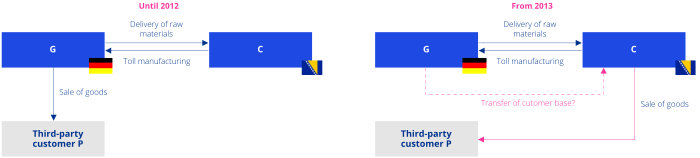
      Until 2012, the German company G supplied materials at cost to its Bosnian sister company C, which processed these materials into finished products. G purchased the goods back and resold them to the third-party customer P. From 2013 onwards, C supplied P directly, as G was unable to offer competitive pricing if production were carried out in Germany.

      The tax authorities assumed a hidden distribution of profits. The Federal Fiscal Court set aside the lower court’s decision and remitted the case for a renewed examination of whether the customer relationship with P had been transferred from G to C without appropriate remuneration.

      Regarding the analysis of a potential transfer of functions, the court held that the activities performed for P—i.e., the production for a single customer—could not be regarded as independent and that there was no organic part of a company, which in turn is a prerequisite for the existence of a function.

      The Federal Fiscal Court remitted the case to the lower court to assess whether a transfer of the customer relationship with P had occurred without adequate remuneration, which could indicate a hidden distribution of profits. The court also addressed methodological considerations, including the application of the cost‑plus method (excluding material costs supplied by G), the need for reliable benchmarking, and the allocation of location advantages. It further emphasized that § 1 AStG, applies only subsidiarily—at least for the years in dispute—if other income adjustment rules only permit adjustments to a lesser extent.


      4. Judgment of the Cologne Fiscal Court (FG Köln, 13 K 2752/20, 13 June 2024) – Transfer of functions only in the case of a transferred function


      Visual representation of the 4th judgment

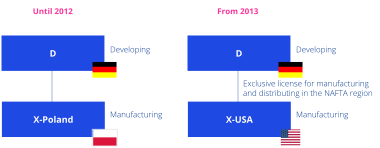
      The case concerned D, which undertook development activities related to the relevant automotive components, while manufacturing was performed by the Polish entity X-Poland. Sales for the North American market were handled by the U.S. entity X-USA. In 2013, D granted X-USA an exclusive license to manufacture and distribute the product in the North American Free Trade Agreement (NAFTA) region.

      During the tax audit, the tax authorities argued that D had previously exercised a production‑related function for the NAFTA region and had transferred this function to X‑USA through the licensing arrangement.

      The court found no evidence that D had ever carried out a coherent or independently organized business function specifically for the NAFTA region. Manufacturing was undertaken by X‑Poland, and D’s development work related to the product as a whole rather than to any regional responsibility. As no such function existed at D, the court held that no transfer of functions within the meaning of § 1 AStG had occurred. The court also noted that documentation shortcomings do not allow the tax authorities to assume the existence of a transfer of functions on the merits; the burden of proof remains with the tax authorities. The decision is final.

      Conclusion

      The cases discussed demonstrate how courts applied the former transfer of functions rules when examining cross‑border restructurings.

      Firstly, current case law shows, that in order for a transfer of functions to exist, a clearly separable organic part of a business must be transferred. Second, there must be a causal link between the functional restriction at one company and the functional expansion at the other company.

      From the taxpayer’s perspective, the current case law is welcome, as it provides concrete and relevant guidance on how to interpret the rules on functional relocations, particularly when it comes to decisions by the highest courts.

      Our KPMG Transfer Pricing experts would be pleased to assist you with any questions you may have.

      attach_email

      Current topics and developments relating to transfer pricing

      Your contacts