

For existing SAP customers, the migration to S/4HANA is the next step in the digital transformation. This requires the conversion of existing licences. SAP has now announced drastic changes to the conversion rules for contracts, which could lead to a sharp increase in licence and maintenance costs for many customers. To make SAP's licence policy more transparent for you, we have compiled information on the changes and their effects:
Possible ways of a contractual conversion to S/4HANA
The migration to S/4HANA is an important step for companies that requires careful preparation. In addition to the technical transformation, the main challenge lies in the conversion of licences and contracts. SAP offers existing customers two options for this: Product Conversion and Contract Conversion.
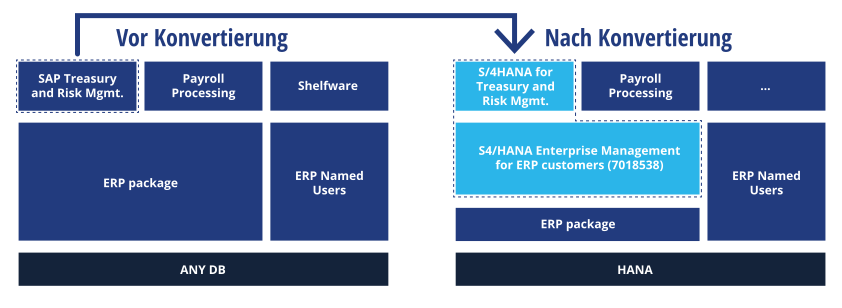
Product conversion is the option of a 1:1 conversion of classic "Industry & Line of Business" licences into new S/4HANA licences. With this procedure, the existing contract is only transferred in parts, as the products to be converted can be selected according to requirements. It is also possible to carry out several product conversions if the requirements are spread over a period of time. With this procedure, the old ERP named user licences remain in place and can continue to be used under S/4HANA in accordance with their definitions. The prerequisite for the product conversion is the flat fee, which includes the right to use S/4HANA Enterprise Management.
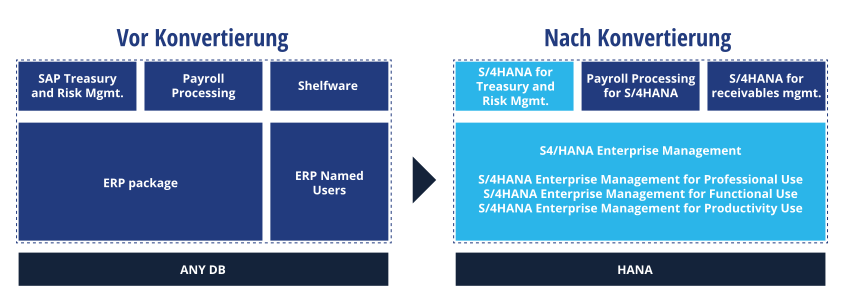
With contract conversion, on the other hand, the entire contract landscape is completely reorganised. Customers are given the opportunity to reconfigure their SAP contracts according to the "milkshake" principle. This means that unused software or shelfware can also be credited to new, unrelated software licences. However, it is assumed that at least 100 per cent of the existing maintenance base is always continued.
Both options have different advantages and disadvantages and may prove to be preferable depending on the company's objectives, situation and planning. Regardless of the option chosen, the usage rights of the legacy licences remain intact as long as the migration has not been completed.
Recent changes to the conversion regulations
In recent months, SAP has surprised its customers with two major changes to the framework conditions for conversion options. The first change related to Product Conversion and meant that the familiar flat fee ("SAP S/4HANA Enterprise Management for ERP customers") was removed from the price and conditions list (PKL) at the start of the second quarter of 2023. As a result, product conversion will only be possible for companies that have already purchased the flat fee.
In the course of the recently published price list for the third quarter, SAP has also changed the framework conditions for contract conversion, namely the crediting factors for existing licences. Previously, a conversion credit equal to the lower of 100 per cent of the previous maintenance base or 90 per cent of the net payment of the new transaction was granted. With immediate effect, SAP has now reduced the credit factor to 80 per cent of the maintenance base. There will be no defined exceptions or transition period. In addition, a staggered approach has already been announced for the coming years, whereby the crediting factor will be reduced by ten percentage points each year from 1 January 2024. SAP has not yet given specific reasons for the reduction, but the targeted cloud business appears to be a possible justification.
Economic consequences for customers
The current changes have some serious consequences for companies and put them under pressure to make decisions. Economically, this means that customers will either have to accept a high loss in value of their existing licences or pay an increase of 25 percent of the existing maintenance base. By way of comparison: previously, the maintenance base only had to be increased by a factor of 1.11 for legacy licences to be fully credited.
Even if, in the opinion of experts, it was to be expected that SAP would change the crediting rules sooner or later, the lack of communication and transparency towards customers is the real problem. Many companies are now forced to examine the effects of the changed conversion rules under time pressure and evaluate the various scenarios according to their own objectives and from a profitability perspective. As early as the beginning of next year, the chargeable value would otherwise be reduced by a further 10 per cent or require an increase of around 42 per cent (17 percentage points), which is hardly a realistic additional requirement for any company.
Be proactive and look into ways to convert contracts now
With the latest changes to the framework conditions for product and contract conversion, SAP has presented its existing customers with a fait accompli and imposed new pressure on decision-makers. For companies that have not yet contractually converted to S/4HANA, these changes could mean significant financial disadvantages and additional costs. It is therefore more advisable than ever to scrutinise the individual options for contract conversion and reconcile them with your own goals and plans. Our experts will advise you on the path to a successful and sustainable S/4HANA migration. They will be happy to help you evaluate your current contracts, check the cost-effectiveness of a contractual conversion and work out a cost-optimised solution for you.
More KPMG insights for you


Your contact

Dmitrij Spolwind
Partner, Consulting, Lighthouse Germany - AI & Data Solutions
KPMG AG Wirtschaftsprüfungsgesellschaft

- Item 1
- Item 2