

International trade relations between the US and the EU are once again tense. In recent weeks, the US government has announced and partially implemented several far-reaching tariff measures that could potentially have a significant impact on European - and therefore German - companies in particular.
Trade tensions with an impact on supply chains and investments
Recent announcements by President Donald J. Trump regarding possible additional tariffs on top of the previously agreed all-inclusive tariff ceiling of 15 per cent on EU imports threaten the successful conclusion of the trade agreement between the US and the EU, which was first drafted in the summer of 2025.
These tariff measures and the countermeasures taken by other countries in this context require a high degree of attention and not only affect the level of duties in the US, but also have an impact on international supply chains.
Relevance of the US additional tariffs for German companies
The issue remains highly relevant for German companies. Germany is one of the world's largest export nations - particularly in the areas of motor vehicles, machinery, chemical products and electrical engineering. Many of these exports traditionally go to the USA. Due to this export-orientated economy and the considerable trade surplus with the USA, Germany is particularly vulnerable to the current changes in customs duties.
The executive order signed by President Donald J. Trump, which provides for at least a general minimum import tariff of 10 per cent on all imports into the USA, further increased the uncertainties. The US administration also plans to increase tariffs for countries with high trade surpluses, such as Germany and the EU. The aim of these measures is to address existing trade deficits, create fairer competitive conditions in the US market and reduce dependence on foreign production.
These measures and their partial and temporary suspension and reinstatement created major uncertainties for German companies in recent month - both in the supply chain and for investments.
We summarise the current status and highlight steps that companies should consider when assessing and managing risk in the current environment.


Current developments
- February 2026
- August 2025
- July 2025
- June 2025
- May 2025
- April 2025
- March 2025
20 February 2026: US announces additional tariffs above agreed limits after US Supreme Court rules IEEPA tariffs unlawful
Recent announcements by US President Donald Trump regarding further additional tariffs exceeding the previously agreed all-inclusive tariff cap of 15 per cent on EU imports jeopardise the successful conclusion of the trade agreement between the US and the EU, which was first drafted in the summer of 2025.
On 20 February 2026, the US Supreme Court ruled that some of the tariffs imposed by the President were unlawful. The President himself had argued that the tariffs were crucial to the economic security of the US, but the court did not agree with this argument.
In an initial response, Donald Trump announced additional tariffs of 10 per cent, according to official White House statements. In public discussions, the US President is now calling for a 15 per cent surcharge.
If further talks between the US and the EU fail to produce an agreement, it is conceivable that the EU will respond with a strategy of proportional retaliation, reactivating previously suspended tariffs (approx. €21 billion) and imposing additional tariffs on various US products (approx. €72 billion). This would allow political pressure to be exerted on the US without placing an excessive burden on the EU's own economy.
21 August 2025 – EU and US publish joint statement on transatlantic trade and investment
On 21 August 2025, the EU and the US published a joint statement containing further details of the political agreement already reached on 27 July 2025. The statement confirms the previously agreed tariff cap of 15% for EU products and provides important specifics. These include the US commitment to apply the all-inclusive tariff cap of 15% to passenger cars and car parts from the first day of the month in which the EU initiates the procedures to implement the tariff reductions agreed in the agreement. Until now, US tariffs of 27.5% have continued to be levied on passenger cars and motor vehicle parts.
18 August 2025 – Extension of steel and aluminium tariffs to other product categories
The Bureau of Industry and Security (BIS) announced in a notice dated 18 August 2025 that the list of products considered to be steel or aluminium derivatives will be expanded to include 407 codes from the Harmonised Tariff Schedule of the United States (HTSUS). For these products, steel and aluminium tariffs pursuant to Section 232 of the Trade Expansion Act will be applied to the respective steel or aluminium content. Components that are neither steel nor aluminium will continue to be subject to reciprocal and other relevant tariffs. The product groups affected include motorcycles, railway carriages, crane vehicles and pumps. The complete list of affected HTSUS codes can be found in Annex I of the notice. The new tariffs on steel and aluminium derivatives listed in Annex I apply to goods placed on the market or removed from storage on or after 18 August 2025.
11 August 2025 – US and China extend tariff suspension
On 11 August 2025, US President Trump signed an executive order extending the suspension of increased tariffs on Chinese goods for a further 90 days. This prevented the tariff surcharges from coming into effect on 12 August 2025, after which the suspension period of the executive order of 12 May 2025 would have ended as scheduled (see ticker message of 12 May 2025). The Ministry of Commerce of the People's Republic of China then announced that it would also extend its suspension period by 90 days. If no solution to the tariff dispute between the two countries is found by 10 November 2025, tariffs of up to 145% will come into effect.
7 August 2025 – Entry into force of the amended reciprocal tariffs
The announced adjustments to reciprocal tariff rates in accordance with the Executive Order of 31 July 2025 (see ticker message dated 31 July 2025) come into force. In addition to the EU, almost 70 other countries are affected by the changed tariff rates.
31 July 2025 – US government publishes list of adjusted reciprocal customs duties for some trading partners
In an executive order dated 31 July 2025, US President Trump announces that the country-specific reciprocal tariff rates previously in force will be adjusted. The adjusted country-specific tariff rates can be found in Annex I of the executive order. For all countries not listed in Annex I, the basic tariff rate of 10% continues to apply.
The changes to the reciprocal additional tariffs are to come into force on 7 August 2025.
30 July 2025 – Suspension of the de minimis rule and announcement of additional tariffs on copper of 50%
In an executive order, US President Trump suspends the de minimis rule, thereby eliminating the tariff exemption for low-value commercial shipments (less than $800) worldwide. Previously, the suspension of the exemption only applied to small shipments from China. The suspension of the de minimis rule will take effect on 29 August 2025.
During the first six months after this regulation comes into force, companies can decide whether to pay a flat fee per parcel or apply the customs duty at the IEEPA tariff rate applicable to the country of origin of the goods. Subsequently, all shipments will be subject to the country-specific IEEPA tariff rate.
In addition, the White House announced in a proclamation that additional tariffs of 50% on imports of semi-finished copper products and intensive copper derivatives into the US will come into force on 1 August 2025. The copper tariffs under Section 232 of the Trade Expansion Act apply exclusively to the copper content of goods covered by this proclamation. The non-copper content, on the other hand, is subject to reciprocal tariffs and all other applicable tariff regulations (including IEEPA additional tariffs on Canada, Mexico and China). Refined raw materials such as copper cathodes, copper ores and concentrates are exempt from the new additional tariff.
27 July 2025 – Political agreement on agreement between the EU and the US – Joint political declaration of intent lacking
On 27 July 2025, the EU and the US agreed on a trade agreement that provides for a maximum basic tariff rate of 15% for EU exports. This is to come into force on 1 August 2025 and will represent an upper limit that also includes the US most-favoured-nation tariff. Exceptions apply to certain strategic products, including those in the chemicals, aviation and natural resources sectors. For goods from these sectors, tariffs are to be reduced to January levels. In addition, the EU announced in a letter dated 29 July 2025 that a lower tariff rate is planned for steel, aluminium and copper goods, compared to the current tariff rate of 50%.
Important: The EU considers the political agreement to be non-binding. There is no joint political declaration of intent at this time.
7 July 2025 – US government extends deadline for reciprocal tariffs until 1 August 2025
In an executive order on 7 July 2025, the White House announced that the 90-day suspension of reciprocal US tariffs, which was originally set to expire on 9 July 2025, would be extended to 1 August 2025. In addition, letters were sent to 14 countries in which the US government specified its new reciprocal tariff rates, which are to come into force on 1 August.
16 June 2025 – The White House publishes an executive order implementing the trade agreement with the UK
On 16 June 2025, the White House published a new implementing regulation providing instructions for implementing the trade agreement between the US and the UK, which was announced on 8 May 2025 (see ticker message dated 8 May 2025). Specifically, it describes instructions for the automotive, aerospace, steel and aluminium sectors. For motor vehicles, the regulation stipulates that the first 100,000 vehicles imported into the US by British car manufacturers per year will be subject to a total tariff rate of 10%, and all other imported vehicles will be subject to a tariff rate of 25% under Section 232 of the Trade Expansion Act. In addition, motor vehicle parts originating in the United Kingdom and intended for use in British vehicles will be subject to a total tariff rate of 10%. For aerospace, the regulation stipulates that certain products from the United Kingdom will no longer be subject to tariffs. No specific instructions have yet been issued for steel and aluminium products and their derivatives. Products that do not fall under these quotas or do not meet certain requirements will continue to be subject to the existing tariffs under Section 232.
12 June 2025 – Section 232 of the Trade Expansion Act is extended to include additional products
On 12 June 2025, the Department of Commerce announced that the list of products covered by Section 232 of the Trade Expansion Act would be expanded. From 23 June 2025, household appliances such as refrigerators, washing machines and freezers, which are considered "steel derivative products" under the US government's expanded steel tariffs, will also be subject to 50% punitive tariffs.
4 June 2025 – US government raises import duties on steel and aluminium to 50%
On 3 June 2025, the White House announced that President Trump had signed a proclamation raising import duties on steel and aluminium products to 50%. This measure, based on Section 232 of the Trade Expansion Act of 1962, came into effect on 4 June 2025. The new tariffs apply exclusively to the steel and aluminium content of imported goods, while the non-steel and non-aluminium content is subject to other tariffs. The proclamation also contains amendments to the Harmonised Tariff Schedule of the United States (HTSUS) and stipulates strict compliance with reporting requirements for steel and aluminium content. For imports from the United Kingdom, tariffs will remain at 25% for the time being, until possible adjustments are made under the US-UK trade agreement on 9 July 2025.
31 May 2025 – United States Trade Representative (USTR) extends exemptions for certain products affected by Section 301 tariffs on China
The USTR has decided that the exemptions under Section 301 – Investigation of China's Actions, Policies, and Practices Related to Technology Transfer, Intellectual Property, and Innovation – should be extended. The exemptions were originally set to expire on 31 May 2025. Specifically, the USTR concluded that a three-month extension of the 164 exemptions extended in May 2024 and the 14 exemptions granted in September 2024 is appropriate. The extensions apply to goods that are released for free circulation or withdrawn from free circulation between 1 June 2025 and 31 August 2025.
29 May 2025 – Court of International Trade (CIT) declares tariffs under the International Emergency Economic Powers Act (IEEPA) to be unlawful; Court of Appeal temporarily reinstates tariffs while proceedings continue
On 29 May 2025, the US Court of Appeals for the Federal Circuit temporarily suspended a decision made immediately beforehand by the US Court of International Trade (CIT). This decision had found that the tariffs imposed worldwide by the Trump administration under the International Emergency Economic Powers Act (IEEPA) did not meet the legal requirements of an "unusual and extraordinary threat". Furthermore, the IEEPA tariffs against Canada, Mexico and China did not address the underlying emergencies. The CIT had also emphasised that the primary authority to impose tariffs lies with Congress. With the Court of Appeals' suspension of the CIT's decision, the IEEPA tariffs are temporarily reinstated and will remain in effect until the appeal process is complete.
20 May 2025 – U.S. Customs and Border Protection introduces tariff changes to combat "tariff stacking" (addition of different tariffs)
U.S. Customs and Border Protection has published a notice regarding the implementation of tariff changes in accordance with Executive Order 14289, which concerns the elimination of overlapping and historically cumulative tariffs on certain imported items.
Effective 16 May 2025, the Harmonised Tariff Schedule of the United States (HTSUS) will be amended for the affected items. The changes provide for the prioritisation of tariff measures to prevent overlap.
The notice also sets out the conditions under which goods that receive preferential treatment under the United States-Mexico-Canada Agreement (USMCA) will be exempt from certain additional tariffs. In addition, importers can apply for a refund of tariffs paid that are not required under the new regulation.
12 May 2025 – US and China announce trade agreement
The governments of the United States and China today issued a joint statement following the negotiation of a trade agreement aimed at reducing tariffs and eliminating retaliatory measures. According to a White House fact sheet, the agreement calls for both countries to suspend their 34% tariffs announced in April 2025 for 90 days until 14 May 2025, while maintaining a 10% tariff during that period, and to remove additional tariffs and other retaliatory measures imposed later in April 2025. Once these changes come into effect, both countries have agreed to establish a mechanism to continue important discussions on trade and the economy.
8 May 2025 – The White House announced a trade agreement with the UK on tariffs and economic cooperation
The White House announced that a trade agreement had been reached between the US and the UK, whereby the first 100,000 vehicles imported annually from British manufacturers would be subject to a 10% tariff, while additional vehicles would be subject to a 25% tariff; alternative arrangements to the Section 232 tariffs on steel and aluminium are also being negotiated. The Economic Prosperity Deal (EPD) aims to remove trade barriers, strengthen economic exchange and reduce tariffs, particularly on beef and pharmaceuticals, with a focus on digital trade, economic security and intellectual property rights. The agreement takes effect immediately but is not legally binding and is intended to be expanded over time.
29 April 2025 – The White House announces a tariff adjustment on automotive components
On 29 April 2025, the White House published a proclamation by President Trump concerning the adjustment of tariffs on imports of automotive parts into the United States. According to a White House fact sheet, the proclamation offers compensation for a portion of the tariffs on vehicles assembled in the United States. Manufacturers will receive tariff compensation in the following amounts: From 3 April 2025 to 30 April 2026: Compensation of 3.75% of the manufacturer's suggested retail price (MSRP) for vehicles produced in the United States. This corresponds to the total tariff amount that would be payable if a 25% tariff were applied to parts representing 15% of a vehicle's MSRP.
From 1 May 2026 to 30 April 2027: Compensation equal to 2.5% of the MSRP of US production, which corresponds to the total tariff amount that would be payable if a 25% tariff were applied to parts representing 10% of a vehicle's MSRP.
The proclamation provides that the Secretary of Commerce shall establish a procedure within 30 days through which manufacturers may apply for import adjustment compensation.
24 April 2025 – The US lifts the de minimis exemption for low-value imports from China and Hong Kong
U.S. Customs and Border Protection (CBP) has announced new customs regulations for imports from China and Hong Kong. From 2 May 2025, the de minimis rule for products from China with a value of up to $800 will be suspended. New tariffs will include either a 120% ad valorem duty or a specific duty of $100 per postal shipment, which will increase to $200 from 1 June 2025. All goods shipped via the international postal network are affected. These measures follow the national emergency declared on 20 January 2025 due to the threat of illegal drugs and immigration. The emergency was extended to take into account China's failure to control suppliers of chemical precursors. Companies should prepare for increased import costs and adjust their logistics strategies accordingly.
14 April 2025 – EU suspends countermeasures against US tariffs
Following the suspension of reciprocal US tariffs against the EU and the reduction of these tariffs to 10% for a period of 90 days, the European Union (EU) has decided to suspend its countermeasures against US trade tariffs for 90 days as well, in order to gain time for negotiations.
12 April 2025 – Suspension of additional tariffs on certain electronic devices originating in China
Suspension of additional tariffs on certain electronic devices originating in China 10 April 2025 – Reciprocal tariffs largely reduced to minimum tariff rate of 10%
Reciprocal tariffs largely reduced to a minimum tariff rate of 10%
9 April 2025 – Higher tariffs for countries with trade surpluses
Increase in tariff rates for trade surpluses: For countries with a particularly high trade surplus with the United States, an individual, increased tariff rate will be introduced from 9 April. The specific list of countries affected and the corresponding tariffs are set out in Annex I of the Executive Order. The additional tariff for all exports from the EU to the US is therefore 20 per cent.
US content rule and exemptions: The new Executive Order provides for exemptions for goods shipped before 5 April 2025. In addition, a "US content rule" is being introduced, which states that tariffs will only be levied on the non-US portion of a product if at least 20 per cent of the product's value originates in the US. This rule is intended to ensure that multinational supply chains with a substantial proportion of US components receive preferential treatment.
The above measures are separate from the tariffs previously imposed by the US on Canada, Mexico and China, which led these countries to announce countermeasures of their own.
2 April 2025 – New tariffs and expansion of US measures
Introduction of a minimum tariff rate: A new US executive order dated 2 April 2025 significantly expands the previous measures by introducing a general minimum tariff of 10 per cent on all imports, regardless of product category and country of shipment. This represents a significant tightening of the previous tariffs, as a wider range of products is affected.
26 March 2025 – Tariffs on motor vehicles and motor vehicle parts
Publication of an executive order: On 26 March 2025, President Trump publishes a new executive order announcing a 25 per cent tariff on US imports of motor vehicles and motor vehicle parts.
The 25 per cent tariff rate is to apply to vehicles imported into the US from 3 April 2025 and is expected to be extended to vehicle components (such as engines, powertrains and electrical components) on 3 May 2025.
With regard to the previously announced 25 per cent tariffs on motor vehicles and motor vehicle parts, as well as steel and aluminium products, the latest regulation does not make any changes to the tariffs. However, specific exemptions and adjustments are being introduced with the aim of mitigating the impact on certain product categories. In particular, the introduction of the "US content rule" offers companies whose products contain a significant proportion of US components the option of applying the tariffs only to the non-US origin portion.
In addition to these steel and aluminium products, which are already subject to Section 232 tariffs, motor vehicles and parts, which have been subject to a 25 per cent tariff since 3 April, are also exempt from the additional tariffs. Other exemptions include pharmaceuticals, semiconductors, energy products and critical minerals, as well as humanitarian aid supplies. A detailed list of these exemptions is contained in Annex II of the above-mentioned Executive Order.
12 March 2025 – Additional tariffs on steel and aluminium Imposition of tariffs
On 12 March 2025, the US will impose additional tariffs on imports of steel and aluminium from all countries into the US, including products that may contain steel or aluminium. Specifically, the measures will result in:
Reintroduction of a 25 per cent tariff on steel products and products made from them (e.g. steel pipes, wire and tin foil) and termination of all previous country agreements. Increase in the tariff from 10 per cent to 25 per cent for aluminium and increase in the tariff for other steel and aluminium products.
The tariffs affect a wide range of products, including cookware, window frames, machinery, certain electrical appliances and furniture. These measures were first announced by the US on 12 February 2025 and will affect EU exports to the US worth around €26 billion (5 per cent of total EU goods exports to the US).
EU response: The EU is responding by announcing that the countermeasures originally introduced against the US in 2018 and 2020, but then suspended, will be reintroduced with effect from 1 April 2025. However, the EU has postponed the reinstatement date to mid-April. These measures were taken in response to the steel and aluminium tariffs introduced during Donald Trump's first term in office, but were then suspended when the US agreed to suspend its measures against EU exporters within a certain quota.
The EU countermeasures will result in the EU imposing additional tariffs on a range of US imports, including Harley-Davidson motorcycles, bourbon, orange juice, jeans, steel and aluminium. A two-week consultation will be launched to identify additional US products to be subject to new EU tariffs. These new tariffs are expected to be introduced by mid-April. The proposed products affected include a combination of industrial and agricultural products (steel and aluminium products, textiles, leather goods, household appliances, tools, plastics, wood products, poultry, beef, certain seafood, nuts, eggs, dairy products, sugar and vegetables).
Demo video: KPMG Tariff Simulator
Create forecasts based on real customs data and determine the financial impact of new or changed customs tariffs.
International trade policy in focus: tariffs, conflicts and corporate strategies
General customs duties in the EU and the USA
The weighted average tariff rate in the EU and the USA is around 1 per cent. While most goods are subject to a duty rate of 0 per cent, there are significant duties in certain categories:
| Product category | EU tariff | USA tariff |
| Motor vehicles | 10 % | 2,5 % |
| Dairy products | 30 % | 17 % |
| Petroleum products | 2,5 % | 6,5 % |
It is important to note that these are only broad examples and the exact specification of a product is required to determine the applicable duty rate. The EU and the US have free trade agreements with many countries around the world (e.g. the EU with the UK, Canada, Japan and South Korea; the US with Mexico and Canada). However, no such agreement exists between the EU and the USA.
Therefore, importers to the EU cannot claim preferential tariffs (typically 0 per cent) on US products, just as importers to the US cannot claim preferential tariffs on EU products.
Additional duties: Not all goods affected
Additional duties do not automatically apply to all goods traded between the EU and the USA. The decisive factor is the origin of the goods - this determines whether an additional duty is levied.
The USA provides for both sector-specific additional tariffs and so-called reciprocal tariffs, which are linked to the country of origin of the goods concerned.
The determination of origin is based on where a product was last substantially processed or treated. It is often complex and should be checked carefully.
Effects on Germany
The EU's trade in goods with the USA accounted for 17 per cent (EUR 865.0 billion) of the EU's total foreign trade turnover (imports and exports) in 2024.
Of this amount
- 161.4 billion euros were exports from Germany and
- 91.5 billion euros to imports to Germany.
Due to this high trade surplus (69.9 billion euros) in goods, Germany, among others, is the focus of President Trump's administration. As Germany's export economy is mainly driven by motor vehicles and parts, machinery and chemical products, these sectors are particularly - but not exclusively - affected by potential US tariffs and non-tariff measures.
However, the US government considers value-added tax (VAT) to be a form of customs duty. This could mean that even goods that are subject to little or no customs duty when imported into the EU (e.g. pharmaceuticals and electronics) could be subject to high customs duties when exported to the USA.
In addition, the EU's countermeasures mean that many German companies will have to expect higher costs. In view of the more comprehensive US measures, particularly against China, Mexico and Canada, and the risk of a further escalation of the trade dispute in the near future, it is crucial for companies to precisely understand the impact of the measures and closely monitor developments.
Recent announcements by President Donald J. Trump regarding further additional tariffs are causing uncertainty regarding the planned joint trade agreement. The EU has criticised the US threats of further additional tariffs, emphasising that these are not conducive to ensuring fair trade for both sides. However, this was firmly agreed as the goal of a joint trade agreement: tariffs should not be raised above the agreed upper limit. The EU itself now has the task of assessing the current situation and examining the impact of these additional tariffs on the EU. EU imports are to be subject to significantly higher tariffs than the agreed base rate of 15 per cent.
Just a few days ago, the US Supreme Court declared some of the tariffs imposed by the President to be unlawful because the US government invoked an emergency law. The judges ruled that this did not constitute a valid legal basis for imposing additional tariffs. The President himself had argued that the tariffs were crucial for the economic security of the US – the judges contradicted this assertion in their ruling.
Possible development of the trade conflict
The situation remains dynamic and is changing almost daily. However, the pattern already seen in the summer of 2025 is emerging once again: the US announces measures, suspends some of them, but at the same time threatens further action.
The US has initially declared a national emergency based on the large and persistent annual trade deficits in goods that are considered a threat to national security and the economy. Most recently, the White House invoked a 1974 trade law that allows it to impose tariffs on imports for up to 150 days. Experts, however, doubt whether the legal basis for the temporary tariffs is even fulfilled in this case.
German companies should remain aware that the tariff dispute could also affect supply chains outside EU/US trade. As the US imposes new tariff measures on goods imported into the US from other countries around the world, manufacturers from these countries will look for new markets to sell their goods.
The risk is that foreign manufacturers, such as Chinese producers, will focus on the EU market, which in turn could prompt the EU to introduce measures to protect EU manufacturers. As a result, companies that currently pay no or only low tariffs on imports of goods from third countries into the EU could find that these tariffs also increase due to potential EU protective measures.
Possible courses of action for companies
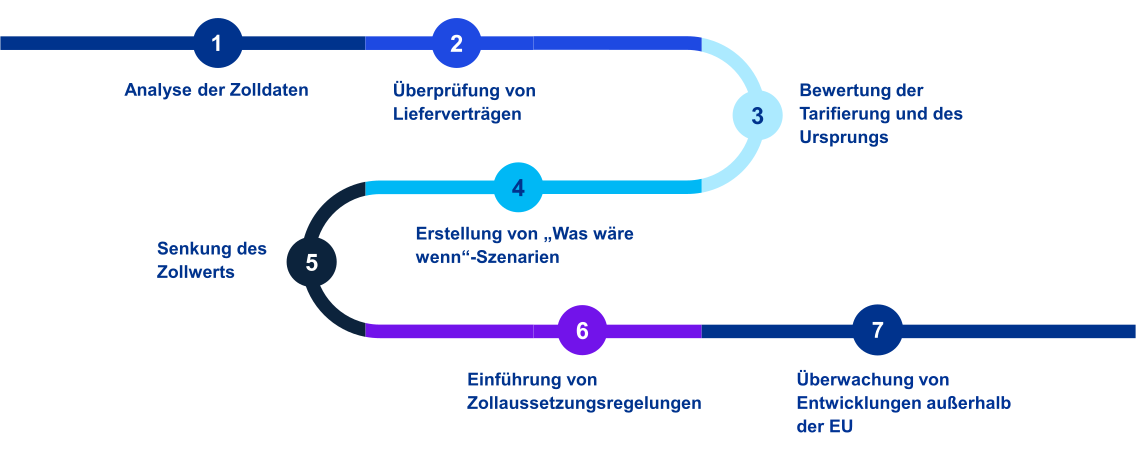
As a first step, we recommend that companies gain a complete and detailed understanding of their supply chain. They should be aware of which suppliers they source what type of products from, which country these products come from and how possible measures could affect purchases and sales.
With the KPMG Trade Data Check, we have developed a tool that can provide a detailed insight into your flow of goods based on your customs data.

Recommended steps for risk assessment and minimisation:
US-Zölle: Impact & Strategy Assessment
Auswirkungen von Handelszöllen auf die Finanzberichterstattung
Auszug aus den Accounting News – Ausgabe Mai 2025
How can KPMG help?
With a team of over 800 customs consultants worldwide, KPMG helps companies to effectively manage the uncertainties created by the new US tariffs and EU countermeasures. A holistic approach is used that aims to minimise risks while identifying and exploiting opportunities within global supply chains. Support is provided through the following measures, among others:
- Analyse trade/customs data to gain visibility of the supply chain, risks and opportunities.
- Use our customs tools to model the impact of customs measures on businesses.
- Quantify customs scenarios and costs under different "what-if" conditions.
- Identify opportunities to utilise bonded warehouses, inward processing, free trade zones and drawback to achieve savings.
- Review tariff classification and origin to avoid or minimise potential duty increases.
- Review valuation methods to reduce customs valuation bases.
- Continuously monitor developments to stay informed about the current situation.
For further information on the impact of current customs measures on your company and the resulting strategic options for action, Mario Urso and the Trade & Customs team at KPMG will be happy to provide you with in-depth expertise, tried-and-tested tools and customised solutions for a personal meeting.
More KPMG insights for you


Your contacts


- 1
- 2
- 3