

      The fiscal strategy is 'hold the line and hope for the best', with an economic forecast worse in the short term, but optimistic in the medium term. Budget 2026 provides relatively limited support for businesses and households. It acknowledges the cost pressures of an ageing population and takes a cautious approach to fuel supply disruption and energy resilience.

      Positioned as a conservative budget, spending in Budget 2026 remains high, with $14.6b additional operating over 4 years. New spend primarily addresses cost pressures in health with $5.8b in funding, in addition to funding announced for education, Defence and law and order initiatives ahead of budget. The Government fiscal position relies on $2b of public sector cuts from 2028 onwards in the face of increasing inflation, which have not yet been planned out. This amounts to an additional 10% savings expectation on top of the existing 2% cut - and on top of an expected 5% inflation adding cost pressures. 
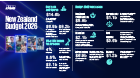
      View the infographic

      New Zealand Budget 2026

      Key facts and figures

      All we expected, and more.


      The economic forecast is optimistic in the medium term

      Budget announcements acknowledge that economic forecasts will worsen in the short term, with inflation rising to 4% and unemployment increasing to 5.5% in the 2026 year. Forecasts are optimistic in the medium term with the fuel crisis expected to pass soon, and economic growth to improve.

      The operating deficit will be the largest since 2019/20 at $11.9 billion (2.6% of GDP) in 2025/26 with a slight improvement to $11.4 billion (2.4% of GDP) in 2026/27, and a return to a small surplus in 2028/29 and increasing in 2029/30.

      Economic growth will be positive but minor at 1.2% to June 2026, but is expected to increase to 2.3% in June 2027 and 3.2% in June 2028.

      Overall, forecasts are optimistic. Treasury forecasts show there are significant downside risks and there is a high degree of uncertainty around fuel supply and oil costs. On the downside, scenario inflation could surge to 5.4% by the September 2026 quarter, and economic activity could be weaker, with unemployment expected to peak at 5.8%.

      There is ongoing reliance on borrowing to get through the short-term challenges. Net core crown debt as a share of GDP continues to increase and is expected to peak at 46.1% of GDP in 2027/28 before gradually declining from 2027/28.

      Welcome tax relief to investors

      Tax changes will have a mixed impact for businesses and employers with:

      • fringe benefit tax for motor vehicles simplified but likely to increase tax bills for some employers,
      • non-resident contractors tax simplified and overall withholding obligations reduced which should help reduce overall costs,
      • changes to the research and development tax incentive seeking to balance the integrity of the regime with flexibility for compliance, some businesses will be disappointed with the proposed cap on non-administrative internal software, but others will be pleased with the ability to claim credits during the year. 

      Read our Budget 2026 Taxmail for a full rundown.

      Budget 2026 provides relatively limited support for businesses and households

      What may come as a disappointment to many, is the lack of investment in cost-of-living relief for families, with a reliance on economic improvement in the medium term to address cost-of-living challenges. High fuel prices are expected to weigh on household spending and business activity over mid-2026, causing unemployment to rise to 5.5% in the June 2026 quarter. Budget 2026 does introduce some tax changes that will benefit investors and shareholders, and changes to the fringe benefit tax (FBT) regime. Capital spend and infrastructure will help with supply chain improvements with investment in new roads and rail maintenance. 

      The cost of the ageing population is here

      The budget recognises the increasing cost of the ageing population but, like many previous budgets, avoids any significant response to it. The Minister of Finance did indicate that this will be an election issue and that there is policy to be announced.

      The cost of NZ Super is increasing from $24.7 billion in 2025/26 to $31.2 billion in 2029/30. This is largely due to an increase of 125,000 new recipients, taking the total to over $1million by 2027/28. $5.5 billion is allocated to rapidly increasing health system costs.

      Capital spending is targeted on maintaining core assets

      The Government has committed up to $1.075 billion to KiwiRail’s planned network investments between 2027-2030, alongside $106.9 million to continue critical metropolitan rail infrastructure renewals. The Government has not indicated where in New Zealand this funding will be focused.

      About $60b is expected to be spent on infrastructure over the next four years, of which just under $7b is new spending. This spending is targeted on core crown assets with $1.8b on new roads, hospitals and new schools.

      In addition to the rail network, Budget 2026 does pay some attention to maintenance of roads, Defence assets, schools and police stations.

      What may be perceived as a relatively low spend, but which is likely to receive a lot of attention, is the Government commitment of $400m for councils to encourage housing growth through an incentive fund.

      There is a cautious response to the fuel crisis and energy resilience

      Budget 2026 will deliver $153.6 million in funding for Health New Zealand to expand national cyber security monitoring, strengthen data security processes, and deliver critical IT safety upgrades across the health system.

      Regarding fuel and energy security, Budget 2026 recognises these as immediate issues and incorporates targeted funding for emergency services and support workers. Around $600m has been ring-fenced for the fuel response with $150m for additional fuel reserves and $450m in contingency funding. 

      Defence and law and order are the big winners of this budget

      Defence has been provided additional operating funding of $1.2b and $2.3b in capital. Corrections receives $500m for frontline services.

      Related insights

      window

      The Government can use lessons from overseas to inform the overhaul of its digital services
      window

      To facilitate a coherent AI system in government there are five clear gaps for public sector leaders to address.
      window

      Brought to you by our tax experts, Taxmail aims to inform, engage, and provoke discussion on key tax policy developments and their impact on New Zealand business.

      Get in touch

      Jack Carroll

      Partner - Consulting

      KPMG in New Zealand

      Jesse Phillips

      Partner - Deal Advisory, Wellington

      KPMG in New Zealand

      Rachel Piper

      Partner - Tax

      KPMG in New Zealand

      Tony Evans

      Partner – Digital

      KPMG in New Zealand


      Gwen Riley

      National Managing Partner - Tax

      KPMG in New Zealand

      Matthew Prichard (he/him)

      Governance Board Chair

      KPMG in New Zealand

      Sladja Lines

      Director - New Zealand Tax Policy Lead

      KPMG in New Zealand