
Economic growth across Europe is expected to remain modest over the next two years, with Eurozone GDP forecast to grow by 1.1% in 2026 and 1.5% in 2027, according to KPMG’s latest European Economic Outlook.
Domestic demand is expected to be the main driver of growth as Europe navigates a more uncertain global trading environment and continues to realign its trade relationships.
Although recent trade agreements with India and Mercosur are important strategic steps for the EU after many years of talks, they won’t have an immediate significant economic impact. The amount of trade between countries is still relatively small and it will take time for existing tariffs to be removed. As a result, any real boost to economic growth is likely to happen slowly and over a longer period.
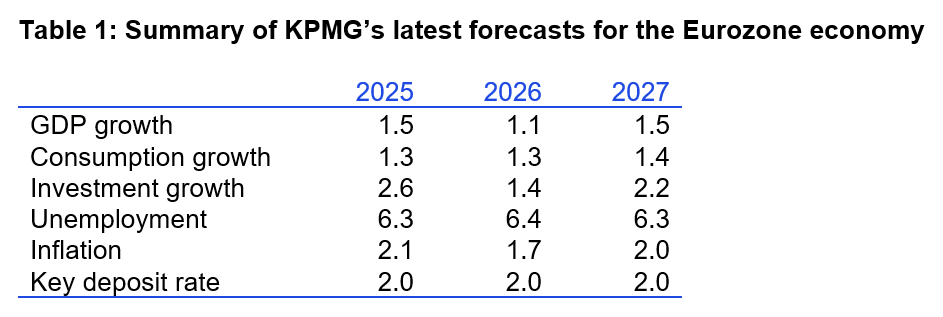
Source: KPMG projections using Oxford Economics' Global Economic Model. GDP, consumer spending and investment are all measured in real terms. Average % change on previous calendar year except for unemployment rate, which is average annual rate, while interest rate represents level at the end of calendar year. Investment represents Gross Fixed Capital Formation. Inflation is measured as HICP.
Yael Selfin, KPMG Chief Economist, EMEA, said: “Europe is entering a period where growth will rely less on external tailwinds and more on domestic fundamentals.
“While new trade deals enhance strategic resilience, they are unlikely to deliver a significant short-term boost. Instead, fiscal support, easing inflationary pressures and investment conditions will be key to sustaining momentum.”
Lower inflation opens door to stable rates
Headline inflation in the Eurozone is forecast to fall to 1.7% in 2026, below the European Central Bank’s (ECB) 2% target, driven in part by easing energy price effects. As a result, the ECB is expected to keep interest rates unchanged over the near term.
At the same time, quantitative tightening (QT) programmes may be approaching their end. With central bank balance sheets having already reduced significantly since 2022, further tightening risks unsettling financial markets.
An end to QT could ease upward pressure on long-term borrowing costs, supporting business investment and government finances. In the UK, this could add around £5 billion to the Chancellor’s fiscal headroom by lowering debt interest costs.
Domestic demand to underpin growth
With external headwinds intensifying, Europe’s growth outlook increasingly depends on household consumption. While savings rates remain elevated and consumer confidence subdued, resilient labour markets and strong nominal wage growth are expected to support real disposable incomes and sustain modest consumption growth through 2026.
However, a sharp acceleration in spending appears unlikely, with households expected to remain cautious amid lingering economic uncertainty. Consumer prudence could persist into the second half of 2026, with savings rates remaining elevated.
AI adoption offers long-term productivity gains
AI is emerging as a key potential driver of Europe’s long-term productivity and growth. Around 37% of EU firms report some degree of AI adoption, broadly in line with the US, although uptake varies widely across countries*. Finland, Denmark and the Netherlands lead, while southern European economies lag behind.
Europe’s industrial and occupational structure makes it relatively well suited to early applications of generative AI, KPMG estimates around 2.5% of tasks currently performed by workers will potentially be subject to automation. While AI-related unemployment risks are expected to remain low over the long term, active retraining and labour market policies will be important to support workers during the transition.
Yael added: “AI has the potential to raise productivity and incomes across Europe, but the benefits will depend on how effectively economies adapt. Public investment in skills and retraining will be critical to ensure that technological change translates into inclusive growth.”

-ENDS-
*Source: European Investment Bank
For further information please contact:
KPMG Media Relations
Gerard Swinley
Gerard.swinley@kpmg.co.uk
M: +44 7510 375540
About KPMG in the UK:
KPMG is trusted to make the difference for our clients, people and the communities we work in. With our people’s deep sector expertise and cutting-edge technology, we help organisations overcome their biggest challenges and unlock new opportunities to transform and grow.
On 1 October 2024, KPMG UK and KPMG Switzerland merged to form KPMG UK/Swiss Group, scaling our strengths and amplifying the difference we make.
KPMG International Limited is a global organisation of independent professional services firms providing Audit, Tax and Advisory services in 138 countries and territories. Each KPMG firm is a legally distinct and separate entity and describes itself as such.