


Christoph Marchgraber
Partner
KPMG in Austria
E: cmarchgraber@kpmg.at
Updated October 2026
With the EU list of non-cooperative jurisdictions being updated twice a year (February and October), taxpayers should be mindful of how the evolution of the list triggers the application of defensive measures imposed by EU Member States against listed jurisdictions. In particular, taxpayers should take into consideration that EU countries may refer to different (local) lists and apply different defensive measures, based on different timelines, and have other specific requirements in this context.
Against this background, KPMG’s EU Tax Centre surveyed EU jurisdictions on EU and domestic defensive measures applicable against non-cooperative jurisdictions. The information included in this article with respect to national defensive measures has been collected with the participation of KPMG member firms based in the EU since 2023 and was most recently updated in August/September 2026. The information related to the EU list of non-cooperative jurisdictions reflects the October 2026 version of the list.
Jump to: Background | Consequences of being placed on Annex I and/or Annex II | National defensive measures | Potential developments
Background
The fight against harmful tax competition and aggressive tax planning has been high on the European Union’s agenda in the past few years. Following calls from both Member States and the European Parliament, the European Commission included in their January 2016 Anti-Tax Avoidance Package a proposal for a common EU external strategy for effective taxation, which included a commitment for a common approach to third country jurisdictions on tax good governance matters The objective of this initiative was to coordinate the fight against base erosion threats from third countries, by replacing the various national tax haven or white-lists with a single EU listing system.
The outcome was the adoption on December 5, 2017, of the initial EU list of non-cooperative jurisdictions for tax purposes (the EU List – Annex I to the Council conclusions on the EU list of non-cooperative tax jurisdictions). The list is the result of an in-depth screening of non-EU countries that are assessed against agreed criteria for tax good governance by the Code of Conduct Group (‘CoCG’ or ‘Group’), which is composed of high-level representatives of the Member States and the European Commission. The current screening criteria are founded upon the following principles:
- tax transparency: requires compliance with OECD standards on automatic exchange of tax information (AEOI) and the exchange of information on request (EOIR). When assessing compliance with these standards, the CoCG takes into consideration the peer review reports issued by the Global Forum on tax transparency and exchange of information (Global Forum). This category also requires jurisdictions to be party to the OECD multilateral convention on mutual administrative assistance in tax matters.
- fair taxation: requires jurisdictions to not engage in harmful tax practices or facilitate offshore structures or arrangements seeking to attract profits without any real economic activity. In this context, the CoCG takes into consideration the peer review reports by the OECD Forum on Harmful Tax Practices.
- implementation of OECD anti-BEPS measures: requires jurisdictions to commit to implementing the OECD anti-BEPS minimum standards (i.e., harmful tax measures, treaty shopping, country-by-country reporting and dispute resolution). In addition, jurisdictions are required to have in place arrangements to exchange (non-public) Country-by-Country reports. The CoCG takes into consideration the peer review reports by the Global Forum in this context.
Jurisdictions that do not comply with all criteria, but that have committed to reform are included in a state of play document – the so-called “grey list” (Annex II). The EU List is an on-going project and is updated and revised in February and October of each year.
Following the latest revision on October 9, 2026, the EU list of non-cooperative jurisdictions includes the following eight jurisdictions: American Samoa, Anguilla, Guam, Palau, the Russian Federation, Turks and Caicos Islands, the US Virgin Islands and Vanuatu.
In addition, the grey list now includes the following ten jurisdictions: the British Virgin Islands, Brunei Darussalam, Eswatini, Greenland, Jordan, Montenegro, Morocco, Panama, Türkiye and Viet Nam.
Consequences of being placed on Annex I and/or Annex II
Mandatory Disclosure Rules (DAC6)
The EU list of non-cooperative jurisdictions is relevant for the purposes of the EU Mandatory Disclosure Rules under DAC6, where recipients of cross-border payments are resident for tax purposes in a jurisdiction that is included in Annex I. Under the current wording of DAC6, Hallmark C1b(ii)) refers to payments involving jurisdictions considered “non-cooperative” for tax purposes either within the framework of the OECD or collectively by the Member States, which has led to some uncertainty as to which list is relevant for these purposes. The proposed DAC recast1 removes the reference to the list of third-country jurisdictions which have been assessed within the framework of the OECD as being non-cooperative. Instead, the hallmark would refer to payments to jurisdictions that are included on Annex I of the Council conclusions on the revised EU list of non-cooperative jurisdictions for tax purposes. Note that under this Hallmark, such payments may trigger a reporting obligation irrespective of whether the transaction is aimed at generating a tax benefit (i.e., the main benefit test does not apply).
In addition, consensus has not formed among Member States on the point in time at which the EU list and / or OECD list should be tested (e.g. the triggering date, or the reporting date).
Groups that make payments to associated enterprises resident for tax purposes in a non-cooperative jurisdiction should carefully examine whether such arrangements are reportable under DAC6 and should refresh this assessment with every iteration of the EU list. Note that penalties for non-compliance with DAC6 apply and, for example in Poland, may be as high as PLN 46.13 million (approximately EUR 10.63 million) for non-fulfilment of reporting obligations.
EU Public Country-by-Country Reporting Requirements (CbyC Reporting)
In addition, the EU list of non-cooperative jurisdictions has a direct impact on the EU Public CbyC Reporting obligations that generally apply in relation to financial years starting on or after June 22, 2024 (with the exception of certain early adopters, such as Romania and Croatia2).
Under the EU Public Country-by-Country Reporting Directive, EU-based MNEs and non-EU headquartered MNEs that operate in the EU (and that meet certain size criteria) are required to make publicly available certain data points on a country-by-country basis for each EU Member State, as well as for:
- each jurisdiction listed on Annex I of the EU list of non-cooperative jurisdictions, and
- each jurisdiction that has been on the grey list (Annex II) for a minimum of two years.
Data for other non-EU jurisdictions is to be disclosed on an aggregated basis.
More information on EU public CbyC Reporting is available on the dedicated KPMG website.
Groups in scope of EU public CbyC reporting that operate based on a calendar year are required to disclose public CbyC Reports with respect to financial year 2025 by December 31, 2026 (with exceptions, as mentioned above). Where relevant, groups will need to report jurisdictional information for those countries that were listed on Annex I of the EU list of non-cooperative jurisdictions for tax purposes as at March 1, 2025 (American Samoa, Anguilla, Fiji, Guam, Palau, Panama, the Russian Federation, Samoa, Trinidad and Tobago, the US Virgin Islands and Vanuatu) and on Annex II both as at March 1, 2025 and March 1, 2024 (Antigua and Barbuda, Belize, the British Virgin Islands, Eswatini, the Seychelles, Türkiye and Vietnam).
FASTER Directive
Following its publication in the Official Journal of the European Union on January 10, 2025, the “Faster and Safer Relief of Excess Withholding Taxes (FASTER)” Directive entered into force on January 30, 2025. Member States are required to transpose the Directive by December 31, 2028, with new rules becoming applicable from January 1, 2030.
FASTER aims to establish two fast-track procedures complementing existing standard procedures in each Member State for relief from withholding tax on dividends from listed securities, including:(i) a relief at source system, and (ii) a quick refund system. In-scope Member States will be required to implement one of the two systems (or a combination of both). The fast-track withholding tax relief procedure will be facilitated by so-called Certified Financial Intermediaries (CFIs) that will be subject to additional due diligence and common reporting requirements.
Financial intermediaries established outside the EU may apply for registration as a CFI provided that the third country of residence is neither on (i) Annex I of the EU list of non-cooperative jurisdictions, nor (ii) on the EU list of high-risk third countries (anti-money laundering list (subject to certain additional conditions).
More information on the FASTER Directive is available in a previous tax alert from KPMG’s EU Tax Centre.
National tax-related measures
On November 25, 2019, the Code of Conduct Group for Business Taxation (CoCG) published guidance on tax defensive measures against non-cooperative jurisdictions. Whilst the guidance is not binding, the document was endorsed by the Member States, which implies a commitment to applying at least one of the measures proposed by the CoCG:
- Non-deductibility of costs: Member States that opt for this measure should deny deduction of costs and payments that otherwise would be deductible for the taxpayer when these costs and payments are treated as directed to entities or persons in listed jurisdictions. The measure should impact, for example, interest, royalties and other concessions on intellectual property, assets and service fees.
- Controlled Foreign Company (CFC) rules: Member States that opt for this measure should include in the tax base of the taxpayer the income of an entity resident or a permanent establishment situated in a listed jurisdiction. Member States could apply this measure in accordance with the rules laid down in Articles 7 and 8 of the Anti-Tax Avoidance Directive (EU) 2016/1164.
- Withholding tax measures: Member States that opt for this measure should apply withholding tax at a higher rate on, for example, payments such as interest, royalties, service fees or remuneration, when these payments are treated as received in listed jurisdictions. Alternatively, or in combination with this measure, Member States could consider applying specific targeted withholding tax on such payments.
- Limitation of participation exemption on profit distribution: Member States, which have rules that permit excluding or deducting dividends or other profits received from foreign subsidiaries when computing the relevant corporate income tax, could deny or limit such participation exemptions if the dividends or other profits are considered as received from a listed jurisdiction.
Based on this commitment, the deadline to introduce one or more such defensive measures was January 2021. Countries encountering difficulties in enacting the measures, for example, due to institutional or constitutional issues triggered by the national process of implementing the rules, benefited from a six-month extension. In practice, the commitment does not translate into full harmonization of such measures across the EU – Member States are free to choose the type and scope of measures applied against jurisdictions on the EU list, in line with the framework of their national tax systems.
The CoCG has undertaken a review of defensive measures applied by Member States and the latest state of play report (as at September 30, 2025) was published in December 2025. Given the non-binding character of the CoCG’s guidance, a significant degree of disparity in local implementation can be observed. Against this background, the chapter below on national defensive measures provides an analysis of how the application of tax defensive measures varies among EU Member States.
(Administrative) defensive measures
In addition to the four measures mentioned above, in December 2017, Member State also agreed to apply at least one of the following administrative measures:
Reinforced monitoring of certain transactions
increased audit risks for taxpayers benefiting from the regimes at stake
increased audit risks for taxpayers using structures or arrangements involving these jurisdictions
Based on the review performed by the CoCG, as at September 30, 2025, twenty-six Member States applied at least one administrative countermeasure, i.e. reinforced monitoring of certain transactions and increased audit risk rating.
Effects outside the tax area
The EU List produces effects outside the tax area, impacting EU funding, the regulatory field, as well as potentially the foreign policy of Member States. As such, the EU itself restricts access to several EU funding instruments, if channeled through entities based in a listed jurisdiction. Member States were also invited to take the EU List into account when developing their foreign policy, as well as in their economic relations with third countries.
Furthermore, the general framework for securitization (Regulation (EU) 2021/557 refers to the EU List. Specifically, in the context of investments in third countries through Securitization Special Purpose Entities (SSPEs), SSPEs should not be established in a listed jurisdiction, while notification requirements apply in cases where an investor intends to invest through an SSPE based in a grey list jurisdiction.
National defensive measures applied across EU Member States
What tax defensive measures do Member States apply?
The following table provides an overview of the tax defensive measures from the CoCG guidance that are applied by EU Member States, based on information collected with the participation of KPMG member firms based in the EU and our understanding of the relevant Member State legislation in place as of September 2026.
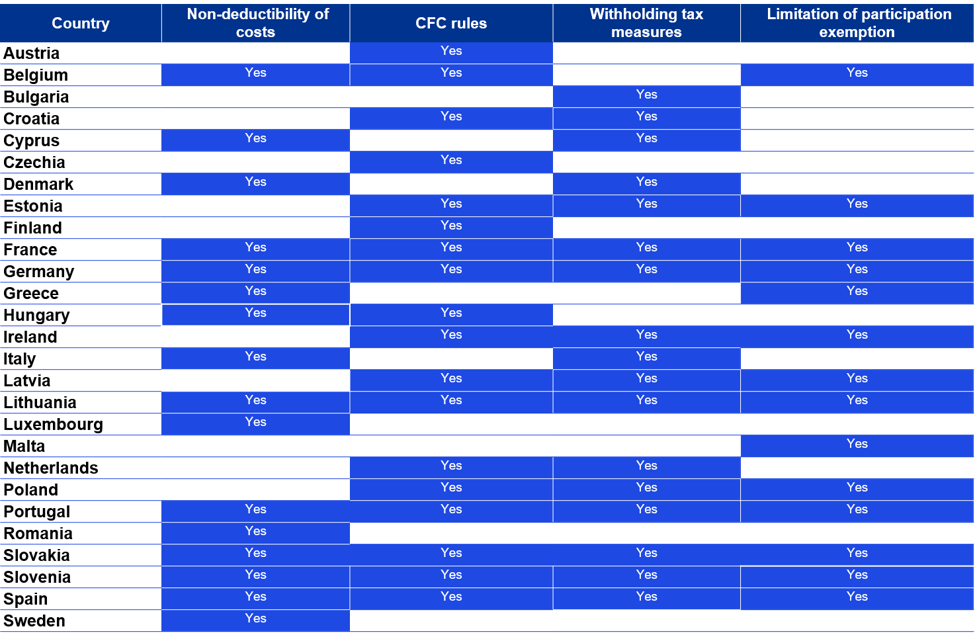
As illustrated above, most Member States have implemented multiple measures from the CoCG’s guidance, with seven countries having implemented all suggested legislative tax defensive measures: France, Germany, Lithuania, Portugal, Slovakia, Slovenia and Spain.
In contrast, a suite of countries limited their reaction to only one type of measure, as follows:
Non-deductibility of costs:
Greece, Luxembourg, Sweden
CFC rules:
Austria, Czechia, Finland
Withholding tax measures:
Bulgaria
Participation exemption restrictions:
Malta
The list of measures applied above is constantly evolving. Member States continue to expand the scope of the measures or are investigating whether they should implement additional rules. Recently introduced changes to national tax defensive measures include:
- Cyprus introduced new tax defensive measures with effect from 2026 in respect of low-tax jurisdictions. Interest and royalty payments made to associated entities established in such jurisdictions may become non-deductible for corporate tax purposes, subject to certain conditions. In addition, a withholding tax of 5 percent applies to dividend distributions made to associated entities established in low-tax jurisdictions. For more information, please refer to E-News Issue 228.
- As from tax year 2025, Greece introduced a participation exemption regime for intra-group dividends received by Greek tax-resident legal entities from non-EU entities subject to certain conditions (e.g., minimum share of 10 percent held for a minimum period of 24 months). The participation exemption also applies to capital gains from transferring shares in a non-EU entity subject to the same conditions. However, the participation exemption does not apply where the non-EU entity is resident for tax purposes in a non-cooperative jurisdiction.
- From January 1, 2025, Ireland applies a participation exemption for qualifying foreign dividends. Initially applicable to relevant distributions received from subsidiaries resident in an EEA jurisdiction or a jurisdiction with which Ireland has concluded a double tax treaty, the regime was extended with effect from January 1, 2026, to certain non-EEA, non-treaty jurisdictions that generally impose a foreign withholding tax on distributions. However, similar to Greece, jurisdictions included on the EU List of non-cooperative jurisdictions remain excluded from the exemption.
Are national defensive measures limited to jurisdictions listed by the EU?
Several EU Member States apply national tax defensive measures only against those countries that are included on the EU List. This group includes: Austria, Croatia, Czechia, Denmark, Estonia, Germany, Hungary, Latvia, Luxembourg, Malta, Romania and Sweden.
Other EU countries apply national tax defensive measures against countries that are included on the EU List, as well as against other countries considered non-cooperative / tax havens based on national listing criteria. Examples include:
- In the Netherlands, the EU List is relevant for the Dutch CFC defensive measure. In addition, the Netherlands apply a conditional withholding tax on interest, royalties and dividends paid to affiliated companies in designated jurisdictions included on the EU List as well as those on the Dutch tax haven list (i.e., jurisdictions without profit taxes or with a statutory rate of less than 9 percent). The conditional withholding tax on interest, royalties and dividends also applies in tax abusive situations, i.e., if both subjective and objective tests are met (similar to the EU concept of abuse).
- Slovakia maintains a list of cooperative countries (the “white list”) that are not subject to national tax defensive measures. The white list excludes countries from the EU List, as well as jurisdictions that do not impose a corporate income tax or that apply a nil corporate income tax.
- In other EU Member States different national tax defensive measures are applied depending on whether a country is included on the EU List or a national tax haven list. Different measures could also apply depending on the listing criteria based on which a country is listed. Examples include:
- Belgium denies the deduction of payments to jurisdictions on the national tax haven list where the payments are not properly reported, are not at arms-length, or are made to artificial constructions. Special conditions apply for the deduction of interest and royalty payments that are paid to countries on the national tax havens list. These limitations are not directly linked to countries mentioned on the EU List. The national tax haven list was last updated by the Royal Decree of March 1, 2016. In addition, there is a (rebuttable) presumption that a foreign company or establishment located in a jurisdiction on the EU List or national list fails the taxation test for CFC purposes. Furthermore, dividends from companies established in a jurisdiction on the EU List would not qualify for the dividends-received deduction regime3.
- Cyprus applies tax defensive measures by reference to the EU List (Annex I). Since April 2026, Cyprus also maintains a domestic list of low-tax jurisdictions, defined as jurisdictions with a corporate income tax rate lower than 50 percent of the Cypriot corporate income tax rate (currently 15 percent, resulting in a threshold of 7.5 percent). Different defensive measures apply depending on the list concerned. Jurisdictions included on the EU List are subject to withholding tax on dividends and interest at a rate of 17 percent and on royalties at a rate of 10 percent. In contrast, payments to associated entities established in jurisdictions included on the Cypriot list of low-tax jurisdictions may be subject to a 5 percent withholding tax on dividends, while interest and royalty payments may be non-deductible for corporate tax purposes, subject to certain conditions. Where a jurisdiction is included on both the EU List and the Cypriot list of low-tax jurisdictions, the EU List defensive measures take precedence. For more information, please refer to E-News Issue 228.
- In France, the participation exemption limitation and the increased withholding tax rate of 75 percent on outbound payments only apply where the jurisdiction was listed due to failure to provide for an effective information exchange or where the jurisdiction facilitates offshore structures aimed at attracting profits that do not reflect real economic activity (EU criterion 2.2). In other words, these defensive measures do not apply with respect to jurisdictions that are listed due to non-compliance with other EU listing criteria.
- In Italy, expenses incurred in relation to transactions with companies / professionals based in jurisdiction on the EU List will only be deductible up to the normal free market value (subject to certain exceptions), whilst the WHT defensive measure applies for countries that are not included on the Italian white list.
- Poland uses a national tax haven list that includes some of the jurisdictions on the EU List, as well as jurisdictions listed by Poland. For the purposes of the national tax haven list, Poland applies criteria including the application of international tax transparency standards, the exchange of tax information with Poland or features of the tax system that may give rise to harmful tax competition. Where the EU list of non-cooperative jurisdiction is updated, those changes are not automatically reflected in the national tax haven list. For this reason, Poland has a second list that covers those jurisdictions that are included on EU List but not on the national tax haven list. The national tax haven list provides for a broader scope of defensive measures compared to the second EU-related list (e.g., the WHT defensive measure only applies to those countries included on the national tax haven list).
- Sweden uses the EU List for deduction limitation purposes and a white list of countries where income is not considered to be subject to low taxation for CFC purposes.
Lastly, a few EU Member States use only a national tax haven list, which is not necessarily connected with the EU list (Bulgaria, Greece, Lithuania, Portugal, Spain). Nevertheless, a number of jurisdictions included on the EU list may still be captured by the national tax haven lists:
- Greece distinguishes between non-cooperative jurisdictions and jurisdictions with a preferential tax regime. The list of non-cooperative jurisdictions includes non-EU jurisdictions which are included on the OECD list of uncooperative tax havens (not implementing the OECD's standards of transparency and exchange of information) and which (a) have not signed an agreement on administrative cooperation in the field of taxation with Greece or the Council of Europe/OECD Convention on Mutual Administrative Assistance in Tax Matters, and (b) have not committed to implementing the automatic exchange of information (AEOI) as of 2018, at the latest. The list of jurisdictions with preferential tax regimes are defined as jurisdictions with a nil corporate income tax rate, or jurisdictions taxing profits, income or capital at a rate which is equal to or less than 60 percent of the corporate tax rate applicable in Greece. For more information, please refer to E-News Issue 235.
- Portugal operates a national tax haven list that was last updated in September 2025 by Ministerial Order No. 292/2025 (effective as from January 1, 2026). Following this update, the list includes 77 jurisdictions and is not connected with the EU List, although it includes most of the jurisdictions included in Annex 1 (excluding the Russian Federation) and some included in Annex 2 of the EU list. For more information, please refer to E-News Issue 218.
In Spain, the Official Gazette published an order on June 27, 2026, amending the list of jurisdictions considered to be non-cooperative or to have harmful tax regimes. The order removes Barbados, Dominica, Gibraltar, Seychelles, Trinidad and Tobago, and Samoa, and adds the Russian Federation due to its international holding companies regime. As a result, the Spanish list now includes 19 jurisdictions and territories. For more information, please refer to E-News Issue 231 and Issue 232.
Are changes to the EU List directly applicable in EU Member States?
The complexity of navigating between the various tax haven lists applicable and the various measures applied by each Member State is compounded by the fact that not all countries take into account changes to the EU List in the same way.
Whilst local legislation in the majority of Member States includes a direct reference to Annex I so that changes to the EU list have immediate effect,4 some Member States do require a separate legislative act or ministerial order for updates to the EU List to become effective. Some of these Member States typically adopt the revised EU list shortly after the Council decisions in February and October of each year (e.g., Czechia, Denmark, Latvia). Other Member States adopt the revised EU list only once a year (e.g., France, Germany, Ireland, the Netherlands), or without a pre-determined frequency (e.g., Hungary).
In Poland, the date of application depends on the type of defensive measure and the list (EU/national) which has led to the application of the respective defensive measure. Some of these measures have immediate application from the effective date of the revision of the EU list (e.g., Mandatory Disclosure Rules). Other measures are relevant for the national list, meaning that they start applying to jurisdictions listed by the EU only after the revisions of the EU list have been reflected on the national EU list (provided that the respective jurisdictions were not already included on the national tax haven list). The national EU list is typically updated to reflect changes at EU level within three weeks after the revised EU list is published.
For completeness, additional or separate national tax haven lists usually need to be adopted through a legislative act or ministerial order to become applicable (e.g., Belgium, Greece, the Netherlands, Poland, Portugal, Spain). The white list used by Slovakia only becomes effective once published on the website of the Slovak Ministry of Finance.
When do defensive measures become effective or cease to apply in case of changes to the EU List?
Tax defensive measures introduced by Member States in line with the recommendations of the CoCG with respect to jurisdictions listed by the EU generally apply or cease to apply as soon as the updated EU List is effective for domestic purposes.5 In other Member States changes to the EU List do not always have immediate effect, as follows:
- In some EU jurisdictions, the state of the EU List at the end of the respective taxation period or tax year is decisive for the application of defensive measures (e.g., Austria, Czechia).
- In Belgium, the deduction limitation for certain payments applies as soon as the respective country is added to the EU List (publication date in the EU Official Journal). For the other defensive measures, the state of the EU List at the end of the respective taxation period is decisive.
- In France, defensive tax measures will apply against newly included jurisdictions from the first day of the third month following the publication of the decree adopting the change. As regards jurisdictions removed from the list, the defensive measures cease to apply from the publication date of the decree.
- In Germany, the defensive measures generally apply from the beginning of the year (or financial year) that follows the year in which the legislative decree became effective. For example, where the EU list is updated in October 2026, a decree to align the national list with the EU list is expected to be enacted by end of December 2026. Accordingly, defensive measures regarding the newly listed jurisdictions would start applying from January 1, 2027. However, the deduction limitation and the limitation of the participation exemption are subject to a deferred application (i.e., beginning of the third/fourth year following the entry into force of the decree). Where a jurisdiction is removed from the list, the defensive measures should cease to apply retroactively from January 1 of the respective year or the beginning of the financial year (e.g., January 1, 2026, in the above example).
- In Luxembourg, the state of the list at the beginning of the calendar year (January 1) is decisive. For example, where a jurisdiction is added to the EU list in October 2026, the domestic defensive measures would apply from January 1, 2027 with respect to that jurisdiction. By contrast, where a jurisdiction is removed from the EU List during the year, the defensive measures would cease to apply as soon as the respective country is removed from the EU List (publication date in the EU Official Journal).
- In Malta, the participation exemption is denied for countries that were on the EU List for a minimum of three months during the relevant year.
- In the Netherlands, the applicable list for a given tax year is the EU list as at the end of the previous tax year (e.g., the version of the EU List as at the end of 2026 is relevant for 2027 for measures related to withholding taxes, or in case of the CFC rules for fiscal years commencing on or after January 1, 2027). The defensive measures continue to apply throughout 2026 for a country that would be delisted in October 2026 (i.e., no immediate effect).
What other key differences need to be considered?
The CoCG report on potential defensive measures lacked further guidance on the practicalities of applying such defensive measures by Member States. This lack of harmonization, coupled with variations in the specifics of each MS’s national legal framework have led to uncertainty on a number of points regarding the application of the defensive measures including:
It is often the case that jurisdictions considered non-cooperative by the EU do not have a practice of entering into bilateral tax treaties. Furthermore, when determining domestic tax havens list, the absence of a double tax treaty is often a condition for listing. Member States will therefore typically not have double tax treaties in place with listed jurisdictions. This is, however, not always the case. The question therefore arises whether a double tax treaty prevails over a domestic defensive measure, or if a treaty override is available, such that e.g., increased withholding tax rates on payments to non-cooperative jurisdictions / tax havens would apply even where a lower rate is available under an existing double tax treaty.
Some Member States – including Croatia, Cyprus, Denmark, Estonia, Finland, France, Lithuania, Poland, Spain will generally disregard the national defensive measure and apply the lower treaty rate (all other things being equal and assuming any treaty anti-abuse provisions would not disregard the payment).
In other EU countries – including Germany, Latvia, Portugal, Slovakia, an increased WHT under a national defensive measures would be applied irrespective of an existing double tax treaty with a non-cooperative jurisdiction, i.e., local legislation provides for a treaty override provision.
Additional consideration should be given to the impact of Russia’s decision to suspend double tax treaties with so-called “unfriendly” countries. This could potentially bring Russia in the scope of domestic tax haven lists – for countries where local lists are not linked to the EU one, and could also impact countries where payments to Russia would have otherwise been outside the scope of certain defensive measures due to lack of treaty override provisions.
The CoCG guidance does not offer additional insights as to the determination of whether the recipient of a payment is resident in a non-cooperative jurisdiction. The question therefore arises whether, when applying defensive measures, Member States should look at the residence of the recipient, their place of establishment and/ or another criterion. The only type of defensive measure for which the answer to this question is clear is the application of CFC rules, which refer specifically to tax residence. For the other types of defensive measures, the identification criteria based on which the defensive measures apply differ among Member States.
For example, some Member States look at the country of tax residence of the recipient of a payment – including Austria, Belgium, Croatia, Czechia, Finland, Germany, Greece, Hungary, Malta, Portugal, Spain.
Other Member States refer to either the country of incorporation (e.g., Latvia, Luxembourg, Romania, Slovakia) or to both tax residency and country of incorporation (e.g., Cyprus, Denmark, France, Italy).
In addition, special nexus requirements are provided in certain EU countries, including:
- Belgium and France do not only refer to the aforementioned criteria but also apply defensive measures where the payment in question is made to a bank account held by a financial institution established in a listed jurisdiction (regardless of the domicile of the account holder).
- In Sweden, the interest deduction limitation refers to the independent legal term “belonging to”, which is not further defined – it should generally follow tax residence but is also intended to apply to companies that have no tax residence.
In a number of EU countries, certain national tax defensive measures are subject to a purpose/motive test, i.e., the measures do not apply where the taxpayer proves that the underlying payment or transaction follows commercial reasons or has an economic purpose (including France, Greece, Hungary, Italy, Luxembourg, Portugal, Romania, Spain). In Malta, the participation exemption limitation does not apply where the recipient is able to prove that there are sufficient people functions in the non-cooperative jurisdiction.
In some EU Member States, the defensive measures apply based on a certain order of priority. For example, in Germany, the participation exemption limitation does not apply where it can be demonstrated that the dividends are derived from amounts which were subject to a deduction denial of operating expenses or a WHT defensive measure. In addition, the deduction denial does not apply where the underlying payments have been subject to the WHT defensive measure. In Italy, exceptions to the deduction limitation also apply where taxpayers can prove that the underlying transaction carried out with non-residents is covered by the CFC rules.
The interaction between national tax defensive measures and the concept of beneficial ownership differs significantly across EU Member States. While some jurisdictions focus primarily on the residence of the immediate payment recipient, others explicitly look through to the beneficial owner. In other countries the assessment remains largely case-by-case.
In several EU Member States, the application of tax defensive measures is assessed primarily by reference to the direct recipient of the payment. This group includes Croatia, Cyprus France, Greece, Lithuania, Portugal, and Romania. In these jurisdictions, the decisive criterion is generally the residence or incorporation of the immediate payment recipient. As a result, a payment to an entity resident in a cooperative jurisdiction would typically not trigger defensive measures solely because the ultimate beneficial owner is resident in a non-cooperative jurisdiction. In other countries like Germany, Spain and Sweden, the legislation does not explicitly address conduit arrangements or the role of the beneficial owner in the context of defensive measures. For both groups of countries, however, conduit or intermediary structures may be challenged under general anti-abuse rules, domestic anti-abuse measures, or through the denial of treaty or EU Directive benefits.
By contrast, some jurisdictions expressly consider in local legislation the beneficial owner when applying defensive measures. For example, in Denmark, the Netherlands and Slovakia defensive measures may apply if the direct recipient is merely a conduit entity and the beneficial owner is resident in a non-cooperative jurisdiction. In these cases, the tax treatment is determined by reference to the person that is economically entitled to the income rather than the formal recipient. Belgium takes a similar position – defensive measures may apply where the taxpayer knows or is deemed to know that the recipient of the payment is only an intermediary and that the actual beneficiary is located in a tax haven
Potential future developments
According to the CoCG report submitted to the ECOFIN Council in December 2025, the Code of Conduct Group continues reflections on a possible further strengthening of the EU listing process.
The CoCG is currently conducting an in-depth follow-up review of how Member States apply the measures in practice and whether they meet the Group’s expectations in terms of efficiency. This additional investigation would offer the CoCG an overview of the practical impact of the defensive measures and could serve as a starting point for potential additional guidance to better coordinate existing measures as well as to introduce new types of defensive measures.
In addition, further listing criteria are being considered. This includes, in particular, the design of the additional criterion 1.4 on the exchange of beneficial ownership information. Although discussions on this criterion have lingered since the ECOFIN Council originally adopted the listing criteria in 2016, Member States have failed to reach consensus on a viable solution. According to the CoCG report submitted to the ECOFIN Council in December 2025, Member States remain unable to advance the criterion. Instead, the report indicates that the Commission should periodically review international developments and that the Group should revisit the matter at a later stage.
For more information, see Euro Tax Flash Issue 572.
Conclusion
Entities that operate in or make payments towards jurisdictions that have been deemed non-cooperative (either by the EU or by individual Member States) or that are under monitoring, should seek to understand whether any defensive measures may apply and when. As outlined in this article, taxpayers need to consider different lists, different defensive measures, different application timelines and other varying requirements that are applied across EU Member States. Therefore, it is advisable to integrate these considerations into existing internal compliance management procedures.
KPMG’s EU Tax Centre will continue to monitor developments related to the EU list of non-cooperative jurisdictions and its impact and report on events via our publications.
Key links
Visit our website for earlier editions
1 For more information on the DAC recast, see Euro Tax Flash Issue 583.
2 Non-EU groups with significant operations in Romania and MNEs headquartered in Romania were required to publish their first reports by the end of 2024. Similarly, MNEs with a qualifying presence in Croatia are subject to a reporting obligation with respect to financial years starting on or after January 1, 2024, with these reports due by the end of 2025.
3 The dividends-received deduction (DRD) regime applies similar to a participation exemption regime with dividend income first being included in the taxable profit, and – provided all requirements are met, 100 percent of the dividend income being deducted from the taxable profit.
4 For example, Austria, Belgium, Croatia, Cyprus, Estonia, Finland, Italy, Luxembourg, Malta, Romania, Sweden.
5 For example, in Croatia, Denmark, Estonia, Italy, Latvia, Poland, Romania, Slovakia, Sweden.
Our insights
Our people
Key EMA Country contacts
Margarita Liasi
Principal
KPMG in Cyprus
E: Margarita.Liasi@kpmg.com.cy
Jussi Järvinen
Partner
KPMG in Finland
E: jussi.jarvinen@kpmg.fi
Zsolt Srankó
Partner
KPMG in Hungary
E: Zsolt.Sranko@kpmg.hu
Ilze Berga
Partner
KPMG in Latvia
E: iberga@kpmg.com
Erwin Nijkeuter
Partner
KPMG in the Netherlands
E: Nijkeuter.Erwin@kpmg.com
Ionut Mastacaneanu
Associate Partner
KPMG in Romania
E: imastacaneanu@kpmg.com
Caroline Valjemark
Partner
KPMG in Sweden
E: caroline.valjemark@kpmg.se
Kris Lievens
Partner
KPMG in Belgium
E: klievens@kpmg.com
Ladislav Malusek
Partner
KPMG in the Czech Republic
E: lmalusek@kpmg.cz
Patrick Seroin Joly
Partner
KPMG in France
E: pseroinjoly@kpmgavocats.fr
Ágúst K. Gudmundsson
Partner
KPMG in Iceland
E: akgudmundsson@kpmg.is
Vita Sumskaite
Partner
KPMG in Lithuania
E: vsumskaite@kpmg.com
Thor Leegaard
Partner
KPMG in Norway
E: Thor.Leegaard@kpmg.no
Zuzana Blazejova
Executive Director
KPMG in Slovakia
E: zblazejova@kpmg.sk
Stephan Kuhn
Partner
KPMG in Switzerland
E: stefankuhn@kpmg.com
Alexander Hadjidimov
Associate Partner
KPMG in Bulgaria
E: ahadjidimov@kpmg.com
Birgitte Tandrup
Partner
KPMG in Denmark
E: birgitte.tandrup@kpmg.com
Oliver Heinsen
Partner
KPMG in Germany
E: oheinsen@kpmg.com
Cormac Golden
Director
KPMG in Ireland
E: cormac.golden@kpmg.ie
Olivier Schneider
Partner
KPMG in Luxembourg
E: olivier.schneider@kpmg.lu
Michał Niznik
Partner
KPMG in Poland
E: mniznik@kpmg.pl
Marko Mehle
Senior Partner
KPMG in Slovenia
E: marko.mehle@kpmg.si
Timur Cakmak
Partner
KPMG in Turkey
E: tcakmak@kpmg.com
Maja Maksimovic
Partner
KPMG in Croatia
E: mmaksimovic@kpmg.com
Joel Zernask
Partner
KPMG in Estonia
E: jzernask@kpmg.com
Antonia Ariel Manika
Director
KPMG in Greece
E: amanika@kpmg.gr
Lorenzo Bellavite
Partner
KPMG in Italy
E: lbellavite@kpmg.it
John Ellul Sullivan
Partner
KPMG in Malta
E: johnellulsullivan@kpmg.com.mt
António Coelho
Partner
KPMG in Portugal
E: antoniocoelho@kpmg.com
Julio Cesar García
Partner
KPMG in Spain
E: juliocesargarcia@kpmg.es
Matthew Herrington
Partner
KPMG in the UK
E: Matthew.Herrington@kpmg.co.uk