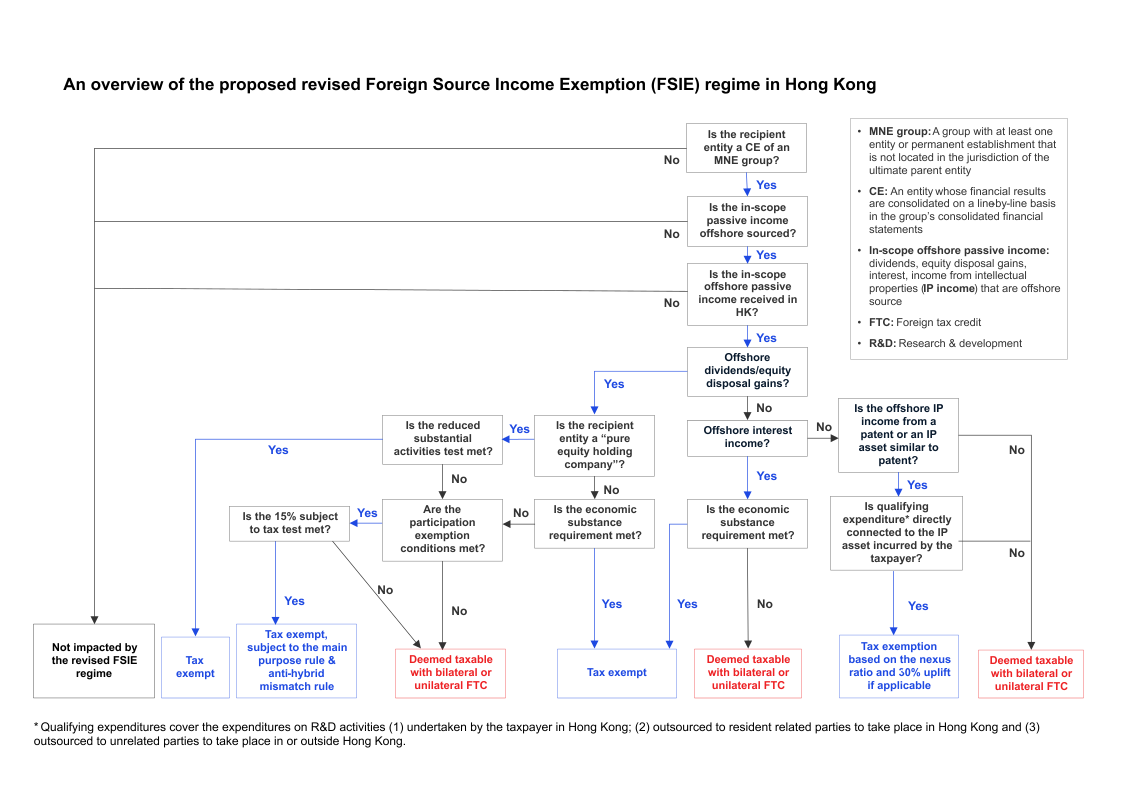
After discussion with the EU, the HKSAR Government has recently proposed a revised FSIE regime for passive income in Hong Kong. Please refer to the flowchart in the Appendix for an overview of the proposed revised FSIE regime. The key features of the proposed regime are summarized below.
Covered taxpayers and covered income
- Covered taxpayers – Only a constituent entity (CE) of a multinational enterprise (MNE) group will be in-scope. A MNE group will be within the scope irrespective of the group’s revenue or asset size. The definitions of CE and MNE are the same as those under the GloBE Rules. That is, an MNE Group means any Group that includes at least one Entity or Permanent Establishment that is not located in the jurisdiction of the Ultimate Parent Entity whereas a CE effectively means an entity whose financial results are consolidated on a line-by-line basis in the group’s consolidated financial statements. As such, associates and joint venture entities within an MNE group that are not included in the group’s consolidated financial statements, standalone local companies and purely domestic groups without any offshore operations would not be affected.
- Covered income - Dividends, gains from the disposal of shares or equity interest (equity disposal gains), interest and income from intellectual properties (IP income) with an offshore source will be in-scope offshore passive income.
Offshore passive income deemed to be Hong Kong sourced and taxable
Under the proposed regime, a CE of an MNE group will first need to determine whether the in-scope passive income is with an offshore source and then whether the income “is received in Hong Kong”. In-scope offshore passive income that is “received in Hong Kong” by a CE of an MNE group will be deemed to be sourced from Hong Kong and taxable unless the economic substance requirement (for non-IP income), the nexus approach requirement (for IP income) or the participation exemption conditions (for dividends and equity disposal gains) are met.
The economic substance requirement for non-IP income
- Offshore dividends, equity disposal gains and interest will be tax-exempt if substantial economic activities relevant to the income are conducted in Hong Kong.
- Covered taxpayers will need to employ an adequate number of qualified employees and incur an adequate amount of operating expenditures in Hong Kong for carrying out the relevant activities. Instead of setting the minimum threshold requirements, the totality of facts of each case will be considered in determining whether the adequacy test is met.
- A reduced substantial activities test will be applied to a “pure equity holding company”2 under which the relevant activities will only include (1) holding and managing its equity participation and (2) complying with the corporate law filing requirements in Hong Kong.
- Outsourcing of the relevant activities will be permitted provided that they are conducted in Hong Kong and being adequately monitored by the covered taxpayer.
The participation exemption regime for dividends and equity disposal gains
- A participation exemption regime will be introduced to provide tax exemption for offshore dividends and equity disposal gains regardless of whether the above economic substance requirement is met if the following four conditions are fulfilled:
- the investor company is a Hong Kong resident person or a non-Hong Kong resident person with a permanent establishment in Hong Kong;
- the investor company holds at least 5% of the shares or equity interests in the investee company;
- no more than 50% of the income derived by the investee company is passive income; and
- the passive income or the underlying profit of the investee company (for dividends) is subject to tax in a foreign jurisdiction with a headline tax rate of 15% or above.
- The switch-over rule – if the headline tax rate mentioned in 4 above is below 15%, the dividends will be subject to Hong Kong profits tax, but double tax relief will be switched over from participation exemption to foreign tax credit (FTC). The FTC will be limited to the amount of Hong Kong profits tax attributable to the passive income concerned.
- The main purpose rule – any non-genuine arrangements that have been put in for the main purpose or one of the main purposes of obtaining a tax advantage that defeats the object or purpose of the participation exemption will be ignored.
- The anti-hybrid mismatch rule – Where the income concerned is dividends, participation exemption will not apply to the extent the dividend payment is deductible by the investee company.
The nexus approach for IP income
- Only income derived from a patent or an IP asset similar to a patent (qualifying IP income) can be entitled to a tax exemption under the nexus approach3. Income derived from other IP assets (e.g. trademarks and copyright) are excluded from the tax exemption.
- The portion of the qualifying IP income that is exempt from tax will be computed based on the nexus ratio i.e. the qualifying expenditure as a proportion of the overall expenditure that have been incurred by the covered taxpayer to develop the IP asset.
- Qualifying expenditure is expenditure on R&D activities that are directly connected to the IP asset and (1) undertaken by the taxpayer in Hong Kong, (2) outsourced to resident related parties and take place in Hong Kong and (3) outsourced to unrelated parties to take place in or outside Hong Kong. Acquisition costs of IP assets are not qualifying expenditure. The 30% uplift on the qualifying expenditure under the OECD’s nexus approach can be applied in computing the nexus ratio if the covered taxpayer has incurred non-qualifying expenditure.
Introduction of unilateral tax credit in Hong Kong
To provide double tax relief for in-scope offshore passive income that is subject to tax in both Hong Kong and a foreign jurisdiction that does not have a Double Taxation Agreement with Hong Kong, a unilateral tax credit will be provided. Unilateral tax credit is only applicable to in-scope passive income and will not be available for other income even though it may be subject to tax in both Hong Kong and overseas.