
EcoVadis Gold Medal
in the sustainability ranking and thus among the top 5 per cent of the companies assessed
in the sustainability ranking and thus among the top 5 per cent of the companies assessed
mandatory for all our employees
since about 15 years according to ISO/IEC 27001, ISO 9001 and ISO 14001
Over 5,000 employees take part in the Values Week
Our aim is to be the leading auditor and consultant in quality. It is therefore essential for us to always apply the highest standards to our services. Through clear processes, structures and responsibilities, we want to ensure that we always act in a responsible, sustainable and future-orientated manner and that our services meet the highest quality standards.
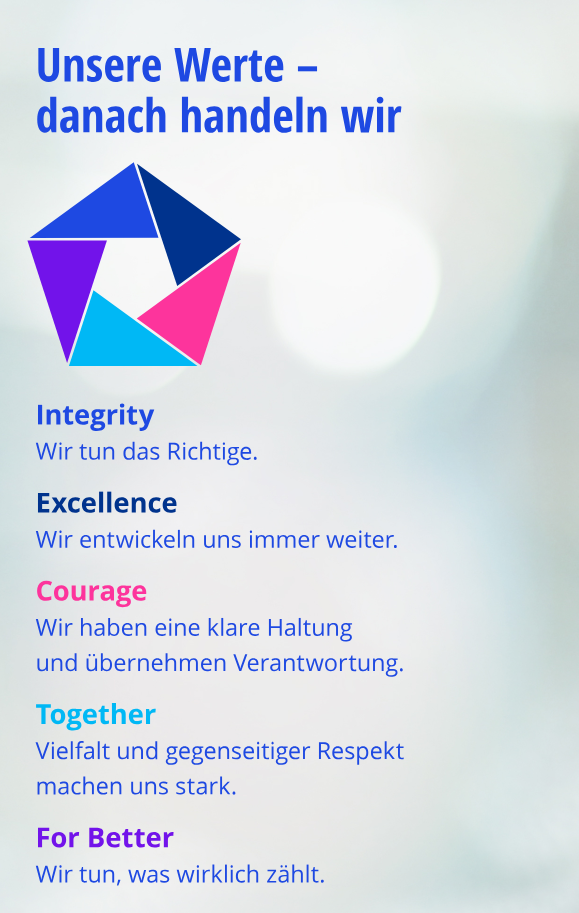
The most important basis for this is the integrity and independence of our employees. We are committed to our values of Integrity, Excellence, Courage, Together and For Better, which are anchored in the global KPMG network, and regard them as a non-negotiable guideline that shapes our personal and professional behaviour.
As a multidisciplinary auditing and consulting firm, it is of central importance for us to comply with legal and professional regulations. We also see it as one of our main tasks to further develop the common quality approach of all global KPMG member firms. We achieve this with our structured quality and risk management system. It regulates the organisation of our business practice as well as the execution and processing of our assignments and thus forms the framework with which our services can reliably meet our quality standards. At KPMG, there are clear responsibilities and programmes for the alignment and implementation of risk management, compliance and quality assurance as well as for monitoring compliance and quality. Further information on this can be found in the current KPMG Transparency Report.
Our values - Integrity, Excellence, Courage, Together and For Better - which are anchored in the global KPMG network, are our foundation at both national and international level and are at the centre of our daily actions. This set of values is the basis for KPMG's inclusive and diverse culture and guides our personal and professional behaviour.
Our values are also the basis for trusting relationships with our clients and the key to our business success. They characterise our corporate culture and guide us in our decision-making and cooperation. In this way, our values are put into practice in our daily work and make a significant contribution to making KPMG a Home for Talents.
Compliance with laws, regulations and standards is at the centre of the work of all KPMG employees. Through mandatory and regular independence and compliance training, we strengthen our employees' awareness of our corporate culture and ethical behaviour in their daily work processes.
KPMG's CARE (Consider, Assess, Respond, Evolve) framework for ethical decision-making is designed to build and strengthen trust and contributes to our values and our Code of Conduct.
CARE is a global, company-wide model that helps our employees make ethical decisions, especially when faced with a difficult situation or ethical dilemma, and reminds them that they do not have to make these decisions alone. In addition, our corporate values become tangible in concrete measures and actions. We regularly sensitise our employees to consciously living our corporate values - both in their day-to-day work and in special situations:
Establishment of a company-wide network that places the topic of values at the centre of its activities - the Values Champion Community.
Annual organisation of a Values Week in Germany. In the 2024 financial year, we reached more than 5,000 employees at around 75 different face-to-face and online events and workshops.
Annual organisation of an international values week - Global Values Week - in which employees from all over the world come together virtually to focus on corporate culture and values globally. In 2024, we recorded more than 117,000 views in 115 different countries during five global broadcasts of speaker events with renowned guests.
Detailed information on our corporate culture can be found in the latest KPMG Transparency Report.
In providing our services, we focus on the highest standards of quality and integrity. This is how we gain and retain the trust of our customers, our employees and society.
With our commitment to integrity, the prevention and avoidance of corruption and compliance with our professional standards, we not only want to maintain our high quality standards, but also continuously develop them. In this way, we aim to achieve our goal of always being the first choice for our clients and building and maintaining trusting relationships with them.
In addition to professional and legal regulations, company-specific guidelines and global co-operation agreements form the basis of our daily activities. These include the following standards:
KPMG has an international code of conduct, the Global Code of Conduct. This forms the basis for our national code of conduct, the Code of Conduct. The two codes complement our corporate values and provide essential guidelines and principles for our actions and behaviour in our day-to-day work. All KPMG employees are obliged to act in accordance with the codes of conduct and to take responsibility for compliance with legal, statutory and ethical standards in line with their respective area of responsibility and position. Regular reviews are carried out to ensure that the Code of Conduct is always up to date and relevant.
The KPMG quality management system also provides a reliable framework for our daily activities in a highly complex working environment characterised by extensive legal regulations. By effectively implementing quality and risk management processes, we aim to avoid violations of the (professional) law applicable to us, liability issues, economic risks and the loss of our independence.
We have introduced a System of Quality Management (SoQM) in accordance with the international quality management standard "International System of Quality Management Standard 1" (ISQM 1). By implementing ISQM 1, we have been able to improve the robustness of our quality management system and are thus pursuing a standardised approach with regard to quality assurance guidelines, responsibilities and reporting lines. Minimum requirements have been defined for each component of ISQM 1 that relate to the respective objectives, risks and measures. In addition, KPMG International has implemented a risk assessment process that identifies specific quality objectives and relevant risks. This enables us to take the necessary steps to continuously review and evaluate our quality management system.
Through regular, mandatory training on independence and compliance, we raise our employees' awareness of compliance with laws, regulations and standards and support them in avoiding conflicts of interest and anti-competitive practices. In addition, our employees regularly submit a declaration of independence.
KPMG has established an internal system-based approval process and control mechanism that is binding for all our donations, sponsorships, collaborations and memberships. In order to avoid bribery or the appearance of bribery, all employees are subject to clear rules on accepting and offering benefits from or to third parties, particularly in the case of invitations and gifts. The principles set out in these rules are integrated into our internal processes and form part of the mandatory training for all employees.
Our management systems are certified in accordance with international and industry-specific standards and therefore fulfil the key requirements of our business partners and customers. Our certified management systems include our quality management system in accordance with DIN EN ISO 9001, our information security management system in accordance with ISO/IEC 27001, our environmental management system in accordance with DIN EN ISO 14001 and our occupational health and safety management system in accordance with ISO 45001.
Suspected cases of illegal or unethical behaviour can be reported anonymously via our whistleblowing hotline. It is available to employees, customers, subcontractors, suppliers and external third parties. Every report is processed in accordance with the legal requirements (in particular Section 17 HGSchG and Sections 8, 9 LkSG). Further information can be found on our external website: Whistleblowing hotline/reporting centres for whistleblowers - KPMG Germany.
In order to comply with legal requirements relating to corruption and bribery and to prevent cases of corruption by third parties with whom we work, we have implemented established processes that are anchored in our due diligence checks of third-party companies (including customers and suppliers).
Our training courses focus on the following areas and are mandatory for all new employees and then repeated annually by all employees:
The measures we implement are continuously reviewed and further developed. Further information on our governance issues can be found in the KPMG Transparency Report, which also contains a detailed description of our quality management system.
United Nations Global Compact
Since 2002, KPMG International has been a member of the United Nations Global Compact, the world's largest initiative for responsible corporate governance. This initiative defines ten principles for a sustainable global economy. As part of the global KPMG organisation, KPMG is also committed to the standards of this alliance. Further information and the current progress report of the United Nations Global Compact can be found at the following link: KPMG International - Our Impact Plan.
The security of information and the data protection of our stakeholders are our top priority.
Protecting client and personal data is of central relevance to us, especially in our auditing activities. In addition to data protection regulations - in particular the EU General Data Protection Regulation (GDPR) - KPMG as an auditing firm is subject to mandatory legal obligations under criminal and professional law to maintain confidentiality as well as professional supervision. Possible errors in the handling or auditing of data, for example due to data leaks or the loss of sensitive client data, could have a significant negative impact on our company. These include reputational damage and a long-term loss of trust in society, which would be difficult to remedy in the long term and would therefore have a lasting negative impact on our business activities.
The protection of client and personal data of third parties, including our clients, service providers and cooperation partners as well as our own employees, is therefore an important goal for KPMG. Particularly in light of the rapid pace of technological progress, we endeavour to continuously adapt our systems and processes to future technical and regulatory requirements in order to ensure that we handle our stakeholders' data responsibly now and in the future.
The responsible handling of personal data is an elementary component of our quality and risk management. The basis for this is formed by mandatory requirements, such as our internal information security brochure. We implement and continuously develop measures as part of our information security management system in accordance with ISO/IEC 27001. These include
Our Group Data Protection Officer acts as an independent body in accordance with the EU GDPR and reports directly to the Executive Board. Together with his team, he is the central point of contact for all data protection matters at KPMG. The Data Protection Officer also plays an active role in cross-departmental processes with data protection relevance, such as supplier onboarding. All KPMG employees are instructed to report (suspected) cases of data breaches directly to the KPMG Group Data Protection Officer.
All new employees and subsequently all employees every year are required to complete our data protection training. Employees in particularly sensitive areas receive additional specific training and information.
All KPMG employees are contractually obliged to comply with professional secrecy and data protection requirements and with KPMG's information security guidelines (information security brochure).
When integrating service providers into KPMG's data processing processes, KPMG's high data protection standards are contractually transferred to the service providers. In the case of commissioned data processing relationships in accordance with Art. 28 EU GDPR, legally standardised data protection contracts are agreed and the service providers are subjected to a corresponding IT security assessment in advance.
When integrating service providers into KPMG's data processing processes, KPMG's high data protection standards are contractually transferred to the service providers. In the case of commissioned data processing relationships in accordance with Art. 28 EU GDPR, legally standardised data protection contracts are agreed and the service providers are subjected to a corresponding IT security assessment in advance.
Our information security management system is certified in accordance with ISO/IEC 27001.
A key aspect of our environmental and social responsibility is compliance with environmental and social standards - not only in our company, but throughout our entire supply chain.
Our suppliers are an important part of our value chain. By obliging our suppliers to comply with environmental and social standards and promoting sustainable procurement practices, we aim to continuously reduce the environmental impact of our supply chain. By working in partnership, we can analyse both short-term and long-term effects on the environment and society, jointly define potential improvements and tackle them together. In doing so, we rely on long-term partnerships with whom we share common development goals.
Our supply chain accounts for a large proportion of our carbon footprint and therefore plays an important role in our sustainability strategy and in achieving our climate targets (see Planet chapter). For this reason, we are not only committed to strict compliance with environmental and social standards ourselves, but also expect the same from our suppliers. The binding minimum standards for business relationships with KPMG are set out in the Supplier Code of Conduct (SCoC). Our internal purchasing guidelines also summarise binding rules for the procurement of all goods and services.
We also base our business activities on the internationally recognised United Nations Guiding Principles on Business and Human Rights and fulfil the requirements of the Supply Chain Due Diligence Act (LkSG), which has also applied to KPMG since January 2023. Further information on this can be found in the Declaration of Principles on Respect for Human Rights and the Environment, which has been mandatory for KPMG since 2023.
In order to avoid social and ecological risks, we regularly review our existing and future contractual partners based on a supplier self-assessment as well as database queries and internet searches. This comprehensive review covers three main components:
As part of the LkSG requirements, we regularly carry out abstract risk analyses of country, sector and volume risk, measured against the supplier's annual turnover. This has resulted in suppliers being categorised as having a low to medium abstract overall risk. No classifications with a high overall risk have been identified to date. In a second step, suppliers with an abstract medium risk classification are checked to see whether sufficient preventive measures are being taken to control the risks. Based on these results, we have implemented further suitable preventive measures, including revising our Supplier Code of Conduct (SCoC), repeatedly qualifying suppliers and requesting self-declarations from new contractual partners. We have also introduced regular training for our employees in Purchasing, which has been supplemented by the requirements of the LkSG.
The Carbon Disclosure Project (CDP) is an international non-profit organisation that provides a system for the disclosure of environmental impacts for the private and public sectors, thereby helping to increase the transparency of companies with regard to their environmental impact. In this context, KPMG is working with the CDP to continuously improve the data on the CO₂ emissions of our largest suppliers.
The KPMG organisation worldwide is committed to the United Nations Guiding Principles on Business and Human Rights. This commitment is documented transparently and publicly in the Business and Human Rights Statement. Our commitment builds on our long-standing support of the UN Global Compact, which we signed back in 2002.
As a German KPMG member company, we are also committed to respecting internationally recognised human rights and upholding them in our business activities and along our value chain. Our commitment to respecting human rights and the environment is reflected in already established corporate guidelines and quality management systems, such as
We also expect our suppliers and other business partners to commit to complying with the principles set out here and to implement appropriate processes to respect human rights. Further information on this can be found in the Supplier Management section.
An effective complaints and reporting procedure is also an important part of our due diligence processes. With our whistleblowing hotline, we have set up a company complaints management system that is available to anyone inside or outside our company. It serves as an important point of contact for raising concerns and issues relating to human rights. 4
Since 1 January 2023, KPMG has been subject to the provisions of the German Supply Chain Due Diligence Act (LkSG), which aims to improve compliance with human rights and environmental due diligence obligations in global supply chains. To this end, we have implemented the required measures to fulfil our due diligence obligations both in our own business area and with our direct suppliers, as well as in relation to our whistleblower system (see Declaration of Principles on Respect for Human Rights and the Environment).

Partner, Central Services, Head of Our Impact Plan Germany
KPMG AG Wirtschaftsprüfungsgesellschaft
