About this report

      This report was prepared in accordance with the standards of the Global Reporting Initiative (GRI) and the "Principles of Stakeholder Capitalism" of the World Economic Forum (WEF IBC Metrics) and taking into account the UN Sustainable Development Goals (SDGs). The information in the Our Impact Report 2024 is also already based on the European Sustainability Reporting Standards (ESRS) of the European Financial Reporting Advisory Group (EFRAG). Detailed information on these standards can be found in the index of the report.

      The information and data in this year's report was collected and carefully quality-assured by our specialist departments and business divisions. The Our Impact Report has not been externally audited. This report covers the period from 1 October 2023 to 30 September 2024. To ensure an up-to-date presentation of KPMG's sustainability activities, activities that extend beyond the 2024 financial year and were recorded up to the editorial deadline of 31 January 2025 were also taken into account. The disclosures and employee-related key figures are based on the HGB consolidated financial statements of KPMG AG Wirtschaftsprüfungsgesellschaft, including its three fully consolidated domestic Group companies, as at 30 September 2024. Detailed key figures and information on the measures and activities that KPMG has implemented in the areas of action mentioned are listed at the end of each chapter.


      Key fields of action

      As part of the global KPMG sustainability programme Our Impact Plan, we have identified material topics in the areas of governance, people, planet and prosperity. We focus on these priorities and implement measures, the progress of which we report on in the Our Impact Report. This is how we demonstrate our contribution to sustainable development.

      As part of our sustainability strategy Our Impact Plan, we regularly use our materiality analysis to analyse possible changes and further developments in our corporate impact on the economy, the environment and people, including the impact on human rights.

      We also include KPMG International's materiality analysis in this process, as it plays a central role in the development of our sustainability strategy and the management of our reporting.


      Our key topics
      • Integrity and quality
      • Sustainable supplier management
      • Data protection and information security
      • Employer attractiveness and working conditions
      • Development and career
      • Inclusion, diversity and equity
      • Reducing our environmental impact
      • Services in the interests of society
      • Social commitment

      KPMG International's analysis in the 2023 financial year also took into account recent geopolitical events, changes among global stakeholders, current business developments and new data and findings. This data includes:

      • Data from an independent Trust Survey conducted annually in KPMG Global's eight largest markets (Australia, Canada, China, France, Germany, Japan, the UK and the US), including the views of senior executives, broader stakeholders (industry and trade associations, academics:inside, non-governmental organisations, multilateral organisations, business analysts, investors) and the informed public.
      • Data from the Employee Engagement Index and the Employee Trust Drivers from the Global People Survey.
      • Our most important business risks, which were identified using our proprietary dynamic risk assessment methodology.
      • Benchmarking of the key sustainability issues of KPMG member firms and our international competitors.

      We have carefully validated this global analysis for our national topics and adapted or supplemented it accordingly. The result of this year's analysis confirms the relevance and continuation of the existing material topics.

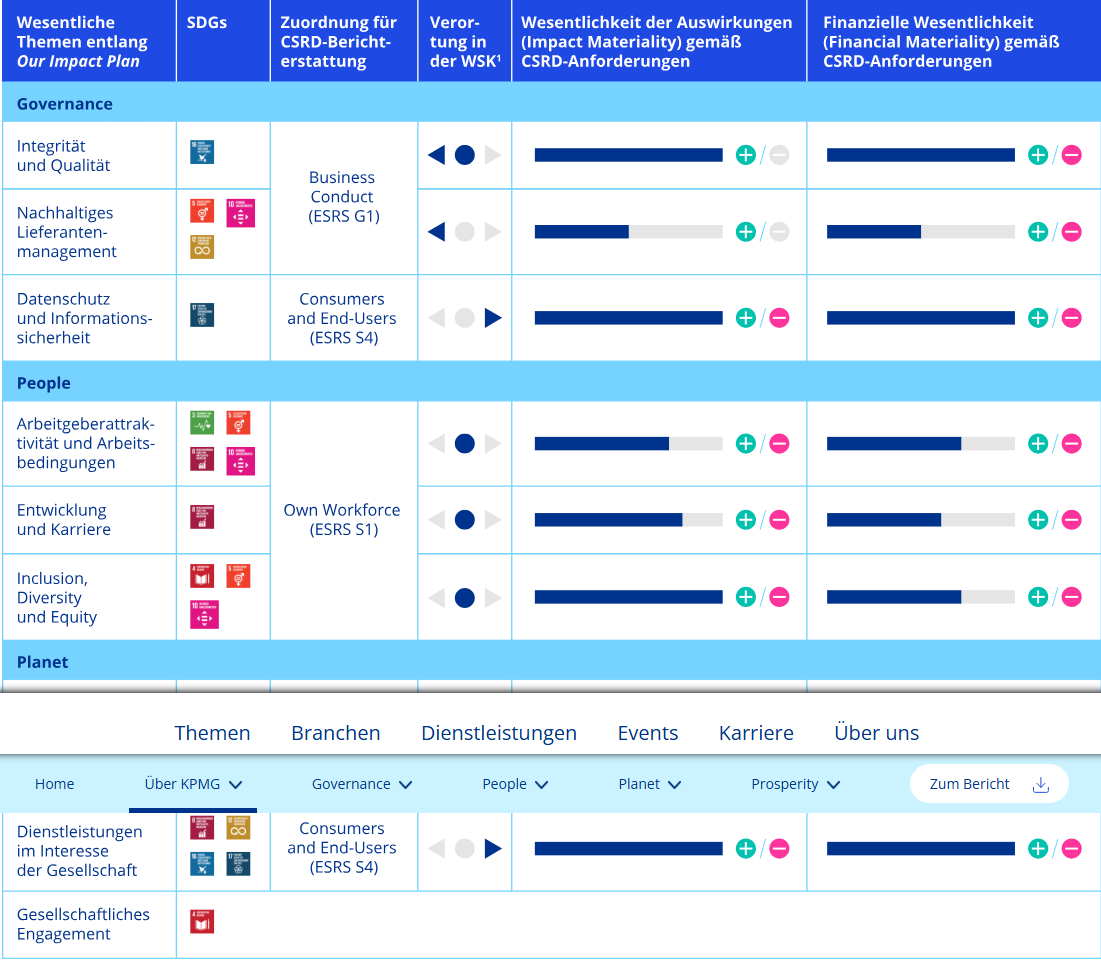
      In preparation for the future mandatory reporting in accordance with the Corporate Sustainability Reporting Directive (CSRD), we initially analysed and evaluated our material sustainability topics in line with the requirements of dual materiality. The principle of dual materiality requires an assessment of these topics in terms of the impact of each topic on the environment, employees and society (impact materiality perspective) on the one hand, and in terms of business relevance (financial materiality perspective) on the other. For the time being, we estimate that our existing topics continue to represent the material sustainability aspects in accordance with the CSRD requirements.


      An overview of our material topics based on Our Impact Plan and their provisional allocation to the European Sustainability Reporting Standards (ESRS) on which the CSRD is based can be found in the following table. It also contains an overview of the SDGs to which we contribute with our activities along Our Impact Plan.

      Stakeholder interests

      The following table also summarises how we are in continuous dialogue with our stakeholders and take their interests into account.

      Feedback from our employees is collected annually through the Global People Survey. In addition, KPMG regularly conducts surveys on various sustainability topics. Development meetings, feedback meetings, exchanges with business and employee representatives and exit interviews are also part of the dialogue with this stakeholder group.

      We regularly exchange information with this stakeholder group via recruiting events, webcasts, the KPMGnext community and interviews.

      KPMG regularly conducts client feedback, interviews and surveys. In addition, we continuously process assessments and sustainability questionnaires from our clients, which set out their expectations of KPMG with regard to our own sustainability performance.

      We follow socially relevant topics, for example through media reports and public commentaries.

      Through continuous dialogue within the global KPMG network, we always stay informed about key issues and any national peculiarities. Our peer review process also includes analysing our national and international competitors.

      Through our involvement in various associations and chambers and our participation in the professional dialogue by commenting on draft legislation and guidelines at the request of the legislator, as part of our usual advisory activities for our clients and due to the presentation and discussion of legal or regulatory issues aimed at the general public, we keep ourselves continuously informed about the current requirements placed on us as a professional services firm, such as the CSRD.

      Information is exchanged through tenders, contract negotiations, supplier evaluations, questionnaires or self-disclosures, certifications and annual meetings as part of framework agreements with larger suppliers.

      About KPMG

      KPMG is an organisation of independent member firms with around 273,000 employees in 143 countries and territories. We are one of the leading auditing and advisory firms worldwide and in Germany. In Germany, around 14,500 employees work for our clients at 29 locations. Our services comprise five services: Audit, Tax, Deal Advisory, Consulting and - new from the 2025 financial year - Performance & Strategy. Audit centres on the auditing of consolidated and annual financial statements. Tax stands for KPMG's tax advisory activities. The Deal Advisory, Consulting and Performance & Strategy services combine our extensive expertise in business, regulatory and transaction-oriented topics. In addition, we have specialised in important sectors that require interdisciplinary expertise. Our experts in Germany and around the world pool their experience to continuously improve the quality of our services.

      KPMG is part of the global network of independent member firms of KPMG International Limited, an English private company limited by guarantee. KPMG - like all other member firms - is committed to maintaining consistent global standards in the provision of services to our clients and to maintaining the highest levels of independence and integrity in all business activities.

      The governing bodies of KPMG AG Wirtschaftsprüfungsgesellschaft (hereinafter referred to as KPMG) are the Executive Board and the Supervisory Board. The Executive Board is responsible for the management of KPMG. In accordance with the German Auditors' Code (WPO), it consists primarily of auditors and manages the company's business in accordance with the law, the Articles of Association, the rules of procedure issued by the Supervisory Board and the professional principles for auditors and auditing firms.

      Under the leadership of the CEO, the Executive Board develops the corporate strategy, taking into account the global sustainability programme Our Impact Plan. The Supervisory Board, which has equal representation, monitors the actions and advises the Executive Board. Further information on KPMG's governance structure can be found in the current KPMG Transparency Report.

      Memberships and initiatives


      Awards and honours

      Certifications

      Your contacts