
The redesign of energy systems permeates all levels of society – from private households to industry and commerce to the energy sector and public administration. Heating, mobility and industrial processes must be decarbonised in parallel. This simultaneity makes energy a strategic competitive factor.
Shaping the energy transition strategically – instead of merely reacting
We support companies from decarbonisation strategy and investment assessments to the implementation of new technologies and business models. With our in-depth understanding of the energy industry and clear focus on implementation, we create decision-making bases that deliver results.
Focus on industry topics

Michael Salcher
Regional Head East, Head of Energy & Natural Resources
KPMG AG Wirtschaftsprüfungsgesellschaft
Do you need advice in the energy sector?
Are you interested in more details about our work and would like to arrange a meeting with us? Then simply contact us via the following channels - we look forward to hearing from you!!
Key challenges and trends
The energy transition is placing greater demands on finance functions and making finance a key driver of transformation.
- Shift of investments to capital-intensive, long-term transformation projects
- Higher volatility requires improved planning, forecasting and scenario capabilities
- Integration of CO₂ costs and ESG KPIs into investment and control models
- Increasing importance of CAPEX optimisation, subsidies and risk management
Increasing regulatory complexity poses significant challenges for companies and leads to growing burdens.
- EU climate targets necessitate long-term investments with limited planning security
- EU taxonomy and CSRD increase requirements for data, reporting and processes
- CO₂ pricing (ETS, ETS 2, CBAM) has a direct impact on cost structures
- Frequent national adjustments (e.g. EEG, GEG, grid fees) make stable business cases difficult
Companies must anticipate regulatory developments at an early stage and systematically integrate them into their decision-making processes.
In future, companies will increasingly operate independently on the electricity market in order to strengthen their supply and actively manage costs.
- Direct marketing and own consumption of electricity from own generation facilities
- Hedging via corporate PPAs and active electricity price hedging
- Revenue from flexibility marketing (e.g. balancing energy, demand side management)
- Use of storage and load management to optimise electricity procurement and prices
- Bundling decentralised plants via virtual power plants (prosumer models)
Companies must understand market mechanisms and use them in a targeted manner to make their energy supply resilient and economical.
ESG is evolving from a pure compliance requirement to a key lever for value creation and competitiveness.
- Access to capital through ESG-compliant financing instruments and better financing terms
- Cost reduction through energy efficiency, resource conservation and optimised processes
- Strengthening of market position and brand through rising expectations of customers and business partners
- Reduction of risks along the supply chain through transparency and ESG standards
- Support for strategic decisions through ESG KPIs as a management tool
Companies must systematically integrate ESG into their strategy, investment decisions and operational processes in order to realise sustainable value potential.

KPMG Insights on the energy sector


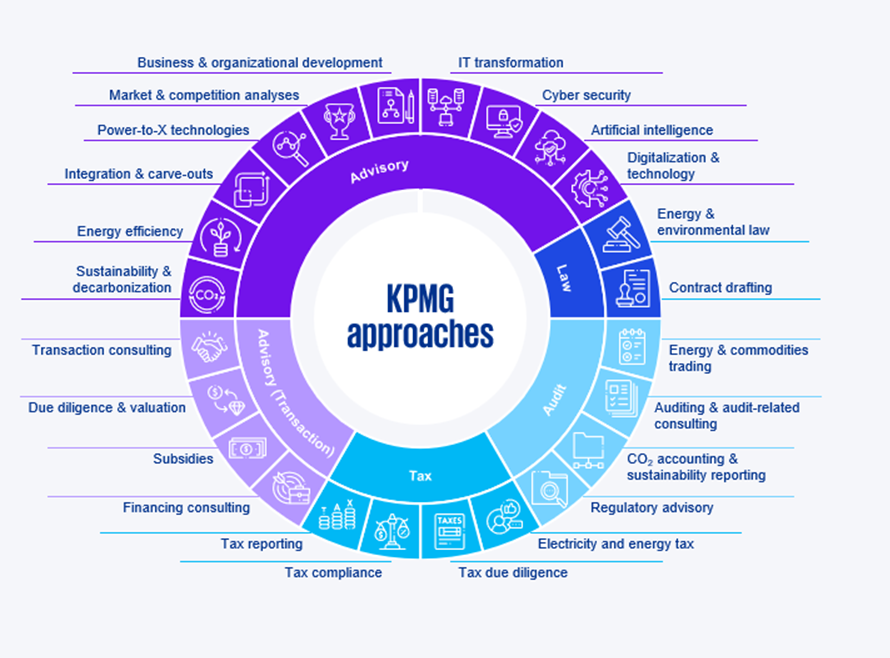
Our range of services
We provide you with individual advice on the following industry topics.
Your contacts
Michael Salcher
Regional Head East, Head of Energy & Natural Resources
KPMG AG Wirtschaftsprüfungsgesellschaft


Gernot Gutjahr
Partner, Consulting - Intelligent Enterprise Technology
KPMG AG Wirtschaftsprüfungsgesellschaft


- Item 1
- Item 2
- Item 3
- Item 4
- Item 5
- Item 6
- Item 7
* Legal services are provided by KPMG Law Rechtsanwaltsgesellschaft mbH.
Energy consulting for the transformation of the energy sector
The energy transition is changing investment decisions, cost structures and business models in the energy sector. The expansion of renewable energies, new demands on grids, volatile procurement markets and rising expectations regarding security of supply are increasing the pressure to act. For companies, energy is thus becoming a management challenge that closely links strategy, financing, regulation and operational implementation.
Energy consultancy helps companies translate changes in the energy sector into viable decisions. We advise energy suppliers, network operators, industrial companies and investors on issues ranging from decarbonisation and capital allocation to digital operating models, regulatory requirements and growth targets.
Consulting for the energy sector, commodities and industry
Many companies in the energy sector face the challenge of prioritising transformation projects from a business perspective. These include investments in renewable generation, grid infrastructure, storage solutions, hydrogen, energy efficiency and new digital platforms. We examine business cases, assess opportunities and risks, and support you in deploying capital in a targeted manner.
Regulatory requirements are further increasing the pressure to act. Reporting obligations, CO₂ pricing, funding mechanisms, grid tariffs and security of supply requirements have a direct impact on planning and management. Our energy consultancy helps to integrate these framework conditions into strategies, processes and governance structures at an early stage and to align them with your growth objectives.
Digitalisation is also continuing to grow in importance. Data from generation, consumption, grid operations and market communication is becoming a key driver for more efficient decision-making. We support you in developing data-driven management models, utilising AI and securing digital infrastructures.
KPMG Energy: Effectively managing transformation and growth targets
KPMG Energy stands for energy consultancy that combines strategic vision with operational feasibility. We support you in structuring transformation programmes, conducting robust assessments of investments and embedding changes in organisation, technology and governance.
Whether you are an energy supplier, infrastructure operator, industrial company or investor: We bring together experts from KPMG’s Services Consulting, Tax, Deal Advisory and Performance & Strategy teams. This expertise is complemented by specialists from the Energy & Natural Resources sector – with a particular focus on ESG – as well as from the field of cyber security. The result is a consultancy service that integrates energy industry, financial, regulatory and technological aspects whilst taking your growth objectives into account.
Frequently asked questions
Energy consultancy involves advising on strategy, decarbonisation, investment, regulation, digitalisation and operational transformation within the energy sector.
Energy consultancy is relevant for energy suppliers, network operators, industrial companies, raw materials companies, infrastructure investors and energy-intensive industries.
We provide support in developing strategic visions, evaluating business cases, implementing regulatory requirements and establishing manageable transformation programmes that also take growth targets into account.
The focus is on decarbonisation, financing, digital transformation, cyber security, ESG management, market models and organisational adjustments.