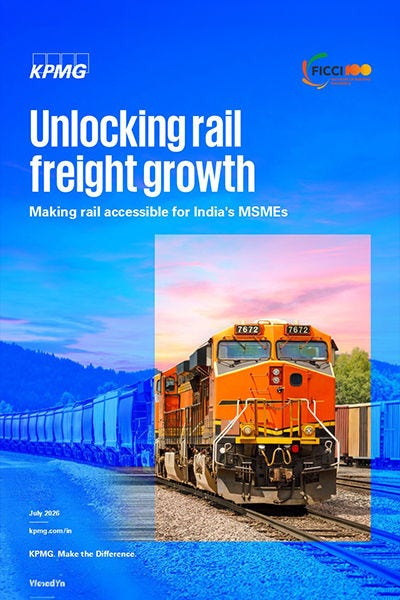
India's growth as one of the world's largest economies depends significantly on the efficiency and competitiveness of its logistics system. Railways play a central role in supporting economic activity by moving freight across the country in a cost-effective and sustainable manner. As India's economy continues to expand, the discussion on rail freight competitiveness needs to move beyond network capacity, train speeds and freight tariffs alone.
The analysis reveals that one of the large, untapped opportunities for rail freight growth lies in improving accessibility for Micro, Small and Medium Enterprises (MSMEs). At over 35 per cent of India’s manufacturing output MSMEs are an important customer segment for logistics. However, as per the National Council of Applied Economic Research estimates, they bear a disproportionately high logistics burden, with logistics costs estimated at 16.9 per cent of output for firms with turnover up to INR 5 crore versus 7.6 per cent for firms above INR 250 crore.
While rail continues to offer a cost advantage over long distances, many smaller businesses face challenges related to cargo aggregation, terminal access, rolling stock availability, first- and last-mile connectivity and service predictability. These factors often determine whether rail remains a viable alternative to road transport.