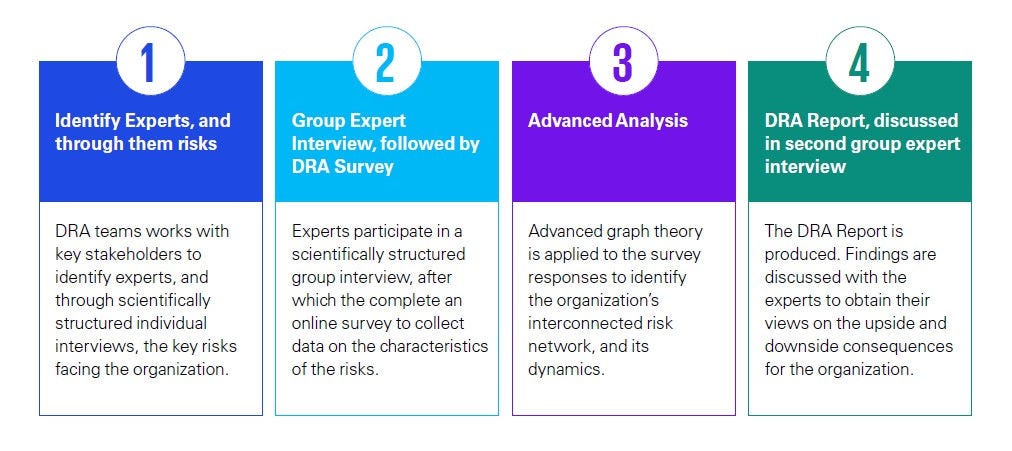
AH: After completing step 4 of the process, we handed over the report to VTTI. This report visualizes the entire strategic landscape using the four dimensions of a Risk Assessment: impact, likelihood, connectivity, and velocity. Jennifer, what did you do with the DRA report and what choices did you make after receiving the results?
JF: Our company operates with an open mindset and consequence-conscious decision-making process. We carefully evaluate the implications of our choices. We discuss the DRA key insights regularly, sometimes specific to a risk domain and sometimes broader.
We also share essential points with the Audit Committee.
This ensures an ongoing risk dialogue and helps integrate consciously factoring risk aspects into daily decision-making. As a risk facilitator, it is important to be aware of the overall landscape and how this impacts our business. Building connections that help people understand the interconnectivity of risks featured in our DRA in their daily work is a continuous process.
It requires refreshing the discussion from time to time and evaluating if things have changed.
Keeping the dialogue going is the essence. Especially the aspect of interconnectivity represents a mental shift for the organization since there was a tendency to focus on risks from a functional perspective. The insight was not so much on the individual risks, but more on the way they influence each other.
That also means taking the DRA and looking deeper into the risk ecosystem with more detailed risk analysis. For external or strategic risks, the approach to address them is different to more preventable operational risks. That is where each risk owner needs to work on a suitable, cross-functional approach that goes deep into the organization, and ensure the actions are relevant.
After the DRA, we started taking a fresh look at our existing risk & control matrices (RCM) to see where the interconnectivity aspects play a role and if we need to take a different approach to some topics. While we did the DRA at enterprise level, our team of experts also included operating site representatives, who now take the learnings of the process to their teams, giving a new impulse to the local site dialogues on risk.
Finally, we ensure we have the right assurance activities in place to close the PDCA (plan, do, check, act) circle. Risk-based auditing is part of the approach, along with focused actions aimed at enhancing awareness around specific themes.
Within VTTI we recognize the importance of better risk dialogues and necessity to address risk in a cross-functional manner. Sometimes, cross-functional communication is challenging, given everyone’s full agenda and different perspectives on a topic. Still, dialogue is vital as it can reveal insights that are not visible on paper. It can also help identify the low-hanging fruit and promote a lean approach to processes. Expert elicitation as a concept ensures you have participants with relevant knowledge in any given dialogue. For any topic, take care that knowledgeable colleagues within the organization take a seat at the table.