error
Subscriptions are not available for this site while you are logged into your current account.
close
Skip to main content

Loading

The page is loading.

Please wait...


      2026 will be the Year of the Carve-Out. The momentum is already clear. Over the past two years, we have seen the number of announced and completed carve-outs rise significantly across the UK.

      Some of the UK’s biggest consumer and retail firms are getting in on the action. Reckitt recently divested its Essential Home business to Advent International, valuing the business at £3.5 billion.[1] Unilever’s demerger of its ice cream business into The Magnum Ice Cream Company in December resulted in a valuation of the standalone company of £7.8 billion.

      Indeed, even while traditional M&A deal volumes remains fairly flat, public-company divestitures are on the rise around the world – growing 16.3 percent between 2023 and 2024. Our data suggests that carve-outs made up nearly a third of all deals announced in 2024.


      Marc Summers

      Partner, Sell-Side Lead

      KPMG in the UK


      Why are carve-outs so popular now?

      According to Mala Shah, a Deals Partner with KPMG in the UK, current slow growth, political uncertainty and financial pressures are causing businesses to continue to look at their portfolios and consider what is core to their strategy while, at the same time, considering who is the best owner of certain parts of their business where they are not maximising value.

      Yet carve outs can be tricky. With common carve-out challenges including shared technology and data, multi-role resources, shared assets, combined financials and reporting and shared support services. Carve-outs are not “business as usual” (BAU) and require a specific execution muscle to be built in advance to successfully divest at optimum value including creating value in the business often before the decision to divest is made.

      In a recent report by KPMG International, we explain how the leading sellers are taking a more strategic approach to deciding which assets to divest and what models to employ. We also explore the steps to bring value creation efforts forward in order to drive up enterprise value and maximise shareholder value.


      Professionalising the portfolio strategy

      Maximising shareholder value starts with great portfolio management. While many UK companies have made significant effort to professionalise their approaches to portfolio management, we still see many organisations struggling to apply a truly systematic approach to analysing and determining which portfolio business to allocate capital to and which to sell. In part, that is because most corporate incentive programs focus on ‘growth’ type metrics over economic profits, thereby encouraging behaviours that are not necessarily optimal for long-term value creation.

      “I often ask my clients on their own business units whether they would purchase that asset if it were on the market today,” notes Marc Summers, Partner and Sell-Side Lead at KPMG in the UK. “You have a lot of choices on where to invest your capital – are you delivering the greatest returns to your investors by keeping the asset? Or should you divest the asset and use that capital to reinvest into the business to generate new value for your shareholders?

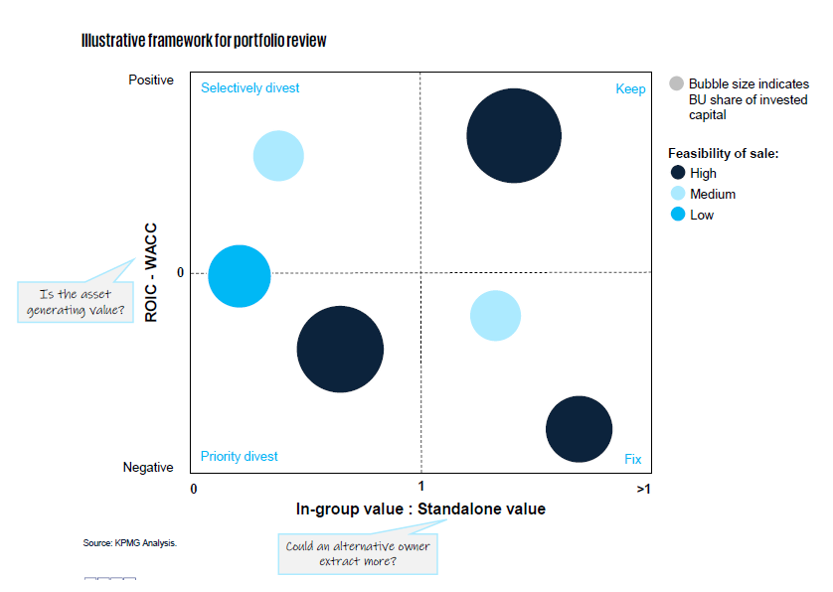
      In reality, divestment assessments should be based on an ongoing assessment of the value of an asset within and outside of the corporate entity. The analysis needs to link revenue, margin and invested capital down to the lowest common level across all portfolio companies or segments. This gives the initial clarity on which assets generated positive returns on investment capital (ROIC) and which destroy value.

      Next, overlay cost allocations to get to true profitability. Shift corporate overhead to the businesses that consume it and strip out group subsidies. Then run external benchmarks to compare each business unit to peer top quartile on cost, growth and ROIC. Finally weigh the value of the PortCo within the group, to standalone value based on listed and private transaction comparables.

      In our report, we provide a simple framework that uses this data to rapidly illustrate which assets should be divested, which should be kept and which could be fixed.

      Given the pace of change in the markets these days, this strategic approach to assessing portfolio assets cannot be a one-time event. Rather, the leading organisations are those that take a regular, dynamic and iterative approach to portfolio assessment and decision-making. What is more, they use their portfolio reviews as a capital allocation tool, not just a transactional step, allowing them to better link portfolio evaluation, brand strategy and separation readiness.

      Bringing value creation forward

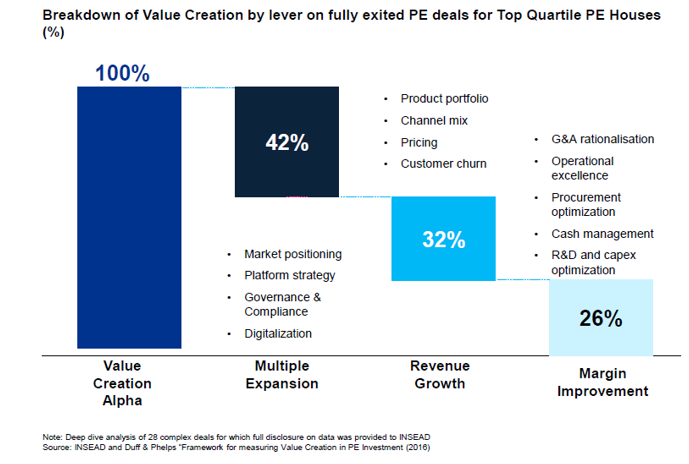
      A lookback over past PE deals clearly illustrates the growing contribution of value creation activities in deal values. Traditionally, top quartile PE Alpha contribution was driven by multiple expansion (i.e. stock picking). More recently, however, a wider range of value creation approaches have started to influence investor returns.


      We are seeing revenue growth initiatives including portfolio, channel and geographical expansion. Cost and margin initiatives are rising up the agenda, focused on pricing, sales channel and organisational optimisation efforts. Working capital is playing a role, led by inventory, cash management and capex investment optimisation. We are also seeing more transformative multiple expansion activities such as repositioning business models, digitalisation and improvements in governance and risk management.

      The key is to start embedding value creation from the outset. This should help sellers to sharpen their strategic focus and enable proactive divestitures, thereby avoiding reactive fixes. Indeed, our experience suggests that corporates should aim for a long-term vision by regularly assessing their product and service portfolios against strategic goals. At the same time, corporate sellers should also prioritise immediate value creation, especially for potential divestitures.

      “Those entertaining strategic acquirers should be taking the time to really think about the sell-side synergies that the deal might unlock and then preparing and executing on value creation strategies that enhance the value proposition for the strategic,” adds KPMG’s Mala Shah. “There is a lot that sell-side players can do to put themselves in a much better position for negotiations.”

      This reinforces the need for sellers and corporates to take a more disciplined approach, building expertise in value creation and carve-out execution well before divestment decisions. This preparation strengthens seller teams’ capabilities, ensuring compelling equity stories that capture maximum value and minimise deal risks.


      Where do you go from here?

      Over the next few months, we will be publishing a series of articles that explore each step of the carve-out process. We’ll look at what structures can be used, how best to articulate the value of the deal and how to execute in a way that unlocks the most value.

      • Chapter 1. Selection & Preparation (Portfolio Strategy): How can we embed value creation into our year-round BAU portfolio management, to help ensure we are always fielding the strongest team and make optimal divestment decisions? How can I build organizational capabilities long ahead of the race day?

      • Chapter 2. Setting the Race Plan (Carve-out Strategy): There are four strategic race-plans for a carve-out: Business-in-a-box, Partial Standalone, Synthetic Standalone(a), and Integrated with RemainCo. How do I choose the playbook which best fits the deal and positions us to win?

      • Chapter 3. Getting off to a good start (Building the Value Case): How do I enhance the performance of the CarveCo – moving beyond baseline performance, to create a winning proposition that bidders can fully value and price into the deal?

      • Chapter 4. Executing a flawless exchange (Separation in Practice): How do I choose the right separation model so that I can run the separation, and execute the final handover with precision, while minimizing disruption and maximizing value, for a clear win?

      In the meantime, we encourage you to contact us to discuss your own carve-out and divestment strategies – or to learn more about how leading sellers are embedding value creation and portfolio reviews into their business as usual operations.


      Winning the carve-out relay: from team selection to the finish line

      Designing, executing and winning Consumer and Industrials carve-outs.

      Our advisory insights

      Something went wrong

      Oops!! Something went wrong, please try again