

Rising sea levels, extreme weather events, shifting regulatory landscapes and evolving consumer expectations: the effects of climate change are no longer distant and they are influencing business around the world now. Companies need to navigate and understand the climate-related risks and opportunities they are facing and develop a strategic response.
Any strategic response – whether to act or not – may impact a company’s cash flows in the short, medium or longer term. Companies will need to ensure that their financial, sustainability and other reporting reflects these impacts and tells a connected story.


Question 1 What is climate change?
Climate change refers to long-term shifts in temperatures and weather patterns, primarily driven by the build-up of greenhouse gases (GHGs) such as carbon dioxide (CO₂) and methane (CH₄) in the atmosphere. These gases trap heat, which raises global temperatures and disrupts natural systems.
Question 2 Which industries are most affected?
All industries are affected, but some are more susceptible to the effects of climate change1.
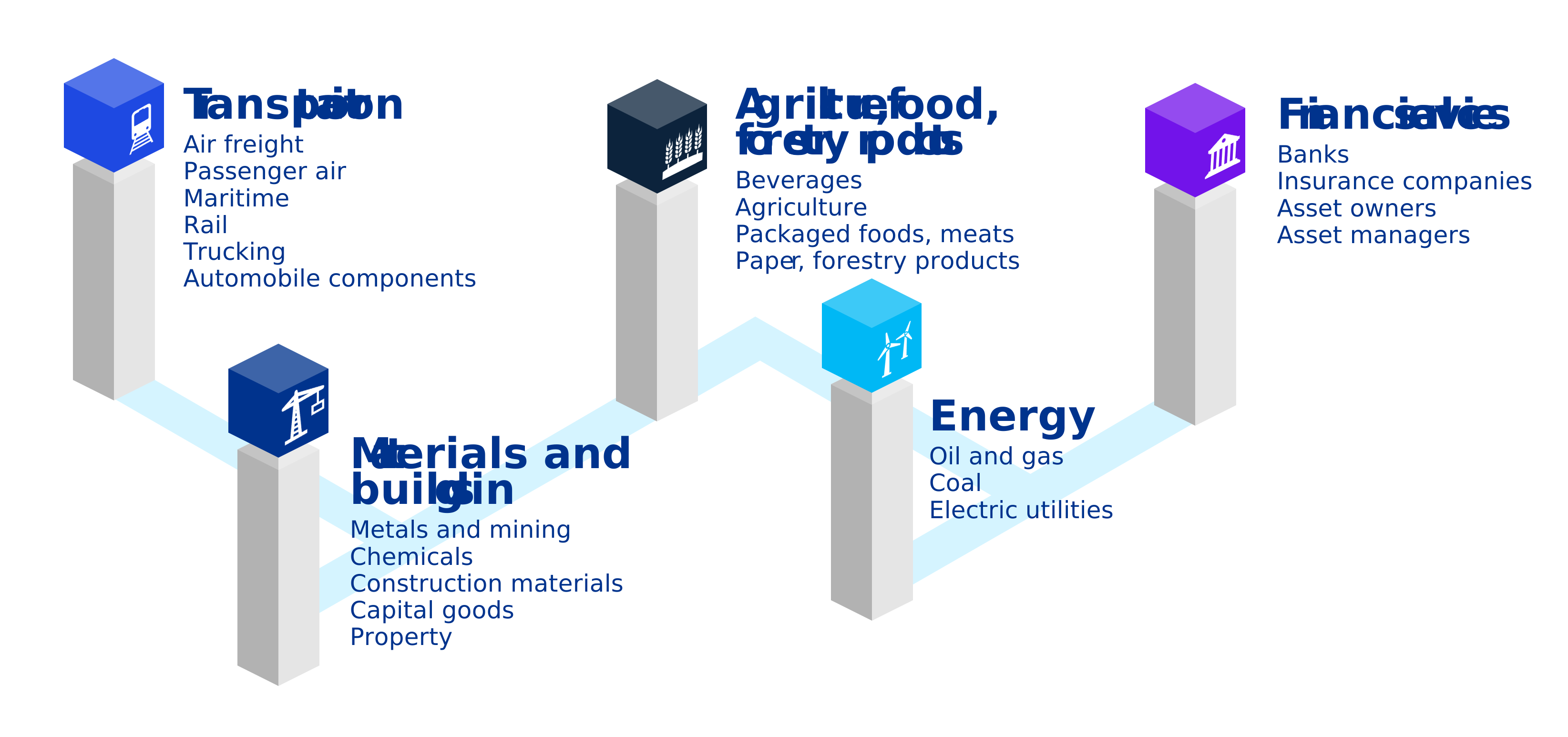
High-risk industries include financial services because of its central role in the economy; the other industries are responsible for the largest proportion of GHG emissions, energy usage and water usage.
Question 3 What are climate-related risks?

Climate-related risks refer to the potential negative impacts of climate change on businesses, economies and financial systems. These risks are broadly categorised into two main types.
Physical risks: These arise from the direct effects of climate change on the environment and infrastructure. There are two categories of physical risks.
- Acute: More frequent or severe event-driven disruptions from extreme weather events such as floods, wildfires and hurricanes – these can cause immediate damage to assets, disrupt operations and lead to financial losses.
- Chronic: Long-term shifts in climate patterns such as rising temperatures, rising sea levels and changing precipitation patterns – these may gradually affect asset values, supply chains and operational viability.
Transition risks: These stem from the shift to a low-carbon economy and include the following.
- Policy and legal: Changes in regulations (e.g. carbon pricing, emissions caps), litigation and compliance costs.
- Technology: Disruption from new green technologies, R&D costs and accelerated obsolescence.
- Market: Shifts in consumer preferences, commodity prices and demand patterns.
- Reputational: Stakeholder perceptions and brand impact in response to a company’s climate action.
Question 4 What are climate-related opportunities?

Climate-related opportunities refer to the positive financial and strategic effects that may arise from efforts to mitigate or adapt to climate change. These opportunities can emerge from both physical changes (e.g. warmer temperatures enabling new crops to grow) and transition changes (e.g. new technologies supporting decarbonisation).
Question 5 What are the impacts on financial reporting?
Climate-related risks and opportunities include both direct financial consequences and broader strategic implications, which companies need to consider as part of their accounting, disclosures and decision-making processes. Some impacts for financial reporting include the following.
- Impairment of assets: Physical risks (e.g. floods, wildfires) and transition risks (e.g. regulatory changes, carbon pricing) may lead to impairment indicators.
- Useful lives and residual values: Climate-related risks may shorten the useful lives of assets or reduce their residual values, requiring changes in depreciation or amortisation schedules.
- Fair value measurement: Climate-related assumptions (e.g. carbon costs, regulatory changes) need to be factored into fair value estimates.
- Provisions and contingent liabilities: Legal or regulatory risks (e.g. emissions penalties, litigation) may require a company to recognise provisions or disclose contingent liabilities.
- Carbon credits and emissions allowances: Emissions and green schemes are evolving and pose various accounting and reporting challenges.
- Connected story: Investors expect consistency between climate-related assumptions disclosed in the front part of the annual report (e.g. transition plans, net-zero targets) and those used in the financial statements (e.g. impairment tests, fair value estimates).
Question 6 What are the impacts on sustainability reporting?
- identify and disclose material information about climate-related risks and opportunities across short-, medium- and long-term horizons;
- explain the impact on strategy, business model, financial planning and resilience – including current and anticipated financial effects;
- provide scenario analysis and disclose assumptions, methodologies and uncertainties; and
- ensure connectivity between sustainability disclosures, financial statements and other parts of the annual report, reconciling differences in assumptions used.
1. As highlighted in the recommendations issued by the Task Force on Climate-Related Financial Disclosures (TCFD) in June 2017.
Useful resources
We deliver insights, high-level guidance and detailed analysis to assist your financial reporting.


© 2026 KPMG IFRG Limited, a UK company, limited by guarantee. All rights reserved.