
      Developing robust frameworks

      AI has transformed financial services, from optimising internal processes to managing different elements of the customer engagement and risk management lifecycles. According to the FCA and Bank of England (BoE), 86% of firms now use AI. Banks have been embedding AI in their operational and wider risk management frameworks, for example in credit risk management and fraud detection, while insurers are increasingly using it in claims-handling. In the capital markets, AI is helping to optimise portfolios and analyse alternative data, and payments firms are using it to process customer behavioural analytics.

      While firms are benefitting from the opportunities presented by AI, FS regulators are alert to the risks it may present. A quick horizon scan of announcements reveals that AI risks are consistently high on supervisory agendas, with frequent speeches and warnings in the UK, EU, US and internationally (see AI Regulatory Radar for more information). And yet, while AI risks attract significant attention, there are no regulatory regimes dedicated specifically to AI governance in financial services. Regulators have emphasised that existing frameworks should be used to manage AI risks and have stopped short of introducing new FS-specific policy or legislation. This is understandable: there are challenges in developing prescriptive regulation of a fast-paced technological change, and in an environment of growth, competitiveness and simplification, there is limited appetite from both firms and supervisors to develop additional regulatory regimes.

      However, relying on existing frameworks can present its own difficulties. As highlighted in the UK Mills Review earlier this year, existing accountability, model risk management and consumer protection frameworks were designed for primarily human interactions. As AI becomes a core operational capability, firms should evolve their approaches and address AI risks such as model drift, data bias, hallucinations, AI agents, and other behaviours – many of which are not captured in traditional validation approaches. As highlighted by the UK Parliamentary Treasury Committee and the BoE’s Financial Policy Committee, there are potential consequences for financial stability and spillover effects into the wider economy if AI-driven FS risks crystallise, including financial impacts for consumers, policyholders and investors. Firms may therefore require more dynamic approaches to AI governance, and they are seeking practical guidance from regulators on how existing frameworks can help achieve this.

      At an international level the Financial Stability Board (FSB) has finalised Sound Practices for responsible AI-adoption. These are the closest development so far to an internationally-agreed AI governance approach specifically for FS firms, but the FSB is clear that while boards are ‘strongly encouraged’ to adopt the practices, they ‘do not constitute a binding international standard’.

      The FCA recently published good and poor AI practices on consumer centricity, accountability and governance, and operational resilience. The publication includes case studies alongside guidance on how to apply the practices to smaller firms. The FCA has been clear that it supports innovation and will update its guidance as technology evolves.

      At KPMG in the UK, we often hear from firms that the lack of guidance around AI adoption can make it harder to manage risks appropriately, proportionally, and consistently with market peers. The FSB and FCA publications are therefore welcome interventions, and firms are likely to use them to guide their AI governance practices. Firms can also look to the AI Governance Principles for Boards developed jointly by KPMG International and INSEAD in 2026. Whilst these principles are sector-agnostic, they can be mapped neatly to the FSB sound practices, providing a prototype framework for AI governance in FS firms.
      The FSB’s Sound Practices on Responsible AI Adoption

      The FSB’s 12 Sound Practices were finalised on 15 October and cover responsible AI adoption by FS firms across the organisation and AI lifecycle. The FSB explicitly notes that the practices are ‘non-prescriptive’; instead, they are meant to ‘promote coordination, cooperation and information-sharing’ between FS stakeholders, and thus can be used by firms as a basis for AI governance. The FSB notes that the sound practices will evolve as AI technologies and understanding of their associated risks develop. For example, the finalised document includes greater consideration of agentic AI and multi-agent systems than the draft.

      Organisation-wide AI governance (sound practices 1-4)

      The FSB’s first four sound practices focus on organisation-wide AI governance and position boards and senior management at the centre of responsible AI adoption:

      1. Strategic direction and oversight – AI should be treated as a strategic business, risk and resilience issue, with boards ensuring that AI adoption aligns with the institution’s business model, risk appetite and long-term objectives.

      2. Governance and accountability – calls for clear governance structures and decision-making processes to oversee AI-related activities. This includes relevant approaches for centralised vs decentralised adoption, establishing cross-functional coordination and splitting responsibilities across the three lines of defence.

      3. AI risk management framework and effective documentation – highlights the need for robust policies, controls and documentation to identify, assess, monitor and manage AI-related risks across the organisation.

      4. Organisational adaptability – firms should develop the skills, resources and capabilities needed to respond to the rapid evolution of AI technologies and risks, including monitoring external developments that can surface early risk signals that internal processes may not detect.

      AI lifecycle management (sound practices 5-12)

      The remaining sound practices address the management of AI throughout its lifecycle:

      5. Materiality and risk assessments and

      6. Selection are important to assess the materiality and risk of AI use cases at the inception and thereafter, and to select models that are appropriate for their objectives and risk profile.

      7. Data governance – ensures that data used to train, test and operate AI systems is accurate, reliable and secure.

      8. Explainability and transparency – firms should understand differences in the explainability of various types of AI, implement controls if appropriate and provide transparency to different stakeholders.

      9. Performance management and

      10. Human oversight – call for rigorous testing, ongoing monitoring and oversight proportionate to the complexity, autonomy and risk of the AI application.

      11. Cyber and ICT risk management and

      12. Third-party risk management – firms should focus on strengthening operational resilience and managing risks arising from AI providers, including model performance, data quality, concentration, supply-chain and business continuity risks.

      Mapping KPMG INSEAD principles to FSB sound practices

      In 2026, KPMG International and INSEAD published a joint report on AI Governance Principles for Boards, highlighting five key principles to help companies evaluate the longer-term opportunities of AI while managing its risks:

      • strategic oversight for long-term value creation
      • active technology and security oversight
      • workforce transformation and human accountability
      • building trustworthy AI
      • the work of the board.

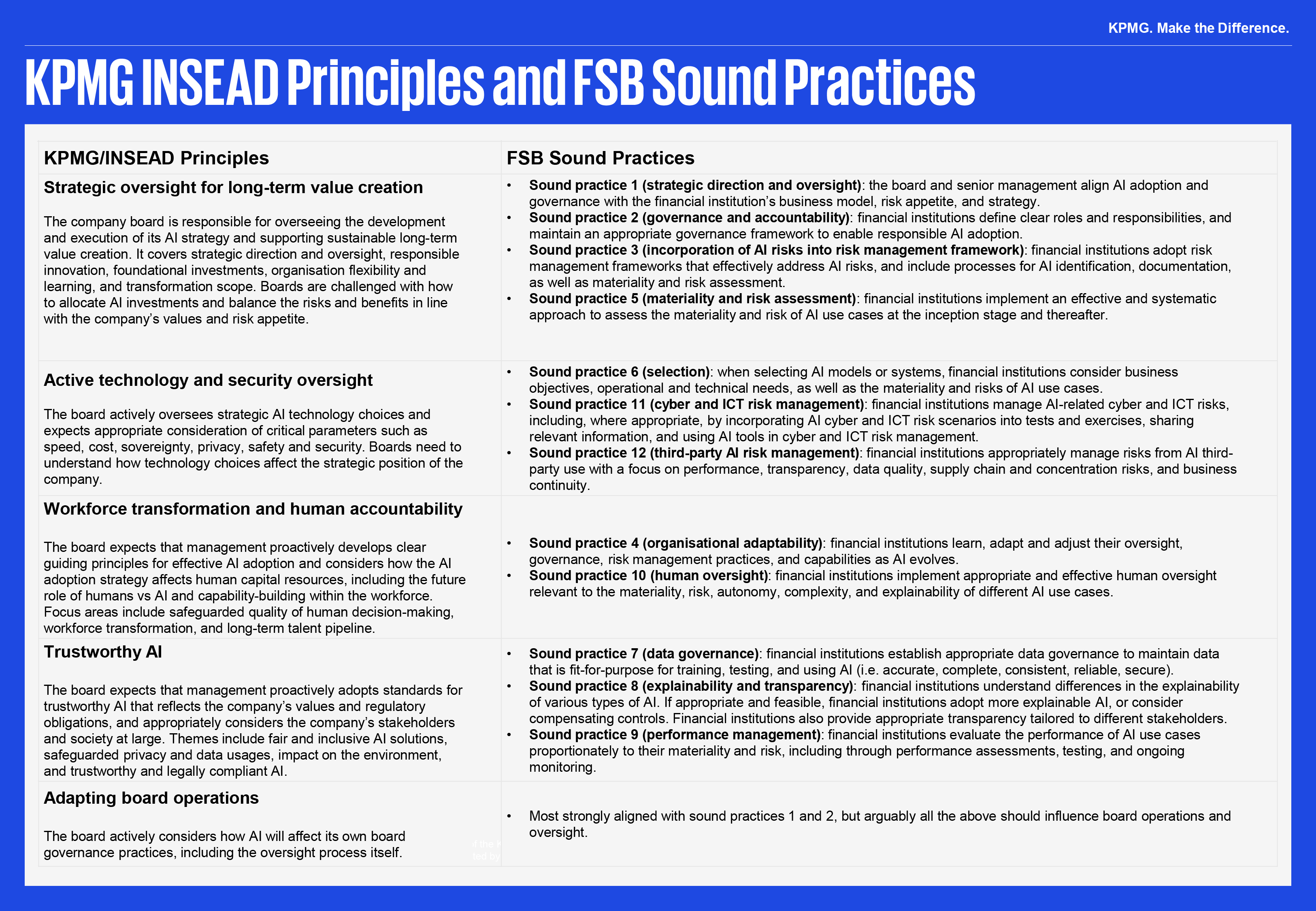
      The FSB’s 12 sound practices can be mapped to the KPMG INSEAD sector-agnostic principles as follows:

      In this way, FS firms can apply the KPMG INSEAD principles alongside the FSB’s sound practices, to help achieve appropriate and proportionate AI governance within their organisations.

      Applying these principles and sound practices involves translating them into proportionate governance, clear accountability and practical controls across the AI lifecycle, building on firms’ existing risk management arrangements.


      How KPMG in the UK can help

      KPMG professionals can work with firms to develop and strengthen AI governance processes, leveraging our Trusted AI assets and accelerators that have supported numerous organisations globally. This could include:

      • Designing an FS-specific AI governance framework aligned with your business model, risk appetites and existing regulatory obligations, drawing on the FSB sound practices, KPMG INSEAD principles and emerging supervisory expectations.
      • Clarifying board and senior management accountability by defining decision rights, committee responsibilities, escalation routes and management information needed to oversee AI strategy, risk and resilience.
      • Assessing current AI governance maturity and identifying gaps across policies, controls, documentation, skills and oversight, benchmarking arrangements against evolving regulatory practice and relevant market peers.
      • Helping to establish a risk-based AI inventory and classification approach to identify AI use cases, assess their materiality and apply proportionate approval, monitoring and control requirements.
      • Strengthening lifecycle risk management across model selection, data governance, testing, explainability, human oversight, performance monitoring and the controlled retirement of AI systems. This includes working with business and technology teams to embed proportionate controls, define human oversight and permitted actions for generative and agentic AI, and establish monitoring, escalation and reassessment following material changes.
      • Enhancing operational resilience and third-party oversight by assessing cyber, ICT, concentration, supply-chain, data quality and business continuity risks associated with external AI models and service providers.
      • Supporting regulatory readiness and organisational adaptability through horizon scanning, regulatory mapping, scenario exercises, and board training.

      KPMG professionals can also support AI assurance readiness and provide independent assurance, with the scope and criteria tailored to the intended purpose. This could include:

      • Assessing AI assurance readiness by determining whether suitable criteria, governance, oversight, controls, documentation and evidence needed to support future assurance are in place.
      • Providing independent assurance over AI-related controls and systems through SOC 1, SOC 2 / SOC 2+ or ISAE 3000 assurance, where appropriate to the subject matter, agreed criteria and intended users, and subject to applicable independence requirements.


      Our insights

      AI insights on where the agenda is heading and implications for firms

      KPMG’s AI Governance Principles for Boards provide a practical, principles-led framework to support board directors as they navigate this evolving landscape.


      Our people

      Kate Dawson

      Capital Markets, EMA FS Regulatory Insight Centre

      KPMG in the UK

      Michelle Adcock

      Banking, EMA FS Regulatory Insight Centre

      KPMG in the UK

      Radhika Bains

      EMA FS Regulatory Insight Centre

      KPMG in the UK

      Douglas Dick

      Head of Emerging Technology Risk

      United Kingdom