Direct ownership or real estate company? 

      Tax considerations

      Individuals who own multiple properties have long faced the question of whether to continue holding their real estate directly (in German) or to transfer it into a real estate company. The reasons for doing so are diverse (for example, estate planning).

      From a tax perspective, two topics have traditionally been at the core:

      • optimizing income tax exposure, and
      • avoiding a potential classification as a professional real estate dealer

      Now that the imputed rental value has been eliminated, another tax-driven consideration comes into play that supports transferring properties into a personally held real estate company: to maintain full deductibility of interest expenses.

      Christoph Frey

      Partner, Real Estate Tax

      KPMG Switzerland

      Sibylle Fankhauser

      Director, Tax & Legal

      KPMG Switzerland

      Overview of the restriction on interest deductibility

      With last year’s decision to do away with the imputed rental value (which is not expected to come into force before 2029), the deductibility of interest expenses has also been significantly restricted. Until now, private interest expenses were tax‑deductible up to the amount of taxable investment income plus CHF 50,000.

      The newly introduced so‑called quota‑restrictive method will apply going forward. Under this method, all interest expenses will only be tax‑deductible in proportion to the share of non‑owner‑occupied properties relative to total assets. For individuals without taxable rental or lease income, no interest deduction will be available at all.

      Example

      • CHF 1 million official value of a rented property
      • CHF 5 million total assets (securities, owner occupied home, rented home)
      • CHF 30,000 total mortgage interest on the rented property

          The relevant quota is 20 percent, meaning that only CHF 6,000 of the mortgage interest will remain tax‑deductible. Until the imputed rental value is abolished, the mortgage interest in this example continues to be fully deductible (see additional calculation examples (in German)).

          This new calculation method is not without issues, as mortgage interest constitutes costs that are necessary to generate rental income, which, unlike the interest expenses, is fully taxable. The restriction on interest deductibility, however, does not apply when the properties are held as business assets.

              When transferring property becomes worthwhile from a tax perspective

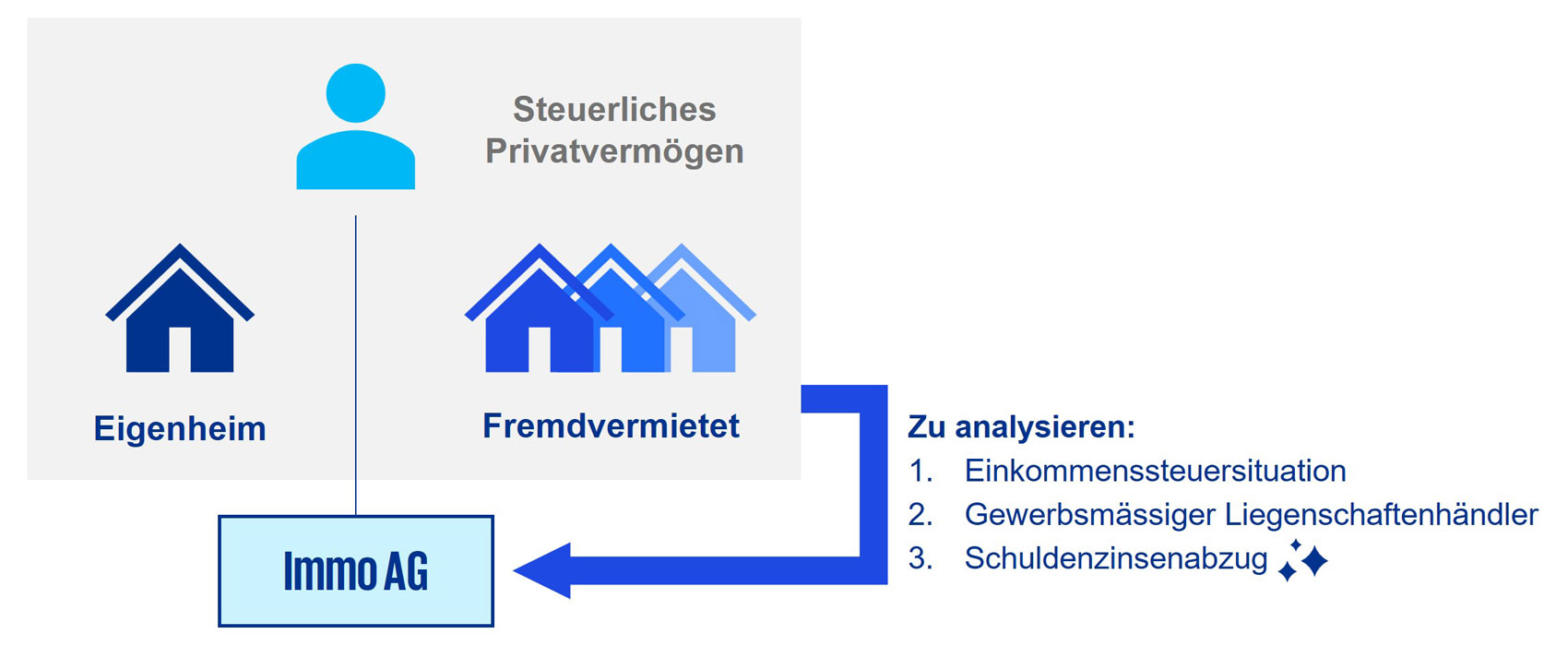
              If you own a larger real estate portfolio, there are three tax‑driven reasons that may support transferring your properties into a real estate company:

              1. Income tax position

              2. Status as a professional real estate dealer

              3. Interest deductibility

              Practical experience shows that transferring properties into a real estate company does not always lead to an improved overall tax position, although this is often the case. In most situations, the decisive factor is the tax burden triggered by transferring the properties to the real estate company as a result of the transfer of ownership (under civil law).

              For many owners, the amount of this “tax entry ticket” is the key determinant of whether they ultimately proceed with the restructuring. 

              Fiscal nuances are decisive

              Understanding the relevant tax nuances can make a significant difference. There are, on one hand, statutory provisions as well as established administrative practice that point toward sensible approaches. For example, in the canton of Lucerne it is possible to transfer a property to a real estate company at its acquisition cost, meaning no real estate capital gains tax is triggered (subject to a five‑year clawback).

              Case law must also be closely monitored. For example, the Federal Supreme Court recently ruled in two cases in favor of taxpayers who, as part of their estate planning, transferred real estate to a real estate company in a tax-neutral manner.

              In decision 9C_87/2025 of 19 September 2025 (in German), the Federal Supreme Court, in a surprisingly straightforward manner, established a link between business assets and the tax requirement of an operational purpose. This is likely to facilitate the tax-neutral transfer of larger real estate portfolios into a real estate company in the future (at least in the cantons of BE, BL, BS, JU, NW, SZ, TI, UR, and ZH, which apply the so called monistic system).

                  On the other hand, this ruling also carries the potential for tax authorities to take a more assertive stance when allocating real estate to taxable business assets.

                  In this context, it is advisable to carefully consider the risk of being classified as a professional real estate dealer, which could lead to a higher overall tax burden as well as additional social security contributions.

                      Outlook: my own real estate company?

                      The restriction on interest deductibility for privately held, rented properties mentioned at the outset is likely to prompt more owners to take a closer look at transferring their properties into a real estate company. From a tax perspective, there have already been strong reasons for doing so.

                      However, any such transfer should be carefully reviewed from a tax perspective in advance: first, to model the “tax entry ticket” into the new structure and the resulting future overall tax position, and second, to assess the possibilities for a fully tax‑neutral transfer of the properties.

                          FAQ on the Abolition of the Imputed Rental Value

                          Anyone living in their own property has a financial advantage compared to someone renting a home. This advantage is taxed as a notional income and must be declared as the imputed rental value in the tax return.

                          The Federal Council determines the effective date. The imputed rental value is expected to be abolished as of 1 January 2029.

                          The mortgage interest deduction will be significantly restricted. Only taxpayers who own a rented or leased property will still benefit from a reduced mortgage interest deduction.

                          Private interest expenses may only be deducted in proportion to the ratio of total assets to non‑owner‑occupied properties. If this ratio is, for example, one third, private interest expenses are only deductible up to one third (view additional calculation examples (in German)).

                          The change affects all taxpayers. Owners of rented properties will also face restrictions on the interest deduction if they hold other assets in addition to real estate.

                          Mortgage interest will continue to be deductible depending on total assets, provided the properties are rented or leased. If the total assets only include owner‑occupied properties, mortgage interest will no longer be deductible.

                          Due to the property transfer (change of owner under civil law), shifting real estate from private taxable assets into a real estate company may trigger real estate capital gains tax and property transfer tax, depending on the canton.

                          Your real estate, optimally managed

                          We support you with all transactions – from property sales to transfers within the family. Receive tailored advice from our experts.

                          Our experts

                          Christoph Frey

                          Partner, Real Estate Tax

                          KPMG Switzerland

                          Sibylle Fankhauser

                          Director, Tax & Legal

                          KPMG Switzerland

                          Related articles and more information

                          An overview for companies, pension funds, institutional investors and high-net-worth families (in German).

                          From 2026, it will no longer be possible to make lump-sum provisions for major renovations. Find out how these changes will affect your tax planning.

                          Together with our local specialists we provide you with competent advice on all tax aspects of your Swiss and international real estate investments.