Skip to navigation

      Clarity on Healthcare 2026: Swiss hospitals and clinics between stabilization and transformation

      The financial situation of many Swiss hospitals and clinics improved noticeably in 2025. Rising margins, positive revenue growth and early signs of financial stabilization provide grounds for cautious optimism.

      At the same time, the pressure to transform remains high. Investment requirements, workforce shortages, digitalization as well as new regulatory and funding frameworks continue to pose significant challenges for the sector.

      This year’s study highlights the developments shaping healthcare delivery in Switzerland and identifies the issues that should remain high on the agenda of boards of directors and executive management teams.

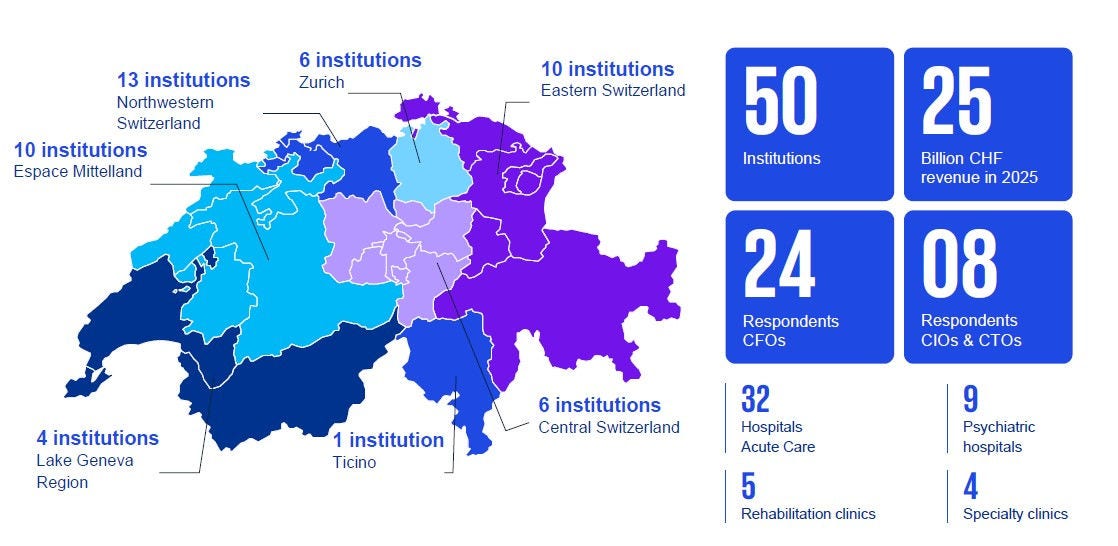
      The study is based on an analysis of the annual reports of 50 Swiss hospitals as well as rehabilitation and psychiatric clinics for the 2025 financial year. In addition, CFOs, CIOs and CTOs were surveyed to provide a perspective on the sector’s current challenges, strategic priorities and expectations for the future.
      Finanzzahlen Schweizer Spitäler und Kliniken

      Clarity on Healthcare 2026

      Swiss hospitals and clinics: 2026 Snapshot and 2027 Outlook

      Key findings at a glance


      5.4%

      EBITDA margin in 2025: the highest level recorded in the past five years (average across the analyzed sample).

      71%

      of surveyed CFOs have already centralized functions or implemented shared services.

      63%

      of surveyed CIOs and CTOs expect AI to reduce administrative workload.

      Swiss healthcare providers showed the first signs of financial recovery in 2025.

      At the same time, new technologies, rising cyber risks, shared service models and the introduction of EFAS are fundamentally reshaping the industry landscape.

      The study highlights how leading organizations can advance financial stabilization and transformation simultaneously.

      Study sample

      Study sample

      Market overview 2025: the sector is stabilizing, but funding pressure remains

      • Financial recovery

        Many hospitals and clinics were able to improve their financial performance in 2025. The EBITDA margin across the analyzed sample increased to 5.4%, exceeding the average of the past five years. At the same time, 96% of the institutions reviewed reported a positive operating result. 

      • Revenue growth and new care models

        Revenue growth of 5.4% points to a positive development on the income side. At the same time, outpatient care, integrated care models and partnerships, as well as the effective management of internal resources and the use of AI, are becoming increasingly important and continue to shape the strategic priorities of many healthcare providers.

      • Financing needs remain high

        Despite the operational recovery, financing future investments remains a key challenge. Significant capital expenditure requirements and pending refinancing needs continue to put pressure on the sector.


      82%

      ...of healthcare institutions have improved their EBITDA margin. 

      Of the hospitals, rehabilitation clinics, and psychiatric clinics surveyed, 96% generated a positive operating profit.

      Four trends, from KPMG’s perspective, are shaping the future of healthcare

      Artificial intelligence creates new opportunities for hospitals and clinics

      Artificial intelligence is increasingly evolving from a future technology into a practical tool for addressing current challenges in healthcare institutions.

      Faced with workforce shortages, growing documentation requirements and ongoing cost pressures, more and more hospitals are adopting AI-enabled solutions to support administrative and operational processes.

      Of the surveyed CIOs and CTOs, 63% see the greatest potential of AI in reducing administrative workloads. At the same time, the large-scale deployment of many AI applications is still in its early stages.

      Areas where AI is already being used: 

      • Medical documentation

      • Staff scheduling

      • Medical coding

      • Knowledge management 

      • Analytics and billing processes


      Cybersecurity is becoming a strategic leadership priority in an increasingly digital healthcare environment

      The digitalization of healthcare is creating new opportunities for patients, employees and healthcare institutions.

      At the same time, dependence on data, platforms, medical technology and external partners continues to grow. As a result, cybersecurity is evolving from a purely IT-related topic into a strategic leadership responsibility.

      Key findings

      • Cyber resilience is becoming a fundamental prerequisite for secure healthcare delivery

      • Third parties and supply chains are gaining importance

      • The increasing connectivity of medical technology systems is raising requirements for security and transparency

      • Governance and AI security are receiving greater attention.

      What this means for boards of directors and executive management teams: 

      Cybersecurity must be embedded into strategy, risk management and governance over the long term. At the same time, the ability to maintain critical processes even during a crisis is increasingly becoming a key success factor and a source of trust.

      Shared services are gaining importance as an operating model

      Rising demands for efficiency, workforce management and digital transformation are increasing the pressure on healthcare organizations to rethink existing structures.

      Shared services help standardize processes, consolidate expertise and realize economies of scale.

      Already today, approximately 71% of surveyed organizations report that they have centralized functions.

      At the same time, significant additional potential remains, particularly in cross-institutional shared service models, to further improve efficiency, quality and financial performance, particularly in administrative functions.

      EFAS is reshaping roles and responsibilities across the healthcare system

      With the introduction of EFAS, Cantons will gain new opportunities to influence outpatient care. At the same time, the operating environment for healthcare providers, insurers and other stakeholders across the healthcare sector is changing.

      The study shows that many executives expect cantons to play a more active role in shaping future care delivery structures. However, views on the specific implications for hospitals and clinics remain mixed.

      What this means for hospitals and clinics

      For healthcare providers, the key question is how to position themselves in a healthcare landscape that is increasingly shaped by outpatient care. Strategic planning, data-driven management and the further development of integrated care models will become even more important as EFAS is implemented.

      At the same time, organizations should closely monitor the impact of new cantonal steering instruments and incorporate these developments into their long-term planning processes.

      What is EFAS?

      The Uniform Funding of Outpatient and Inpatient Services (EFAS) reform fundamentally reshapes healthcare financing in Switzerland by aligning the funding of outpatient and inpatient care.

      This should create new incentives for more efficient and integrated care delivery, while also redefining roles, responsibilities and governance mechanisms across the healthcare system.

      70% 


      of respondents expect Cantons to take on a stronger role in steering outpatient care structures.
       

      61% 


      believe that additional cantonal regulatory measures will lead to more bureaucracy and administrative burdens.


      What's on the agenda for Swiss hospitals and clinics in 2027?

      • New care models

        Outpatient, integrated and community-based care services will continue to gain importance.

      • Artificial intelligence

        AI is increasingly evolving from a pilot initiative into a practical tool supporting day-to-day clinical operations.

      • Data & analytics

        Data-driven management and intelligent decision support are becoming critical success factors.

      • Cybersecurity

        Cyber resilience is becoming a prerequisite for secure and trustworthy digital transformation.

      • Partnerships & shared services

        Collaboration, centralization and network-based operating models will continue to gain momentum.

      • Funding & investment

        Sustainable funding models and the ability to finance long-term investments remain key challenges.


      Want to learn more?

      Download the full study to read all the analyses, figures, and background information in detail.

      Financial figures of Swiss hospitals and clinics

      Clarity on Healthcare

      The KPMG Clarity on Healthcare 2026 study provides insights into the current state of hospitals, rehabilitation clinics and psychiatric institutions in Switzerland. It highlights the key trends, challenges and strategic priorities shaping the future of the Swiss healthcare sector.

      Would you like to discuss specific challenges or explore these topics in greater depth?

      Our experts are happy to serve as sparring partners, whether for a professional exchange of ideas or to discuss your organization’s specific challenges and priorities.

      We look forward to hearing from you.

      Michael Herzog

      Partner, Sector Head Healthcare, Head Audit Not-for-profit organizations and public sector

      KPMG Switzerland

      Florian Vinzenz Schmid

      Director, Sector Head Public

      KPMG Switzerland

      Gabriela Kern

      Director, Government & Healthcare

      KPMG Switzerland


      Matthias Bossardt

      Partner, Head of Cyber & Digital Risk Consulting

      KPMG Switzerland

      Christoph Marschner

      Director, Digital Transformation

      KPMG Switzerland

      Jan-Philipp Weber

      Director, Turnaround & Restructuring, Deal Advisory

      KPMG Switzerland


      Have you not found what you were looking for?

      KPMG specializes in healthcare topics. Learn more about our services and publications for the healthcare sector.

      Related articles and more information

      article

      We advise healthcare institutions in and around the Swiss healthcare sector on financial, organizational, strategic, digital and regulatory issues.
      picture_as_pdf

      Swiss hospitals and clinics: Snapshot 2025 and Outlook 2026

      picture_as_pdf

      Swiss hospitals and clinics: Snapshot 2024 and Outlook 2025