India stands at an important moment in its development journey. As the country advances towards its long-term aspirations of becoming a developed nation, sustained progress will depend on the strength of the systems, institutions and partnerships that enable growth at scale.
Agrasar Bharat Manch is KPMG in India's flagship Public Sector Excellence initiative, that brings together senior leaders from government, industry, academia, development institutions and the innovation ecosystem to exchange perspectives, share implementation experience and explore practical pathways for strengthening India's growth systems.
The challenges and opportunities shaping India's future cannot be addressed in isolation. They demand collaboration across sectors, institutions and disciplines.
Friday, 23 October 2026
Venue: Taj Mahal Hotel, Number One Mansingh Road, New Delhi
200+ Delegates
40+ Speakers
Government leaders
Industry changemakers
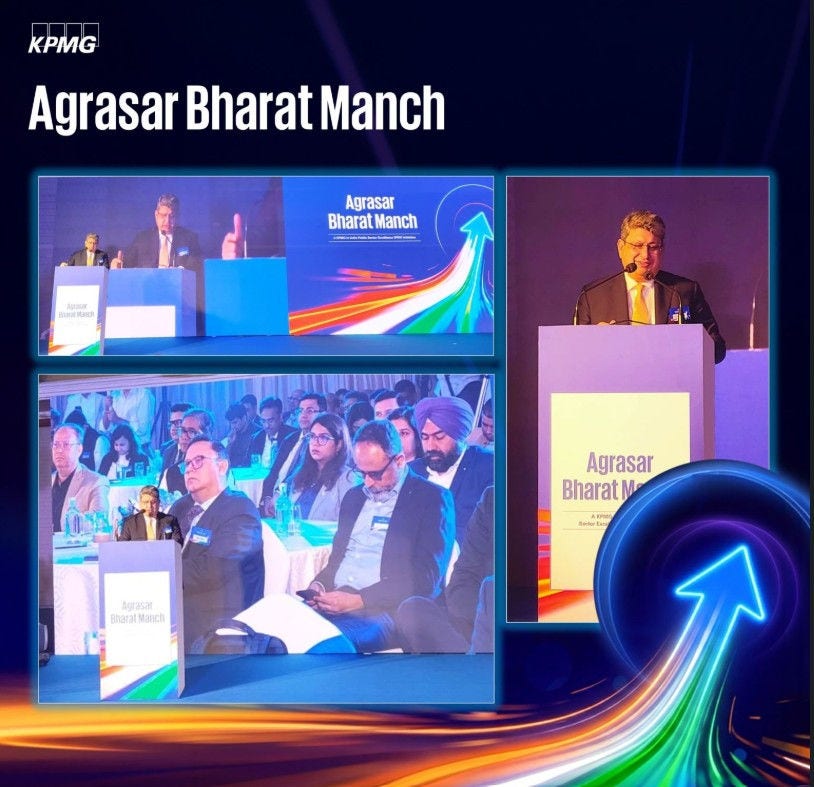


Hon'ble dignitaries and distinguished speakers
Agrasar Bharat Manch brings together policy leadership, implementation experience and global perspectives:
The Agrasar Bharat vision
Agrasar means ‘to move forward’.
India's journey towards Viksit Bharat 2047 will be shaped by sustained progress across governance, industry, technology, infrastructure and human capital.
Agrasar Bharat represents the journey towards Viksit Bharat. It is about building upon existing achievements and accelerating progress through agility, ability and accountability – turning national ambition into measurable outcomes. Agrasar Bharat calls for the agility to navigate evolving geopolitical and economic realities, the ability to foster resilience and innovation at scale, and the accountability to deliver meaningful impact for all stakeholders.
At its core, Agrasar Bharat is about expanding human potential, strengthening institutional and technological capabilities, and creating an ecosystem that enables India not only to adapt to a rapidly changing world, but also to shape and lead it. By fostering innovation, enhancing competitiveness, and building long-term resilience, India can accelerate its growth trajectory and establish itself as a driving force in the global economy and the digital age.
The imperatives for Agrasar Bharat
The forces shaping this decade are profound and transformative. Artificial Intelligence (AI) is redefining how economies operate, institutions function and people create value. As AI becomes increasingly embedded in every aspect of society, there is an equally pressing need to ensure its responsible, ethical, and accountable use.
At the same time, geopolitical shifts are reshaping strategic priorities, trade relationships and global supply chains. In this environment, nations must strengthen self-reliance while remaining agile enough to respond to rapidly evolving global dynamics. Emerging technologies are creating unprecedented opportunities across industries, enabling new models of growth, productivity and innovation. Rising citizen expectations are also placing greater demands on institutions to deliver responsive governance, better services, transparency, and trust.
This is the context in which Agrasar Bharat becomes both relevant and necessary. It calls for building the capabilities that drive competitiveness, the preparedness that strengthens strategic resilience, and the innovation that delivers meaningful impact at scale. It emphasises inclusion that expands opportunity and participation that unlocks collective excellence. Equally important, it underscores the need to foster trust, accountability, and responsible stewardship across institutions, ensuring that progress is sustainable, equitable, and enduring.
Ultimately, Agrasar Bharat is about equipping India to navigate constant change with confidence and purpose – transforming challenges into opportunities and converting national aspirations into tangible outcomes for its people and the world.
The Agrasar Bharat journey can therefore be understood through six interconnected shifts: from capability to competitiveness, preparedness to resilience, innovation to impact, inclusion to opportunity, participation to excellence – while building trust and accountability across the systems that underpin India’s development. Together, these shifts describe the capabilities India needs to build, the outcomes it seeks to achieve, and the institutional foundations required to sustain progress towards Viksit Bharat 2047.
India’s economic opportunity lies in building capabilities at scale and translating them into sustainable global competitiveness. A future-ready workforce, equipped with the skills required for a digital and technology-driven economy, will be central to unlocking productivity and growth.
Strengthening manufacturing capabilities and fostering a vibrant MSME ecosystem can further expand economic opportunity, drive innovation, and generate quality employment across sectors.
At the same time, investments in next-generation infrastructure, digital connectivity, logistics, and resilient supply chains can enhance efficiency and strengthen India’s integration with global value chains. Deeper trade partnerships and greater participation in international markets can enable Indian enterprises to compete and succeed globally, strengthening India’s position as a trusted economic partner.
Equally important is the effective deployment of public and private capital. Improving public finance management, accelerating investment execution, and directing resources towards productive assets, can help convert financial capital into long-term economic capacity and shared prosperity. Together, these efforts will create a foundation for sustained growth, higher competitiveness, and greater economic resilience.
Agrasar Bharat envisions a nation where capability is not merely built, but continuously translated into innovation, productivity, competitiveness, and global leadership, ensuring that India’s growth story remains inclusive, resilient, and future-ready.
India’s growth aspirations and global leadership ambitions must be anchored in the ability to anticipate risks, adapt to disruption, and safeguard national interests in an increasingly complex world. Strategic resilience is no longer confined to responding to crises; it is about building the foresight, capabilities, and partnerships needed to navigate uncertainty while sustaining progress.
A strong and future-ready defence ecosystem, supported by indigenous innovation and advanced manufacturing, will be critical to strengthening national security and strategic autonomy. Investments in frontier technologies, research and development, and domestic industrial capabilities can reduce vulnerabilities while enhancing India’s capacity to respond to emerging challenges. At the same time, deepening strategic partnerships and international cooperation can strengthen collective security, expand access to critical resources, and reinforce India’s role as a trusted global partner.
For Agrasar Bharat, resilience is not merely a protective measure; it is a catalyst for sustained progress. By building the capacity to anticipate, absorb, adapt, and emerge stronger from challenges, India can strengthen its foundation for long-term national advancement and pursue its development goals with greater confidence.
Technology is redefining what India can build, create, and achieve. Emerging technologies such as Artificial Intelligence (AI), semiconductors, quantum, space technologies, drones, green hydrogen, rare earths, biotechnology, and advanced digital infrastructure are creating unprecedented opportunities for economic growth, societal progress, and global leadership. The challenge and opportunity for India lie not merely in adopting these technologies, but in developing the capabilities, enterprises, and ecosystems that can transform technological potential into large-scale impact.
Artificial Intelligence will be a pivotal force in this transformation, reshaping productivity, decision-making, service delivery, and innovation across sectors. From manufacturing and healthcare to agriculture, education, and governance, AI has the potential to enhance human capabilities, unlock new sources of value, and accelerate economic development. Realising this potential, however, will require a strategic focus on talent, research, compute infrastructure, data ecosystems, and responsible governance frameworks that ensure AI is deployed ethically, securely, and inclusively.
For Agrasar Bharat, innovation must ultimately be measured by its impact. The goal is not only to develop breakthrough technologies, but also to ensure that they improve productivity, create jobs, address societal challenges, strengthen public services, and enhance the quality of life for all citizens. By translating innovation into tangible outcomes at scale, India can establish itself as a leading global innovation hub and a catalyst for inclusive and sustainable development.
A prosperous India must ensure that growth translates into opportunity for every citizen, across geographies, communities, and socio-economic groups. Inclusive development is not only a social imperative but also an economic necessity, enabling broader participation in growth and unlocking the full potential of the nation’s people. Expanding women’s participation in the workforce, stronger farmer livelihoods, higher household earnings and better access to health and essential services can deepen the foundations of shared prosperity.
The rise of Tier II and Tier III cities presents a unique opportunity to broaden the geography of growth. Supported by modern infrastructure, digital connectivity, strong local institutions, and simpler, more responsive governance, these emerging urban centres can become engines of entrepreneurship, investment, employment, and innovation. By creating new hubs of economic activity beyond major metropolitan areas, India can drive more balanced and sustainable regional development.
For Agrasar Bharat, inclusion is about expanding access to opportunity and enabling every individual to contribute to and benefit from the nation's progress. It is about ensuring that growth is broad-based, equitable, and empowering, creating pathways for aspiration, participation, and prosperity. By investing in people and strengthening the ecosystems that support their success, India can transform inclusion into a powerful driver of economic growth, social cohesion, and national advancement.
India’s young population represents one of its greatest strategic advantages. Harnessing this demographic potential requires creating pathways that enable every individual to participate, develop skills and strive for excellence. By investing in education, skilling, mentorship, and lifelong learning, India can transform its demographic strength into a powerful driver of economic growth, social progress, and national competitiveness.
Sports and creative pursuits can play a transformative role in inspiring aspiration, building confidence, and creating new avenues for livelihoods and economic value. A strong ecosystem for athletics, entertainment, design, media, and cultural industries can not only generate employment and innovation but also strengthen India's soft power and global influence. By celebrating achievement and fostering a culture of merit, excellence can become a shared national aspiration.
For Agrasar Bharat, participation is the foundation upon which excellence is built. The goal is to ensure that every citizen has the opportunity to contribute, compete, and succeed, regardless of background or location. By unlocking talent at scale and creating pathways for achievement across every domain, India can cultivate a society that is confident, innovative, and globally competitive, transforming its demographic dividend into a lasting source of national strength and leadership.
As India advances in technology, innovation, and digital transformation, building trust and accountability in governance and public systems becomes increasingly critical. Trust is the foundation upon which citizens, institutions, and businesses embrace change, adopt new technologies, and participate confidently in the nation's growth journey. Achieving this requires moving beyond compliance-based approaches towards governance frameworks that are transparent, responsible, and resilient by design.
For Agrasar Bharat, trust and accountability are not merely governance objectives; they are strategic enablers of progress. By building systems that are transparent, secure, explainable, and citizen-centric, India can harness the full potential of technological innovation while upholding democratic values and public confidence. A nation that inspires trust in its institutions and accountability in its actions is better positioned to accelerate growth, foster inclusion, strengthen resilience, and lead confidently in a rapidly evolving world.
Building trusted systems of growth for Viksit Bharat 2047
The inaugural edition will translate this broader vision into four interconnected themes that represent important priorities for India's next phase of growth and transformation:
Defence: Strengthening Strategic Resilience and National Capability
As geopolitical dynamics continue to evolve, strengthening India’s defence capabilities will remain central to securing national interests and sustaining long-term growth. The Manch will examine how technology, indigenous innovation, advanced manufacturing, and strategic partnerships can enhance defence preparedness, strengthen self-reliance, and create globally competitive capabilities. Discussions will explore the role of emerging technologies, defence industrial ecosystems, and public-private collaboration in building a resilient and future-ready security architecture that supports both national resilience and global leadership
Sports economy: Unlocking growth beyond the playing field
Sports is emerging as a powerful catalyst for economic and social development. The Manch will explore how India's sporting ambitions can drive economic growth, create jobs, stimulate tourism, accelerate urban development, and foster innovation across sectors. Discussions will also examine the pathways needed to nurture talent, strengthen sports infrastructure, build sports-related industries, and position India as a leading destination for global sporting events. Beyond athletic achievement, the sports economy represents an opportunity to enhance India's global visibility, soft power, and international standing
Food & Agriculture: Transforming the agri-food ecosystem
India's agricultural sector remains fundamental to livelihoods, food security, and economic development. The Manch will explore how technology, innovation, digital platforms, and stronger value chains can transform the agri-food ecosystem, improve productivity, enhance farmer incomes, and strengthen sustainability. Discussions will focus on opportunities across precision agriculture, agri-tech innovation, food processing, supply chain modernisation, climate resilience, and export competitiveness, with the objective of creating a more prosperous, resilient, and globally competitive agriculture sector
Artificial Intelligence as a cross-cutting enabler
The Agrasar Bharat Manch will position AI as a foundational enabler across all thematic discussions. From defence and national security to sports development, agriculture, governance, and public service delivery, AI is increasingly shaping how institutions operate, decisions are made, and value is created
A flagship leadership dialogue on ‘Governing in the Age of AI’ will bring together policymakers, industry leaders, technologists, and academics to explore critical questions around AI sovereignty, Responsible AI in Government, digital public infrastructure, trust and accountability, data governance, and the future of public institutions. The dialogue will examine how India can harness AI to accelerate innovation, productivity, and citizen outcomes while ensuring transparency, security, fairness, and public trust
While each theme addresses a distinct national priority, their significance also lies in the connections between them. Defence strengthens resilience. Sports expands participation and excellence. Food & Agriculture strengthens livelihoods, inclusion and competitiveness. AI provides a cross-cutting enabler for innovation and transformation across sectors.
Together, these themes provide the inaugural platform through which the broader Agrasar Bharat vision can be examined - connecting national priorities with the capabilities and outcomes required for India's next phase of development.
KPMG leaders on Agrasar Bharat Manch
- Yezdi Nagporewalla
- Hemant Jhajhria
- Nilachal Mishra
- Akhilesh Tuteja
- Dean Grandy
- Pier Stefano Sailer
- Fernando Vizoso Estrades
- Alberto De Negri
- Stefan Hefter
- Mohit Bahl
- Purushothaman KG
- Nikhil Sethi
- Brijendra Kumar
- Himanshu Rattan
- Gaurav Mehndiratta
- Prasanth Shanthakumaran


Nilachal Mishra
Partner and Head, Government & Public Services (G&PS), National Leader - Government and Infrastructure
KPMG in India

Akhilesh Tuteja
Partner & National Leader - Clients and Markets and Technology, Media & Telecommunications (TMT)
KPMG in India
India has built formidable digital foundations. The more interesting question now is what we choose to build on top of them. The next chapter of India’s technology story gets really interesting. It cannot simply be about more technology. It has to be about better outcomes.
AI can make an enterprise meaningfully more productive. Technology can help an institution respond faster. Digital systems make a citizen’s interaction with public services simpler and more empowering. Our technological capabilities translate into greater competitiveness and resilience.
Agrasar Bharat is a 20-year agenda for turning India’s aspirations into action. At its heart are three ideas:
- Agility to respond to change
- Ability to build and compete at scale
- Accountability to translate ambition into outcomes
Technology is one of the engines that can make this possible. But as AI expands the boundaries of what we can do, perhaps we should judge technology by a much simpler test. Ulitmately technology is not progress. What it enables us to achieve is.
Dean Grandy
Global Head of Government
KPMG International
Pier Stefano Sailer
EMA Head of Government & Public Services
KPMG International
Fernando Vizoso Estrades
EMA Head of Infrastructure
KPMG International
Alberto De Negri
EMA Head of Healthcare
KPMG International
Stefan Hefter
EMA Head of Defence
KPMG International

As India advances its AI ambitions, success will depend not only on innovation but also on the trust that underpins it. Building responsible, inclusive, and accountable AI systems can help ensure that technological progress translates into sustainable economic and societal value.


Nikhil Sethi
National Sector Leader - Consumer Markets and Co-Lead Customer & Operations
KPMG in India
As India advances towards becoming a developed nation, food security alone will not be enough. The focus must increasingly shift towards ensuring nutritious food is available, accessible and affordable for all.
Strengthening agricultural value chains, reducing post-harvest losses, leveraging technology and improving market linkages can help build a more resilient and sustainable food ecosystem that meets the needs of a growing population.

AI sovereignty goes beyond where a model is hosted. It encompasses the entire ecosystem, from compute, power and water to data, indigenous datasets, model training and governance. Building sovereign AI means ensuring that the technology is not only available within our borders, but is also designed, governed and aligned with the needs of our nation.

Himanshu Rattan
Partner and Lead – Food, Agri & Allied Services, Government & Public Services
KPMG in India


- India’s sporting ecosystem is evolving beyond cricket, with leagues across football, badminton and tennis creating new opportunities for growth. Realising the sector’s full potential will require stronger coordination among sports federations, the Indian Olympic Association and other stakeholders, alongside greater investment in infrastructure, talent development and sports manufacturing.
- India’s sporting future depends on how effectively our federations, SAI, and private partners work together. Collaboration is the key to building a stronger sporting nation and creating a lasting legacy for Indian sports.
Hear from the experts


Our perspectives


Insights


Real stories of transformation from across Bharat


9.30 a.m – 10.15 a.m IST
Registration
10.30 a.m – 10.40 a.m IST
Welcome address
10.40 a.m – 10.45 a.m IST
Lighting of the lamp
10.45 a.m – 10.55 a.m IST
Welcome address by Yezdi Nagporewalla, CEO, KPMG in India
10.55 a.m – 11.00 a.m
Special address by
11.00 a.m – 11.10 a.m
Inaugural address by
11.10 a.m – 11.15 a.m IST
Report launch - Agrasar Bharat - Turning India’s aspirations into action
11.15 a.m – 12.30 p.m IST
Track 1: Defence
Panel discussion: Battlefield of the future – How AI/ML is transforming warfare
Moderator
Speakers
12.30 p.m – 12.35 p.m IST
Report launch - Battlefield of the future - How AI is transforming warfare
12.35 p.m – 1.15 p.m IST
Fireside chat: Shri. Rajesh Kumar Singh, Defence Secretary, Government of India; Secretary, Department of Defence Research and Development, and Chairman, DRDO
1.15 p.m – 2.15 p.m IST
Lunch
2:30 p.m – 3:25 p.m IST
Panel discussion: Affordable, Nutritious & Resilient Food Systems for Agrasar Bharat
Moderator
Speakers
3.25 p.m – 3.30 p.m IST
Report launch - Future of food systems: Preparing for the next frontier
3:30 p.m – 3:45 p.m IST
Track 3: Sports – Keynote address
3:45 p.m – 4:25 p.m IST
Panel discussion: Aspiration, Achievement and Alignment: Indian Sports heading into a new era
Moderator
Speakers
4.25 p.m – 4.30 p.m IST
Report launch - Strengthening India’s sports ecosystem
4.30 p.m – 5.30 p.m IST
Fireside chat: Shri. Abhinav Bindra, Olympic Champion, Entrepreneur
5.30 p.m – 6.10 p.m IST
Panel discussion: Digital Sovereignty in Al: Building an independent and resilient India
Moderator
Speakers
6.10 p.m – 6.15 p.m IST
Report launch - Sovereign by design - Building India’s independent, inclusive and future-ready AI
6:15 p.m – 6:45 p.m IST
Fireside chat: S Krishnan - Secretary, MeitY
6.45 p.m – 6:50 p.m IST
Fireside chat: S Krishnan - Secretary, MeitY
Vote of thanks
7.00 p.m IST onwards
Cocktails and Dinner
Key Contact
Nilachal Mishra
Partner and Head, Government & Public Services (G&PS), National Leader - Government and Infrastructure
KPMG in India

KPMG Insights Edge
On the go access to KPMG in India’s insights and publications