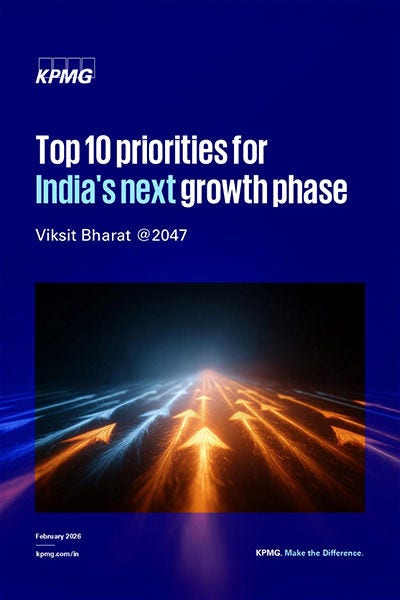
India’s aspiration to become a developed nation by 2047 demands sustained execution over time, not periodic policy resets. This report is framed against that reality, in the context of current geopolitical uncertainty and shifting global trade barriers. It does not propose new schemes or reforms. Instead, it consolidates what is already underway across policy, investment, and institutional practice, and organises these efforts into a coherent execution framework aligned with the long-term vision of Viksit Bharat. The top 10 goals of the execution framework set out clear focus areas to guide delivery at scale.


      Key highlights of the report:

      • Future-ready workforce

        Building a future-ready workforce by strengthening the education-skilling-employment continuum, expanding apprenticeships, and scaling deep-tech capabilities – moving toward 50 per cent of the workforce formally skilled or reskilled and developing around 10 million advanced-technology professionals1

      • Global manufacturing hub

        Positioning India as a global manufacturing hub through plug-and-play clusters and Industry 4.0 adoption, with the ambition of raising manufacturing toward around 25 per cent of GDP and supporting long-term export goals of around USD2 trillion annually2

      • MSME

        Enabling MSMEs to scale and lift productivity by improving access to credit and equity, accelerating digital adoption, and linking smaller firms to supply chains – supporting around 10 million MSMEs to grow3

      • Next-generation infrastructure

        Strengthening the next-generation infrastructure backbone by sustaining investment at around 7-8 per cent of GDP while keeping logistics costs below 8 per cent of GDP4

      • Trade integration and export competitiveness

        Expanding trade integration and export competitiveness through market diversification and FTAs, lifting India’s share of global trade to more than 5 per cent

      • Tier-II and Tier-III cities

        Transforming Tier-II and Tier-III cities into growth engines through transit-led development and stronger institutional mechanism – building globally competitive cities and scaling integrated city-centric economic regions

      • Governance and process reforms

        Accelerating governance and process reforms by simplifying compliance and enabling faster approvals to improve the global and domestic investors’ confidence and trust in the Indian market

      • Sunrise sectors

        Building leadership in sunrise sectors – green hydrogen, semiconductors, space, defence manufacturing, rare earth minerals, AI-driven digital infrastructure, and bio-manufacturing

      • Social capital and inclusion

        Strengthening social capital and inclusion by expanding women workforce participation, improving farmers livelihoods, increasing household earnings, advancing health outcomes to improve the overall ease of living

      • Public finance and investment effectiveness

        Improving public finance and investment effectiveness by strengthening tax capacity, deepening PPPs and asset monetisation, and building stronger project pipelines of long-term investible projects


      [1] Economic Survey 2023-24, Government of India, 31 January 2024
      [2] National Mission on Manufacturing aims to double manufacturing contribution to GDP by 2035, Economic Times, 30 January 2026
      [3] Nandan Nilekani outlines four unlocks that can take India's growth to 8% from 6%, Money Control, 12 March 2025
      [4] From Growth Engine to Global Edge: Supercharging India’s Logistics, Press Information Bureau, 27 November 2025 


      Top 10 priorities for India's next growth phase

      Key execution priorities to help India convert scale into competitiveness and accelerate its journey toward becoming a developed economy by 2047

      Key Contacts

      Yezdi Nagporewalla

      Chief Executive Officer

      KPMG in India

      Akhilesh Tuteja

      Partner & National Leader, Clients and Markets

      KPMG in India

      Nilachal Mishra

      Partner and Head, Government & Public Services (G&PS), National Leader - Government and Infrastructure

      KPMG in India

      How can KPMG in India help

      Collaborating for progress, development, citizen empowerment and upliftment

      Attitudes to tax are changing. Organizations of all sizes are ever more exposed to new trends in tax regulation, not just locally but globally

      KPMG’s Business Consulting professionals we may help you identify and solve the challenges that stand in the way of your growth and progress

      Access our latest insights on Apple or Android devices